




Propane Factors for a Small Fleet
This coffee roasting company says that at 50,000 miles annually per vehicle, the bi-fuel propane autogas conversion on two vans will likely pay back in less than one year.

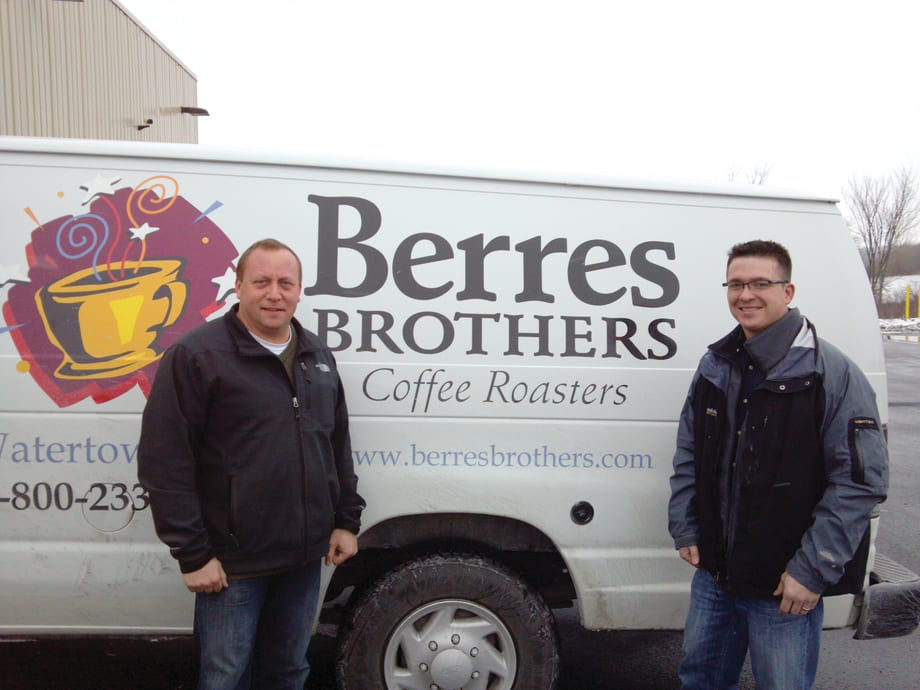
From left to right, Peter Berres, owner of Berres Brothers Coffee Roasters, and Josh Budworth from Charter Fuels.
From left to right, Peter Berres, owner of Berres Brothers Coffee Roasters, and Josh Budworth from Charter Fuels.
With the ultimate goal of running seven to eight vans on propane, Berres Brothers Coffee Roasters in Watertown, Wis. has recently converted two Ford E-250s to propane autogas. Berres Brothers roasts and delivers coffee locally throughout Wisconsin and now all over the world through web sales. Project Manager Greg Beranek discusses the process, payback and other aspects of adding propane to this small fleet.
To get the conversions and infastructure in place, Berres Brothers worked with Charter Fuels, which provides bi-fuel propane autogas systems as part of the Alliance AutoGas complete program. “We really wanted to have the bi-fuel option for areas with no alt-fuel source,” Beranek says.
The company decided to put the conversion kits on its lowest-mileage vehicles. With a propane tank now installed at the company warehouse, the sales and delivery vans traveling locally will likely never have to tap into the gasoline tank, Beranek says. The longest routes go no more than a 225-250 mile radius from Watertown, and anything further out is sent through UPS or FedEx.
Nonetheless, some vehicles in the Berres Brothers’ fleet average 50,000 miles a year, which means an accelerated payback for propane conversions.
Breaking It Down
The Berres Brothers’ route in bringing propane on site started by finding a company that would monitor the propane tank and keep fuel delivered as needed. With Charter Fuels, the company didn’t have to pay for the tank, but did have to get the electrical work and foundation ready. Berres Brothers then pays for each propane delivery at competetive fleet prices.
All in all, Beranek says the company expects to recoup its costs on the tank foundation and these first two propane conversions within a year-and-a-half. Part of this savings comes from the company’s 25% investment credit from the state of Wisconsin.
The credit, which is part of the Wisconsin Profitable Sustainability Initiative (PSI), is designed to help companies develop a sustainability project that provides the maximum return on investment. After receiving approval, a company can receive matching funds of up to 25% — at a maximum of $10,000 — for its project.
Berres Brothers contracted locally to have the foundation and electrical done, which cost about $6,000. Each vehicle conversion ran $6,300. The company expects to save more than $10,000 in fuel a year, Beranek says.
A certifed Alliance AutoGas conversion center installed the kits, which can be carried over to new vehicles for about $2,000, but must be on a six- or eight-cylinder vehicle. As a small fleet that drives vehicles up to 250,000 miles, Berres Brothers won’t have to worry about this for a while.
Operating with Propane
Since completing the propane conversions just weeks ago, as of this writing Berres Brothers’ drivers haven’t had to fill up on gasoline, which they’re “avoiding at all costs,” Beranek says.
Both vehicles were outfitted with 25-gallon LPG tanks, which Beranek says run at about 90% efficiency to their gas counterparts. “But the savings far exceed that,” he says. In initial estimates, he says the drivers are achieving about 13 mpg on propane, a few less than what they get on gas.
For maintenance, there is no cost differential, nor does Beranek notice any operational difficulties. “I drove one myself last week, and I couldn’t tell any difference,” he says.
View more small fleet profiles at www.businessfleet.com/profiles.
More Small Fleet


Developing Budget-Friendly Driver Safety Programs
From driver training and safety meetings to one-on-one coaching and incentive programs, several small fleets share how they have developed a safety culture with their drivers using low- to no-cost resources.
Read More →
Boosting Last-Mile Fleet Uptime, Safety, and Value with AI Vehicle Inspections
AI-powered inspections are transforming last-mile fleets by replacing manual checks with highly accurate automated scans that detect defects in seconds. By giving fleet operations visibility into the daily condition of their vehicles, you can identify trends over the vehicle’s lifecycle that enable improved procurement decisions, route management, driver training and accountability.
Read More →
Five Ways Seat Belts Help Prevent Injuries
There are five ways seat belts protect occupants from injuries, according to the Tennessee Department of Safety and Homeland Security.
Read More →
It’s here: The 2026 Fleet Technology Trends Report
What does AI mean for fleets? Get the answer — and learn other top tech trends.
Read More →
Small Fleets, Big Impact: How Independent Drivers Power Wreaths Across America
Check out how small fleets and independent drivers power Wreaths Across America each December and why their impact matters more than ever.
Read More →
VMS Survey Finds 65% of Small Fleet Managers Run Operations Alone
A new VMS survey shows small fleet managers are stretched thin, with most handling operations solo and eager to adopt digital tools for relief.
Read More →
Tips for Driving Safely on Halloween Night
This video features a reminder from the Connecticut Department of Transportation (DOT) and the Connecticut Police Chiefs Association, urging drivers to prioritize safety this Halloween.
Read More →
AI, Access, and Uptime: VMS’s Next Chapter with David Prusinski
VMS’s new Co-CEO, David Prusinski, shares how an AI-first approach will give small fleets and repair shops the tools to compete like big players.
Read More →
Fleet Managers Share Winter Prep Tips: It's Never Too Early!
Three fleets share best practices to prep vehicles for winter and prevent downtime when the cold sets in.
Read More →