




Read More: Why Have Fleet Maintenance Costs Risen So Steeply?
Prioritizing Fleet Maintenance Issues
Successfully keeping the fleet up and running isn’t just about addressing maintenance issues — it's about understanding what truly matters and ensuring that valuable time and resources are channeled where they're needed the most.
by Rachael Plant, Fleetio
September 1, 2023
Maintenance prioritization allows fleet management software users to tag each maintenance issue with a priority value ranging from Critical to High, Medium, and Low. These values serve as a compass, helping fleet managers steer their team toward the most pressing concerns to maximize labor resources and minimize downtime.
Photo: Fleetio
4 min to read
When it comes to fleet management, every move impacts productivity and operational costs, making prioritizing asset maintenance issues a critical action in maintaining fleet health, productivity, and profitability.
Imagine having a map that guides fleet managers and technicians through the maze of maintenance challenges, ensuring that efforts are focused where they matter the most.
This is the essence of issue prioritization — an essential tool that not only streamlines maintenance processes but also elevates overall fleet efficiency.
Tackling the Core Challenge
Every fleet manager has faced the dilemma of an array of maintenance issues demanding attention. But with limited resources, how do you ensure that the right problems are being tackled first?
The task of identifying and addressing asset maintenance issues can be overwhelming, especially in a bustling fleet environment where resources are finite.
That's where issue prioritization comes in, providing the essential framework to categorize and assign priority levels to asset issues.
Fleet management software (FMS), like Fleetio, is increasingly becoming a key tool in this process.
Fleetio's issue prioritization feature allows users to tag each issue with a priority value ranging from Critical to High, Medium, and Low.
These values serve as a compass, helping fleet managers steer their team toward the most pressing concerns to maximize labor resources and minimize downtime.
Guiding Principles for Effective Issue Prioritization
Whether using FMS or other fleet solutions — or simply going the more analog route — creating a standardized approach to issue prioritization requires careful planning and execution.
Fleet managers can follow several guiding principles to ensure successful issue prioritization:
Define priority framework: Categorize issues into priority levels, and communicate this framework across the team.
Set resolution goals: Collaborate with the team to establish realistic timelines for issue resolution within each priority category.
Assign accountability: Assign each issue to a responsible team member to ensure accountability and streamlined issue resolution.
Monitor and improve: Regularly track issue resolution progress and seek opportunities for refinement through consistent monitoring and reporting.
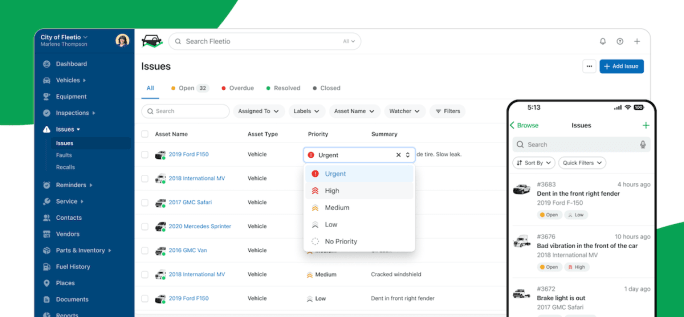
Enabling drivers to assign priorities when reporting problems offers valuable insights into the urgency of maintenance needs.
Photo: Fleetio
The Impact of Priority Values
The true significance of issue prioritization becomes evident when you consider its effects on repair timelines. Claire Flowers, associate product manager at Fleetio, highlights the role of priority levels in expedited issue resolution.
“Issues with a designated priority level were resolved an average of eight days faster than issues without a priority value applied,” she said.
This statistic underlines how a simple priority tag can significantly streamline the maintenance process.
Issue Management Beyond Repairs
While the primary goal of issue management is to rectify vehicle problems, its utility goes beyond that.
Fleets are using issue management tools for a variety of purposes, from tracking maintenance to addressing compliance and safety concerns.
For instance, when a fleet manager identifies an overdue annual DOT inspection or missing equipment, they can designate such tasks as Critical issues to ensure regulatory compliance.
Data-driven Decision Making
Managing fleet maintenance isn't a guessing game; it requires informed decision-making.
FMS empowers fleets to leverage data for effective issue prioritization. Insights from digital work orders, service and inspection histories, and asset usage data guide fleet managers to determine which assets warrant immediate attention.
Taking this proactive approach to maintenance and issue resolution mitigates breakdowns, reduces downtime, and optimizes resource allocation.
Issue Prioritization in Action
From blown tires to DOT inspections, issues run the gamut of severity.
Using issue prioritization, fleets can ensure a shared understanding of the significance of each priority level, fostering efficient service planning and ensuring that critical issues are promptly addressed without hampering fleet operations.
This allows fleets to better allocate labor resources and channel their efforts toward critical maintenance needs.
Drivers Play a Key Role
Drivers, who interact with assets daily, play a vital role in identifying issues. Enabling drivers to assign priorities when reporting problems offers valuable insights into the urgency of maintenance needs. And because issues can be submitted in real time through digital inspections, managers can stay on top of resolution more easily.
“In June 2023, 52% of all fleet issues [in Fleetio] were generated by inspections,” explained Flowers. “These could have been issues that would have otherwise gone unnoticed and led to safety issues or increased maintenance costs.”
Educating drivers on evaluating and setting priorities ensures that the right issues receive prompt attention, leading to improved asset reliability.
Push for Constant Improvement
Once the initial issue prioritization strategy is in place, it’s important to regularly analyze issue resolution times against priority expectations. This provides valuable performance insights that fleet managers can use to fine-tune maintenance processes, optimize resource allocation, and propel fleet performance to new heights.
With limited labor resources and during a time of inflation, prioritizing asset maintenance issues becomes more than just a strategy — it's a necessity.
By implementing structured issue prioritization with the aid of FMS and other fleet solutions, fleets ensure that critical maintenance needs receive prompt attention, minimizing downtime and reducing maintenance and service spend.
Whether it’s a flat tire on the road or a looming compliance deadline, a robust issue priority system keeps fleet operations on course, delivering a smoother and more profitable journey.
Originally posted on Automotive Fleet
Subscribe to Our Newsletter
More Small Fleet


Developing Budget-Friendly Driver Safety Programs
From driver training and safety meetings to one-on-one coaching and incentive programs, several small fleets share how they have developed a safety culture with their drivers using low- to no-cost resources.
Read More →
Sponsored•March 9, 2026
Boosting Last-Mile Fleet Uptime, Safety, and Value with AI Vehicle Inspections
AI-powered inspections are transforming last-mile fleets by replacing manual checks with highly accurate automated scans that detect defects in seconds. By giving fleet operations visibility into the daily condition of their vehicles, you can identify trends over the vehicle’s lifecycle that enable improved procurement decisions, route management, driver training and accountability.
Read More →
Five Ways Seat Belts Help Prevent Injuries
There are five ways seat belts protect occupants from injuries, according to the Tennessee Department of Safety and Homeland Security.
Read More →
Sponsored•January 14, 2026
It’s here: The 2026 Fleet Technology Trends Report
What does AI mean for fleets? Get the answer — and learn other top tech trends.
Read More →
Small Fleets, Big Impact: How Independent Drivers Power Wreaths Across America
Check out how small fleets and independent drivers power Wreaths Across America each December and why their impact matters more than ever.
Read More →
VMS Survey Finds 65% of Small Fleet Managers Run Operations Alone
A new VMS survey shows small fleet managers are stretched thin, with most handling operations solo and eager to adopt digital tools for relief.
Read More →
Tips for Driving Safely on Halloween Night
This video features a reminder from the Connecticut Department of Transportation (DOT) and the Connecticut Police Chiefs Association, urging drivers to prioritize safety this Halloween.
Read More →
AI, Access, and Uptime: VMS’s Next Chapter with David Prusinski
VMS’s new Co-CEO, David Prusinski, shares how an AI-first approach will give small fleets and repair shops the tools to compete like big players.
Read More →
Fleet Managers Share Winter Prep Tips: It's Never Too Early!
Three fleets share best practices to prep vehicles for winter and prevent downtime when the cold sets in.
Read More →