




Pandemic Pivot: Distillery Ups Routing Efficiency to Deliver Spirits and Sanitizer
When this boutique spirits distillery began production and distribution of sanitizer, the company needed to reorganize its routing from a few deliveries a week to over a hundred a day.

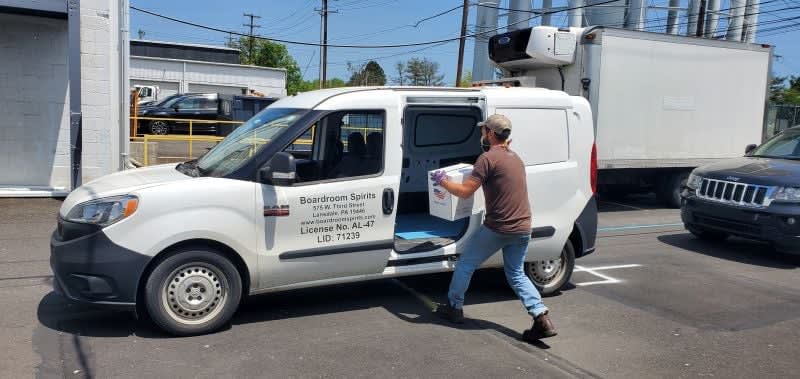
For Boardroom Spirits, A typical day could generate over 100 deliveries, delegated to four drivers.
Photo courtesy of Boardroom Spirits.
Chris Roessler of Boardroom Spirits, a boutique distillery serving the Philadelphia area, never expected a change in business title due to the coronavirus pandemic, but that’s what happened. “I'm the marketing coordinator, but in terms of my COVID-19 pivot, I’m now the online sales coordinator,” he says.
The title change was the result of a business reorganization: What started as a predominantly wholesale business during the pandemic moved to online retail sales, first with curbside pickup and then home deliveries. In that timeframe, the company also became a sanitizer producer and distributor. It all happened in a few weeks.
Boardroom Spirits started some four years ago by a husband, wife, and brother team that learned to make vodka in Eastern Europe. The company expanded into fruit-and vegetable-based whiskies and brandies while gaining exposure with the backing of minority owner and celebrity chef Robert Irvine.
The company’s main sales channels were through state-owned liquor stores, individual sales at its two tasting rooms, and events such as an annual Christmas Village. Deliveries consisted of a bi-monthly run in two Promaster vans from the distillery in Lansdale, Pa. to the state’s warehouse, as well as to 10-15 area restaurants.
The pandemic turned the model upside down. Stay-at-home orders forced the closure of the tasting rooms where the majority of the company’s staff works, with the balance in production. “The first huddle up we had as a business was, ‘How are we going to get all these people back to work?’” says Roessler.
The closure of Pennsylvania liquor stores worked in the company’s favor, as the only places for individuals to purchase alcohol at that point were breweries, distilleries, or wineries.
The company decided to create and market a curbside pickup option — a no-touch drive-thru system that went into operation in March. “But then we realized that people were just scared to go outside,” Roessler says.
The company quickly rebuilt its website to accommodate what would become a flood of retail orders. Roessler stayed up for 19 hours to prepare the new site for launch. The concept took off and the distillery returned to full-time production.
This necessitated graduating from off-the-shelf routing software to an automated route optimization system. “One day we had about 75 deliveries and I just could not figure out how I was supposed to route all of them through what was functionally a souped-up Google Maps,” says Roessler.
After some research, he chose OptimoRoute, a web-based route planning and optimization system for deliveries and mobile workforces. Roessler imports addresses and orders into the system, which calculates the most efficient routes for each driver.
OptimoRoute uses algorithms to match delivery orders to drivers. This automated matching process cuts down the planning time while minimizing unnecessary driving.
“I push a couple buttons and it tells me where I need to send everything,” he says.
The routes are sent to the apps on drivers’ smartphones. Drivers document each stop, and if a new one is added, routes are automatically adjusted on the fly. Roessler can communicate with them through the app. The system uses GPS in the smartphones to track drivers in 15-second increments.
The system generates reports and analytics to show driver performance over time and allow for bigger picture route strategizing.
“On a busy day, our original process took me a little over two hours (to complete the day’s routing) and OptimoRoute brought that down to 25 minutes,” Roessler says.
Next Big Pivot
During this time, the company made its next big pivot: When Pennsylvania relaxed industrial regulations regarding production and distribution of sanitizer, Boardroom Spirits immediately applied for a license.
The supply chain was an issue at first, particularly regarding plastic gallon jugs, four-ounce spray bottles, and ethanol. But being in the spirits business gave it an advantage in making ethanol, which it produced from expired wine and beer from vendor partners.
The move to produce sanitizer wasn’t to increase profits. For each consumer delivery, the company gives away a free four-ounce bottle of sanitizer. Larger liter-sized bottles or jugs are sold at cost.
“When people come here to get a bottle, they get something to take their minds off (the pandemic),” he says, “And we also offer something to help keep them safe too.”
A typical day could generate over 100 deliveries, delegated to four drivers. The deliveries reach a radius of about 30 miles from the company’s distillery. “We’ve been able to distribute as much sanitizer and product is because of the routing software,” Roessler says. “I now understand how routing works.”
Post pandemic, Roessler thinks this new delivery model has potential.
“The need for people to stay at home is what drove us towards this,” he says, “but absolutely, this is a long-term effort for us.”
More Small Fleet


Developing Budget-Friendly Driver Safety Programs
From driver training and safety meetings to one-on-one coaching and incentive programs, several small fleets share how they have developed a safety culture with their drivers using low- to no-cost resources.
Read More →
Boosting Last-Mile Fleet Uptime, Safety, and Value with AI Vehicle Inspections
AI-powered inspections are transforming last-mile fleets by replacing manual checks with highly accurate automated scans that detect defects in seconds. By giving fleet operations visibility into the daily condition of their vehicles, you can identify trends over the vehicle’s lifecycle that enable improved procurement decisions, route management, driver training and accountability.
Read More →
Five Ways Seat Belts Help Prevent Injuries
There are five ways seat belts protect occupants from injuries, according to the Tennessee Department of Safety and Homeland Security.
Read More →
It’s here: The 2026 Fleet Technology Trends Report
What does AI mean for fleets? Get the answer — and learn other top tech trends.
Read More →
Small Fleets, Big Impact: How Independent Drivers Power Wreaths Across America
Check out how small fleets and independent drivers power Wreaths Across America each December and why their impact matters more than ever.
Read More →
VMS Survey Finds 65% of Small Fleet Managers Run Operations Alone
A new VMS survey shows small fleet managers are stretched thin, with most handling operations solo and eager to adopt digital tools for relief.
Read More →
Tips for Driving Safely on Halloween Night
This video features a reminder from the Connecticut Department of Transportation (DOT) and the Connecticut Police Chiefs Association, urging drivers to prioritize safety this Halloween.
Read More →
AI, Access, and Uptime: VMS’s Next Chapter with David Prusinski
VMS’s new Co-CEO, David Prusinski, shares how an AI-first approach will give small fleets and repair shops the tools to compete like big players.
Read More →
Fleet Managers Share Winter Prep Tips: It's Never Too Early!
Three fleets share best practices to prep vehicles for winter and prevent downtime when the cold sets in.
Read More →