




Nissan Leaf: Back in the Game
Significant improvements in power, range, and in-vehicle technology could make the second-generation Leaf a contender in the growing all-electric market.

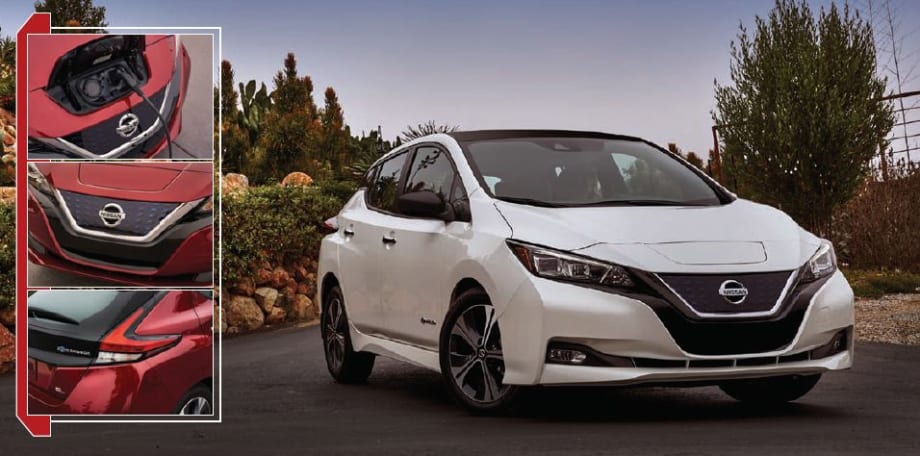
2018 Nissan Leaf
2018 Nissan Leaf
How long does it take to go from a world-beater to an afterthought? About eight model-years, if you go by the Nissan Leaf. The plug-in five-door compact hatchback made waves upon its 2010 debut, only to slip from the public consciousness as newer, better electrics entered the market.
But this Leaf is no shrinking violet. After logging more than 283,000 sales worldwide (including more than 113,000 in the U.S. alone), the second-generation 2018 model adds power, range, and a host of forward-looking driver-assistive features to create a low-cost challenger for the likes of the Chevrolet Bolt and Tesla Model 3, as well as the downmarket Hyundai Ioniq Electric and the Volkswagen e-Golf.
The new Leaf features a larger, 40 kilowatt-hour (kWh) battery that extends its range from 107 miles to 150 miles. A new powerplant delivers 147 horsepower (hp) and 236 pound-feet (lb.-ft.) of torque, up from 107 hp and 236 lb.-ft. in the outgoing model. The factory promises a 15% improvement in zero-to-60 times and plans to introduce a range-extending 60 kWh battery in time for the 2019-MY.
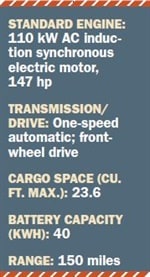
Specs for the 2018 Nissan Leaf
Nissan’s ProPilot Assist makes its worldwide debut in the 2018 Leaf. The system offers a semiautonomous driving experience, combining active cruise control (between 18 miles and 62 miles per hour) with lane-keeping assist and emergency braking.
Also new to the Nissan lineup is E-Pedal, an accelerator that also serves as a brake. The car speeds up when it is depressed and applies regenerative and standard braking power to slow to a stop when disengaged.
The styling sheds its bubble-butt exterior and adopts interior styling cues — including a decidedly mainstream 7-inch touchscreen — from other Nissan models. The result is a perfectly normal-looking car that happens to have a power outlet built into the nose. Using direct-current fast charging, the Leaf’s battery can go from fully discharged to 80% of capacity in just 30 minutes.
Fleet buyers considering the Chevrolet Bolt or Tesla Model 3 should take a hard look at the new Leaf. Nissan’s plug-in can’t beat the 200-plus-mile range of those competitors, but its top-of-the-line SL trim is priced at $37,495 (not including a $7,500-per-unit federal tax credit) — about the same as an entry-level Bolt or Model 3.
The 2018 Nissan Leaf will roll (silently) into showrooms early in the year with a starting MSRP of $29,600.
More Small Fleet


Developing Budget-Friendly Driver Safety Programs
From driver training and safety meetings to one-on-one coaching and incentive programs, several small fleets share how they have developed a safety culture with their drivers using low- to no-cost resources.
Read More →
Boosting Last-Mile Fleet Uptime, Safety, and Value with AI Vehicle Inspections
AI-powered inspections are transforming last-mile fleets by replacing manual checks with highly accurate automated scans that detect defects in seconds. By giving fleet operations visibility into the daily condition of their vehicles, you can identify trends over the vehicle’s lifecycle that enable improved procurement decisions, route management, driver training and accountability.
Read More →
Five Ways Seat Belts Help Prevent Injuries
There are five ways seat belts protect occupants from injuries, according to the Tennessee Department of Safety and Homeland Security.
Read More →
It’s here: The 2026 Fleet Technology Trends Report
What does AI mean for fleets? Get the answer — and learn other top tech trends.
Read More →
Small Fleets, Big Impact: How Independent Drivers Power Wreaths Across America
Check out how small fleets and independent drivers power Wreaths Across America each December and why their impact matters more than ever.
Read More →
VMS Survey Finds 65% of Small Fleet Managers Run Operations Alone
A new VMS survey shows small fleet managers are stretched thin, with most handling operations solo and eager to adopt digital tools for relief.
Read More →
Tips for Driving Safely on Halloween Night
This video features a reminder from the Connecticut Department of Transportation (DOT) and the Connecticut Police Chiefs Association, urging drivers to prioritize safety this Halloween.
Read More →
AI, Access, and Uptime: VMS’s Next Chapter with David Prusinski
VMS’s new Co-CEO, David Prusinski, shares how an AI-first approach will give small fleets and repair shops the tools to compete like big players.
Read More →
Fleet Managers Share Winter Prep Tips: It's Never Too Early!
Three fleets share best practices to prep vehicles for winter and prevent downtime when the cold sets in.
Read More →