




Next Step in CDL Med Card Process Delayed
The delay of the final rule affects the recordkeeping procedures for everyone involved in a driver’s medical exam.

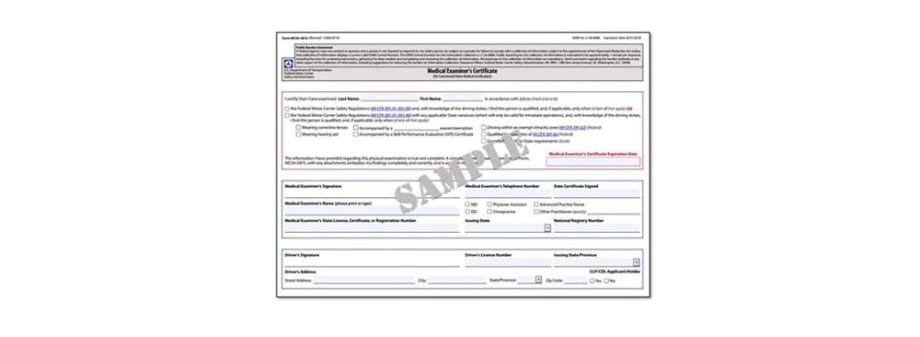
A sample Medial Examiner's Certificate from the state of Wisconsin.
Image courtesy of the Wisconsin DOT
After months of speculation on timing, the Federal Motor Carrier Safety Administration (FMCSA) delayed the implementation of a final rule that was supposed to streamline the medical certification process for those holding a Commercial Driver’s License (CDL).
Final implementation of the “Medical Examiner’s Certification Integration” rule — slated for June 22, 2018 — has been pushed back to June 22, 2021, according to information provided by the agency.
Why the Delay in the Federal Exemption?
The rule would have reduced the number of steps involved in sharing the results of a driver’s physical exam with state driver licensing agencies. Significantly, it would have eliminated the need for the CDL driver to be the middleman in the process.
As an alternative, the rule would have required the medical examiner to use the National Registry of Certified Medical Examiners portal to submit a driver’s medical examination results directly to the FMCSA. The FMCSA, in turn, would transmit the CDL driver’s medical information to the national CDL database. States use that database to populate their drivers’ motor vehicle records (MVRs). The employer would simply request an MVR after the exam as proof of a CDL driver’s medical certification, and law enforcement would have more immediate access to the data during roadside inspections.
As you can see, the concept hinges on information technology (IT). First signs of IT concerns surfaced when the National Registry website went offline in December 2017. Many questioned whether the agency could get the portal up and running in time for the June deadline.
In April, the FMCSA finally admitted it was unable to receive or electronically transmit medical examination certification information from the National Registry to the states. On the other side of the process, many states are not equipped to receive the medical status from the CDL database to post to the driver’s record.
Without the IT infrastructure in place, the FMCSA was forced to delay implementation of the rule for two years, giving states time to make the necessary changes and allowing the FMCSA to restore its National Registry website.
How Does this Impact the Medical Examination Process?
Because of the delay, the existing process for issuing and reporting medical exams remains (mostly) in place.
The driver must:
Be issued a med card by the medical examiner;
Continue to carry the med card for 15 days following the physical exam; and
Provide his or her licensing agency with a copy of the med card within a few days of the exam so it appears on the driving record within 15 days.
The motor carrier must:
Request a copy of the med card from either the driver or the examiner as temporary proof of the driver’s medical status;
Obtain an MVR within 15 days of the exam, showing the recent medical exam and status; and
Verify that the examiner appears on the National Registry.
What’s Different with the Medical Examination Process?
One change did take effect on June 22, 2018, however. Medical examiners must report results of all completed driver physicals — including those in which the driver was found medically unqualified — to the FMCSA by midnight (local time) of the calendar day following the examination. This will provide the agency with more timely information on drivers who are medically unqualified.
The delay of the final rule affects the recordkeeping procedures for everyone involved in the driver’s medical exam. As a result, you may need to dialog with:
Medical examiners, to make sure they are aware of the delay and the need to continue issuing paper copies of the med card to all drivers; and
Any service providers that may audit your files or order MVRs.

Kathy Close is a transportation editor at J. J. Keller & Associates.
Photo courtsy of J.J. Keller
You may also need to communicate the delay to those involved in the driver qualification process within your company.
Supervisors, human resources personnel, and administrative support personnel may also need to understand the effects of the delay.
About the Author
Kathy Close is a transportation editor at J. J. Keller & Associates, Inc. Her areas of expertise include transportation security, DOT drug and alcohol testing, and driver qualification. For more information e-mail transporteditors@jjkeller.com.
More Operations
Family Ties Inside the Fleet Families Building Careers Across Generations
Three fleet families share what it really takes to work together, learn across generations, and keep business from following them home.
Read More →
Shades of Fleet Call for Voices: Fleet's Hidden Heroes
Fleet’s hidden heroes are often the ones keeping everything moving behind the scenes. September’s Shades of Fleet is looking for dispatchers, coordinators, parts specialists, and other support pros to share their stories.
Read More →
Truck Centers, Inc. Celebrates National Truck Driver Appreciation Week with $1,000 Fuel Card Giveaways
During National Truck Driver Appreciation Week, Truck Centers, Inc. is offering customers a chance to fuel up for free. Customers at all Truck Centers locations can enter to win one of four $1,000 fuel cards from Sept. 14 - 18.
Read More →
Fleet Guides, AI Time-Savers, Truck Tariffs & Fuel Strategy Lead the News
This week’s Truck Chat Cheat Sheet covers new fleet vehicle guides, practical AI use cases, U.S.-Canada truck production, mixed-energy strategy, and more.
Read More →
What Fleet Employers Are Missing When Hiring Veterans
What if some of the strongest candidates for fleet are already out there, but their experience is written in a language our industry does not always recognize?
Read More →
Automotive Fleet Opens 2026 Personal Use Survey for Commercial Fleet Managers
Less than two weeks left! Commercial and corporate fleet managers are invited to share how their organizations handle company vehicle personal-use policies, charges, and driver eligibility.
Read More →
What Resilient Fleets Do Differently When Conditions Change
Fleet resilience is about more than reacting to disruption. Lauren Fletcher talks with AP Fleet’s Alex Coveney about flexibility, planning, scaling, and what helps fleets adapt when business conditions shift.
Read More →
If We Want the Next Generation in Automotive, We Have to Give Them a Reason to Care
The automotive industry talks constantly about its workforce shortage. But before we can recruit the next generation, we may need to do a better job giving kids a reason to care about automotive in the first place.
Read More →
Ram ProMaster City Under $40K, Truck Tariffs, and AI Maintenance Lead the News
A sub-$40K commercial van, tariff questions, AI-powered maintenance, and a new EV production strategy headline this week’s Truck Chat Cheat Sheet.
Read More →
Bob Adamsky Shares the Fleet Lessons You Usually Learn the Hard Way
After more than 30 years in fleet, Arrow International’s Bob Adamsky has learned that the job is about far more than vehicles. He shares the lessons he wishes every fleet manager could learn a little earlier.
Read More →