




National Park Adds Propane Buses, Trucks
Partnering with a local Clean Cities coalition, Kentucky's Mammoth Cave National Park's propane-powered buses and pickup trucks have helped reduce its carbon footprint, as well as educate the public on the benefits of alternative fuels.

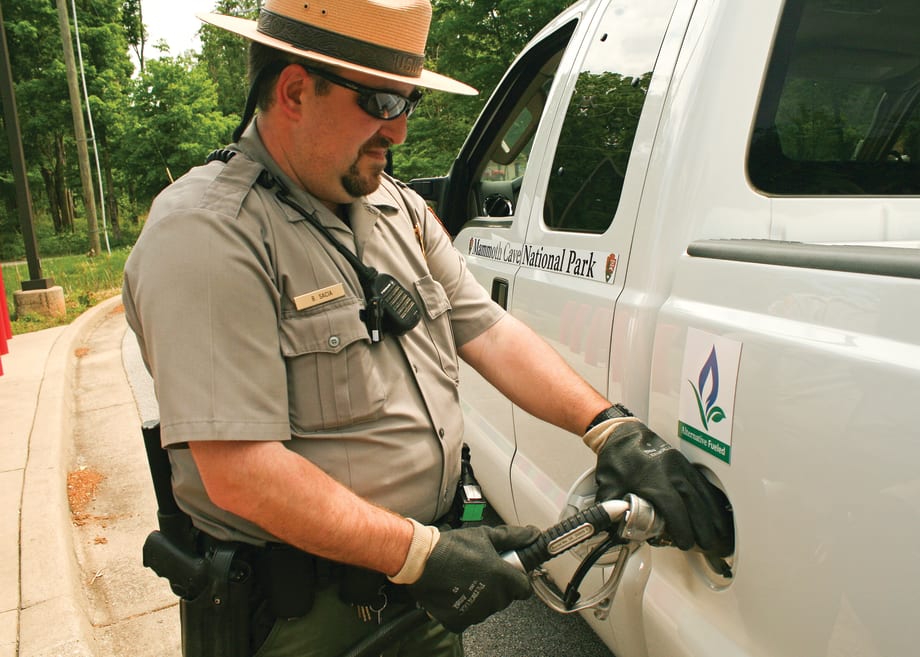
Brian Sacia, a Mammoth Cave National Park ranger, refuels one of the park's propane-powered F-250 pickup trucks.
Brian Sacia, a Mammoth Cave National Park ranger, refuels one of the park's propane-powered F-250 pickup trucks.
As a national park, it is important to protect the environment and the local resources for visitors to enjoy.
For Mammoth Cave National Park, its sustainability initiatives cover everything from reusing waste materials to installing recycled materials in the visitor center to incorporating alternative fuel vehicles into its fleet.
Since 2002, this Kentucky-based national park has used alternative fuels in its vehicle fleet, including E10 bi-fuel (ethanol and gasoline), biodiesel and propane.
“We feel a strong responsibility toward stewardship of what’s here and protection of the resources,” says Vickie Carson, Mammoth Cave’s public information officer. “Because air and water quality are of great concern, fuels like propane help us to show our visitors that there’s another fuel that can be used.”
To help incorporate alternative fuels into its infrastructure, Mammoth Cave has collaborated on alternative fuel and advanced transportation technology projects with the Kentucky Clean Fuels Coalition (KCFC), part of the Department of Energy’s Clean Cities coalition program, since the late ‘90s.
More recently, KCFC helped Mammoth Cave obtain funding for new propane-powered buses and propane pickup trucks, according to Melissa Howell, KCFC’s executive director.
Propane Funding
In 2011, Mammoth Cave received a $505,000 grant from the DOE’s Clean Cities program to replace its aging vehicles with new propane-fueled vehicles.
With this grant, the national park replaced four old propane buses (three 1990 models and one 1977 model) with four new autogas Bluebird school buses, as well as two bi-fuel pickups with two propane Roush CleanTech Ford F-250 pickups, according to Carson.
“KCFC was approached in 2011 by the U.S. Department of Energy with a request for Mammoth Cave National Park to serve as the first national park to participate in a direct Green Parks initiative, which carried with it funding for vehicles,” says Howell.
The Green Parks Plan also educates the public about the benefits of alternative and renewable fuels.
“It’s a good demonstration project,” says Carson. “The 200,000 people who ride the [propane] buses can experience riding in an alternative fuel vehicle.”
In addition to using propane-powered vehicles, Mammoth Cave also uses propane in other areas of its operation. The Propane Education & Research Council (PERC) recently donated propane-powered equipment, including three John Deere mowers, two Generac portable generators and a CleanFuel USA propane dispenser.

A cave tour at Mammoth Cave National Park.
Maintaining Vehicles
From small sedans to passenger vans to a dump truck, a majority of Mammoth Cave’s fleet runs on bi-fuel (ethanol and gasoline) and biodiesel, according to Bobby Sanders, Mammoth Cave’s heavy equipment mechanic.
The eight propane buses transport visitors daily on the cave tours. According to Sanders, the Mammoth Cave Hotel — operated by Forever Resorts — operates the propane buses and takes them to an outside vendor for regular maintenance.
Averaging about 500 miles per week, the two propane-powered F-250 pickups are used by the park’s law enforcement division for patrol and emergency response. Sanders takes care of routine maintenance for the trucks on-site at Mammoth Cave’s garage.
For filling up the vehicles, Mammoth Cave has an on-site refueling area with E10, biodiesel and propane. When it comes to fuel consumption, the savings for propane would be in the cost per gallon; propane is $1.89 per gallon, says Sanders.
“There is no performance difference with propane,” says Sanders. “It is an efficient fuel. Propane is so much cleaner than other fuels; even the engine parts stay cleaner.”
More Small Fleet


Developing Budget-Friendly Driver Safety Programs
From driver training and safety meetings to one-on-one coaching and incentive programs, several small fleets share how they have developed a safety culture with their drivers using low- to no-cost resources.
Read More →
Boosting Last-Mile Fleet Uptime, Safety, and Value with AI Vehicle Inspections
AI-powered inspections are transforming last-mile fleets by replacing manual checks with highly accurate automated scans that detect defects in seconds. By giving fleet operations visibility into the daily condition of their vehicles, you can identify trends over the vehicle’s lifecycle that enable improved procurement decisions, route management, driver training and accountability.
Read More →
Five Ways Seat Belts Help Prevent Injuries
There are five ways seat belts protect occupants from injuries, according to the Tennessee Department of Safety and Homeland Security.
Read More →
It’s here: The 2026 Fleet Technology Trends Report
What does AI mean for fleets? Get the answer — and learn other top tech trends.
Read More →
Small Fleets, Big Impact: How Independent Drivers Power Wreaths Across America
Check out how small fleets and independent drivers power Wreaths Across America each December and why their impact matters more than ever.
Read More →
VMS Survey Finds 65% of Small Fleet Managers Run Operations Alone
A new VMS survey shows small fleet managers are stretched thin, with most handling operations solo and eager to adopt digital tools for relief.
Read More →
Tips for Driving Safely on Halloween Night
This video features a reminder from the Connecticut Department of Transportation (DOT) and the Connecticut Police Chiefs Association, urging drivers to prioritize safety this Halloween.
Read More →
AI, Access, and Uptime: VMS’s Next Chapter with David Prusinski
VMS’s new Co-CEO, David Prusinski, shares how an AI-first approach will give small fleets and repair shops the tools to compete like big players.
Read More →
Fleet Managers Share Winter Prep Tips: It's Never Too Early!
Three fleets share best practices to prep vehicles for winter and prevent downtime when the cold sets in.
Read More →