Work Truck Logo
MenuMENU
SearchSEARCH

Mobile Services Help Fleets Save Labor and Stay Safe During COVID-19 Pandemic

Two fleet operators outline how they’re saving employee labor by allowing maintenance and fueling services to come to them.

by Gregory Van Tighem
June 25, 2020
Mobile Services Help Fleets Save Labor and Stay Safe During COVID-19 Pandemic

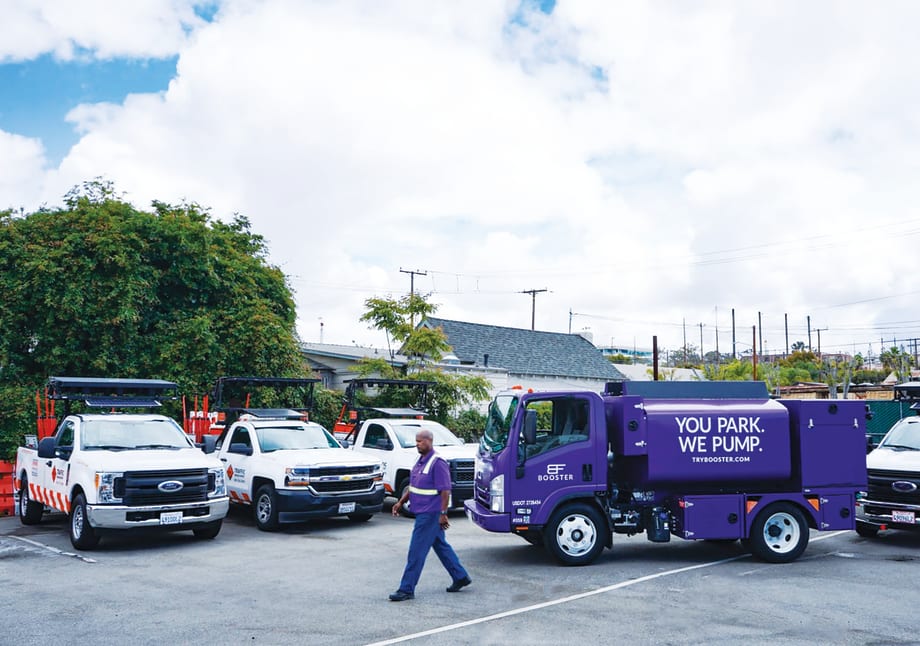
Booster’s fuel trucks visit TMI’s locations to fuel the company’s fleet between shifts. The company is paying 20 to 30 cents less per gallon using Booster than at the pump, reports TMI fleet project manager L.J. Lopez. 

Photo courtesy of Booster.

5 min to read


In response to the need to streamline their fleet operations, companies such as Traffic Management Inc. and Monarch Landscape Holdings LLC are increasingly turning to mobile fleet services to make fleet maintenance and fuel management more efficient. 

Pandemic Drives 1,000% Increase in Demand for Contactless Disinfecting Service  

Wrench offers a cleaning service in which a Wrench technician wipes down vehicles’ high-touch areas, including door handles, consoles, and steering wheels with a U.S. Centers for Disease Control-recommended disinfectant.  

Since March, Wrench says it has seen a thousand-fold increase in demand for its full, contactless disinfecting service as a result of the coronavirus pandemic.   

Rob Tetz, vice president of fleet and facilities for Monarch Landscape Holdings, said the service provides employees peace of mind and helps its companies meet state and federal guidelines for their coronavirus response. 

“Many fleets like Monarch are categorized as an essential service during the COVID-19 pandemic delivering vital items across the nation to people in need, and we’re honored to support their efforts to ensure they maximize uptime and continue operating,” said Ed Petersen, CEO of Wrench.  

“We are committed to protecting the health of customers, employees, and communities with our contactless services and policies to address these new challenges by providing full-service, on-site vehicle maintenance, and repairs to make sure these vehicles stay clean and get back on the roads faster.” 

Los Angeles, California-based Monarch Landscape Holdings is a private equity-backed company that operates several landscaping firms specializing in commercial landscape maintenance, landscape construction, and public infrastructure work.   

Ad Loading...

Monarch’s landscape companies employ 3,000 employees and operate more than 1,300 vehicles including pickup trucks, boom trucks, and flatbeds, as well as 800 trailers. 

Wrench provides vehicle and trailer preventive maintenance, mandatory compliance inspections (California Highway Patrol Basic Inspection of Terminals and U.S. Department of Transportation), and light- and medium-duty repairs for Monarch’s fleet.  

Monarch’s companies use Wrench’s online platform to schedule and track the different stages of the overall maintenance and repair process. Wrench fulfills these needs via an electronic and “single contact” request process. 

Freed Technicians 

Rob Tetz, vice president of fleet and facilities for Monarch Landscape Holdings, says he first learned about Wrench after Monarch partnered with Merchants Fleet Management.  

Ad Loading...

“The process and manpower needed to shuttle vehicles to and from brick-and-mortar facilities was inefficient,” Tetz says. “I started to research potential on-site or mobile options that would work within Monarch’s fleet management partnership with Merchants.” 

Within his analysis, the average time it took for an employee to drop off a vehicle was 50 minutes. This included prep, windshield time, dealer paperwork and processing, and travel time back to the company’s location. The five-mile return trip to pick up the vehicle once the PM work was completed averaged about 40 minutes, according to Tetz.  

Since employees had to shuttle about 800 of the companies’ 1,300 vehicles twice annually, Tetz estimated this cost the company about $55,200 on 2,400 hours in lost productivity.  

Before Monarch Landscape contracted with Wrench for its vehicle preventative maintenance needs, mechanics at the company’s own maintenance facilities completed the work. Those mechanics primarily fulfill contracted equipment repairs for other companies.  

Tetz says since Wrench technicians now provide the PM work, the company’s mechanics, who bill at $98 an hour, are free to accomplish nearly $235,000 worth of outside equipment repairs.  

Ad Loading...

“The Wrench platform also gives our branch operations visibility and communicates real time data so our operators can affect changes within their daily business asset needs,” Tetz says. Eventually, Monarch will be able to use the historical data Wrench collects for predictive maintenance, which could save the company even more money and offer greater efficiencies.  

On-Demand Fuel 

Meanwhile Booster, a mobile on-demand fuel delivery service, provides Traffic Management Inc. (TMI) a way to simplify its refueling process. When drivers start their day, they no longer need to fuel their vehicles before they leave the company yard.   

Instead, around-the-clock trucks loaded with diesel fuel from Booster visit the company’s 32 locations in Northern and Southern California, Seattle, and the Upper Marlboro, Md.-Washington, D.C. area delivering the fuel TMI trucks need. Signal Hill, California-based TMI operates a mixed fleet of about 100 truck-mounted attenuators and 850 ¾-ton pickup trucks.  

TMI fleet project manager L.J. Lopez also credits Booster’s mobile capabilities for delivering significant labor savings and efficiencies to his company. Booster has access to TMI’s yards to deliver fuel to our trucks between shifts,” he says.  

“Because drivers don’t have to spend time fueling up their vehicles at the start of their shifts, we’ve determined that we saved nearly half a million dollars in labor costs at our 32 locations across the United States in the first year,” Lopez says.  

Ad Loading...

TMI specializes in planning and coordinating traffic management for big infrastructure projects, road repairs or potentially hazardous events such as wildfires. The company’s truck-mounted attenuators (or TMAs) act as a crash shield protecting highway construction workers or emergency personnel should a vehicle leave the roadway or veer into the lanes where they are working.  

Company employees also deploy barricades and install temporary lighting to achieve work site and traffic safety. TMI’s customers range from developers and event organizers to public utility companies and government and law enforcement agencies. 

Booster Mobile Fueling Service Boosts COVID-19 Response 

Booster Fuels is helping to limit the spread of coronavirus with a fueling alternative to the traditional gas station — a well-known germ hotspot. 

Seventy-one percent of traditional gas pump handles have high levels of contamination. In an effort to keep people safe, Booster sets up “contactless” gas stations on wheels in the parking lots of essential services such as grocery stores or pharmacies.  

Booster’s proprietary purple mini tankers park in one spot and customers receive full-service no-touch fueling. Customers order through a special website with no memberships or apps required. 

Demand for mobile fueling has shot up across the country as consumers observe shelter-in-place guidelines.  

Recognizing that need, Washington State recently passed legislation that provides for an expedited permitting process for mobile fuel on-demand (MFOD) services to operate in jurisdictions statewide while upholding rigorous International Fire Code (IFC) safety requirements.  

The legislation will help MFOD operators meet urgent fueling needs related to the coronavirus response. This legislation follows four months after Booster launched its MFOD service, fully permitted, in Seattle.  

Fuel Savings 

TMI generally pays Booster the local going market rate for fuel plus a small fueling surcharge for the delivery. In locations where TMI operates more than 20 vehicles, Booster waives the surcharge and only charges for the fuel.  

Lopez says after looking at the costs his company would have paid at the pump, he’s paying 20 to 30 cents less per gallon using Booster.  

“Not only are we saving money on labor costs, but we’re also realizing some fuel cost savings,” Lopez added.  

Ad Loading...

Drivers start off the day with a full tank of gas and are ready to go, which leads to improved productivity. The company also has significantly reduced its reliance on the use of company gas cards, which previously led to problems with misuse and difficulties in tracking fuel transactions each month.  

Instead, TMI managers receive daily summaries on how each vehicle is performing. If there are maintenance issues, Booster drivers report any observable problems. 

Booster also made a recommendation that helped TMI realize greater efficiencies and contributed to even faster fueling service. When TMI drivers end their shifts, they can put up placards that indicate whether their vehicles need fuel, so Booster delivery drivers can focus their attention on those trucks that actually need refueling.   

Soon, that task will go digital:  

“We’re currently working with our telematics provider and with Booster on being able to remotely monitor fuel levels and know exactly when trucks need to be refueled and how much they need,” Lopez says.  

Subscribe to Our Newsletter

More Small Fleet

SponsoredMarch 9, 2026

Boosting Last-Mile Fleet Uptime, Safety, and Value with AI Vehicle Inspections

AI-powered inspections are transforming last-mile fleets by replacing manual checks with highly accurate automated scans that detect defects in seconds. By giving fleet operations visibility into the daily condition of their vehicles, you can identify trends over the vehicle’s lifecycle that enable improved procurement decisions, route management, driver training and accountability.

Read More →
SponsoredMarch 1, 2026

How One Fleet Cut Motor Pool Costs by $45K With Smarter Key Control and Automation

Still managing your motor pool with spreadsheets and manual approvals? Loyola University replaced outdated processes with automated fleet management, eliminating overtime and saving up to $50,000 annually. See how they did it.

Read More →
SponsoredMarch 1, 2026

Artificial Intelligence in Field Service: North America

48% of field service leaders are investing in AI to manage customer communication and self-service. Get the latest on how fleets are using AI and thinking about the future.

Read More →
Ad Loading...
SafetyFebruary 4, 2026

Five Ways Seat Belts Help Prevent Injuries

There are five ways seat belts protect occupants from injuries, according to the Tennessee Department of Safety and Homeland Security.

Read More →
SponsoredJanuary 14, 2026

It’s here: The 2026 Fleet Technology Trends Report

What does AI mean for fleets? Get the answer — and learn other top tech trends.

Read More →
Wreaths Across America graphic highlighting the role of small fleets in delivering wreaths to honor veterans, featuring wreath icons and the American flag.
Small Fleetby Lauren FletcherDecember 8, 2025

Small Fleets, Big Impact: How Independent Drivers Power Wreaths Across America

Check out how small fleets and independent drivers power Wreaths Across America each December and why their impact matters more than ever.

Read More →
Ad Loading...
A stressed person covers their face, illustrating that 65% of small fleet managers handle all operations alone, according to a Vehicle Management Systems (VMS) survey.
Small Fleetby StaffNovember 12, 2025

VMS Survey Finds 65% of Small Fleet Managers Run Operations Alone

A new VMS survey shows small fleet managers are stretched thin, with most handling operations solo and eager to adopt digital tools for relief.

Read More →
Safe Driving on Halloween over spooky fall road
Safetyby StaffOctober 20, 2025

Tips for Driving Safely on Halloween Night

This video features a reminder from the Connecticut Department of Transportation (DOT) and the Connecticut Police Chiefs Association, urging drivers to prioritize safety this Halloween.

Read More →
VMS Co-CEO David Prusinski highlights the company’s AI-powered virtual fleet manager designed to improve uptime and reduce operating costs for fleets.
Green Fleetby Lauren FletcherOctober 6, 2025

AI, Access, and Uptime: VMS’s Next Chapter with David Prusinski

VMS’s new Co-CEO, David Prusinski, shares how an AI-first approach will give small fleets and repair shops the tools to compete like big players.

Read More →
Ad Loading...
Photo of tire tracks and winter scenes.
Small FleetMay 24, 2025

Fleet Managers Share Winter Prep Tips: It's Never Too Early!

Three fleets share best practices to prep vehicles for winter and prevent downtime when the cold sets in.

Read More →