




Landscape Fleet Shortens Truck Lives From 15 to Five Years
This landscape company has decided to try leasing to maintain newer vehicles in its fleet. So far, the newer trucks have decreased maintenance downtime and improved employee morale.


The Summit Landscape Management team with its truck fleet. Photo courtesy of Summit Landscape Management.
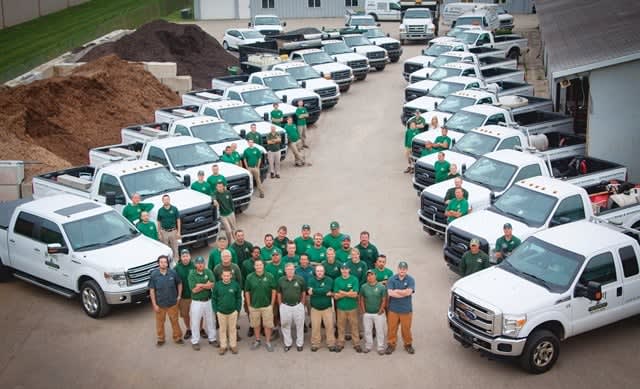
The Summit Landscape Management team with its truck fleet. Photo courtesy of Summit Landscape Management.
After running his company for 18 years, Bill Vander Velde has made a change in how he obtains all of his vehicles. He has decided to give leasing a try.
“The deal is that I’m trying to turn them over quicker,” says Vander Velde, owner of Summit Landscape Management. "If I can turn them over in five years, I can keep my fleet looking nicer.”
According to Vander Velde, he has a history of buying fleet vehicles and running them for at least 15 years; this leads to older vehicles that are more likely to break down.
In 1998, Vander Velde started his company with two vehicles used for mowing, fertilizing, and landscape construction. As time went on, he added irrigation services in 2003 and tree service in 2005. Today, the fleet has expanded to 55 vehicles to cover the different business categories.
Vehicles include vans (Ford Transit Connect, Ford E-150, Ford E-250), pickup trucks (Chevrolet 2500, Ford F-150, F-250, F-350), and heavy-duty trucks with dump bodies (Ford F-650; Freightliner FL60 and M2 106; International 4200, 4700, 4900, and 7300; Chevrolet C8500; GMC Topkick).
Covering the western Michigan region, the trucks average 15,000 miles per year. The number of jobs per day depends on the type of service, commercial or residential.
Leasing Benefits
Currently, Vander Velde is leasing F-250 and F-350 trucks through Ford Motor Credit Co.'s TRACLease program. Through the open-end lease, the deal is to keep the vehicles for five years or about 75,000 miles. At the end of five years, he has the option to buy/sell or trade in the vehicles.
“It helps to know when I can turn them over rather than keeping them running for 15 years,” he says.
When determining the worth of leasing over buying, Vander Velde based his decision on the following items:
- Uptime ratio: With a truck that is five years old or younger, there is significantly less downtime for repairs. “With the increase in uptime, we are more productive, which in turn keeps the customers happy.”
- Appearance: The vehicles will look better compared to keeping them for 15 years. “My old vehicles look really rough at the end of their life.”
- Morale: Driving a newer vehicle versus an older vehicle helps keep the employees happy and improves morale.
“The biggest issue is keeping the vehicles on the road and having less downtime for repairs,” he says.
Currently, Vander Velde’s plan is to continue leasing the Ford pickups and buying the dump trucks. “This is my plan for now, but since I recently started leasing the vehicles, I plan to re-evaluate after the first five-year leasing stint.”
Seasonal Work
Because landscaping and irrigation services are seasonal in Michigan, Vander Velde adds snow plows to his trucks to continue working through the winter.
“From around March 15 through Thanksgiving, we do the landscaping and irrigation services in what we call ‘the outdoor season,’” says Vander Velde. “Depending on when it starts snowing, we consider December, January, February, and part of March the snow plowing months.”
Before the snow hits, Summit Landscape’s in-house mechanics check the oil and fluids, the brakes, the truck’s front end and rear end, and the frames to make sure there are no cracks.
“In the fall, I start rotating the trucks into the shop for a day or two, allowing the mechanics to go through the entire vehicle,” says Jeff Hoeksema, production manager. “I also have our mechanics look at the plow systems to make sure they are working properly and there is no visible damage.”
Out of its 55 vehicles, the landscape fleet only has eight to 10 vehicles rest in the winter.
“The trucks cost so much money that we try to use them year-round,” says Hoeksema. “There are certain vehicles that we just can’t use in the winter, but we try to use what we can.”
More Small Fleet


Developing Budget-Friendly Driver Safety Programs
From driver training and safety meetings to one-on-one coaching and incentive programs, several small fleets share how they have developed a safety culture with their drivers using low- to no-cost resources.
Read More →
Boosting Last-Mile Fleet Uptime, Safety, and Value with AI Vehicle Inspections
AI-powered inspections are transforming last-mile fleets by replacing manual checks with highly accurate automated scans that detect defects in seconds. By giving fleet operations visibility into the daily condition of their vehicles, you can identify trends over the vehicle’s lifecycle that enable improved procurement decisions, route management, driver training and accountability.
Read More →
Five Ways Seat Belts Help Prevent Injuries
There are five ways seat belts protect occupants from injuries, according to the Tennessee Department of Safety and Homeland Security.
Read More →
It’s here: The 2026 Fleet Technology Trends Report
What does AI mean for fleets? Get the answer — and learn other top tech trends.
Read More →
Small Fleets, Big Impact: How Independent Drivers Power Wreaths Across America
Check out how small fleets and independent drivers power Wreaths Across America each December and why their impact matters more than ever.
Read More →
VMS Survey Finds 65% of Small Fleet Managers Run Operations Alone
A new VMS survey shows small fleet managers are stretched thin, with most handling operations solo and eager to adopt digital tools for relief.
Read More →
Tips for Driving Safely on Halloween Night
This video features a reminder from the Connecticut Department of Transportation (DOT) and the Connecticut Police Chiefs Association, urging drivers to prioritize safety this Halloween.
Read More →
AI, Access, and Uptime: VMS’s Next Chapter with David Prusinski
VMS’s new Co-CEO, David Prusinski, shares how an AI-first approach will give small fleets and repair shops the tools to compete like big players.
Read More →
Fleet Managers Share Winter Prep Tips: It's Never Too Early!
Three fleets share best practices to prep vehicles for winter and prevent downtime when the cold sets in.
Read More →