





Watch: Initial Vehicle Quality Declines Due to Supply Constraints (video)
Initial Vehicle Quality Declining Due to Supply Constraints
The 2022 J.D. Power annual Initial Quality Study revealed that the supply chain disruptions caused by the COVID-19 pandemic contributed to vehicle problems, hitting a record high in the 36-year history of this benchmark study.
August 16, 2022
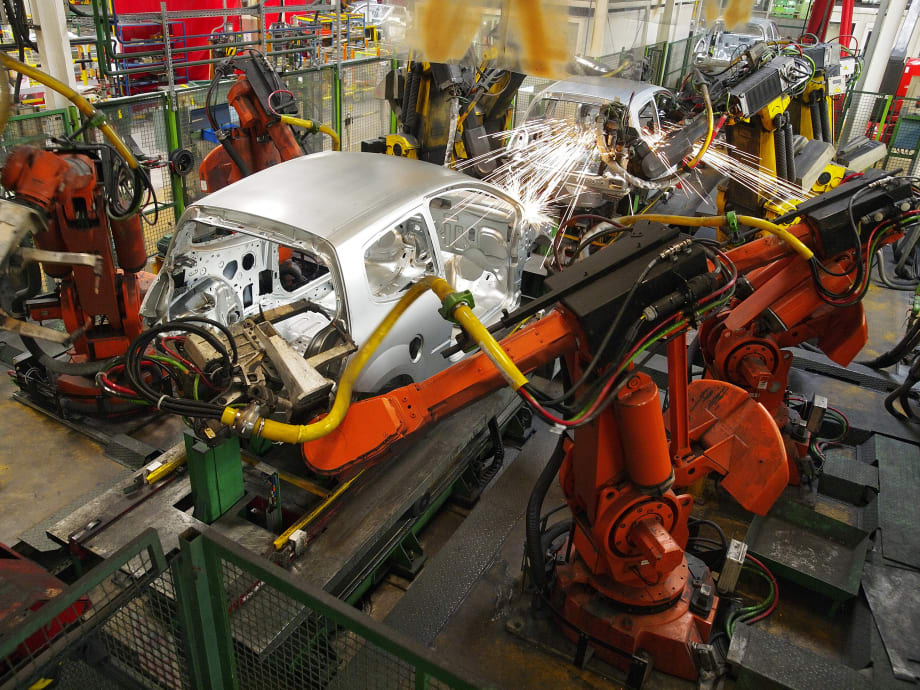
Initial vehicle quality has gone the opposite way of positive, particularly amid ADAS and infotainment systems.
Credit: Getty Images
4 min to read
Ongoing supply constraints (in particular, the microchip shortages) have contributed to the decline in initial vehicle quality as reported by J.D. Power in its 2022 report.
For those unfamiliar with this study, the J.D. Power Initial Quality Study measures the number of problems per 100 vehicles as reported to it by the vehicle owners.
The disruptions caused by the COVID-19 pandemic — supply chain issues, record-high vehicle prices, and personnel dislocations — contributed to vehicle problems reaching a record high in the 36-year history of this benchmark study.
Reported Problems Up 18%
What stood out in the 2022 survey is that there was an 11% increase in reported problems compared to 2021. This represented 18 additional problems per 100 vehicles (PP100) in 2022 compared to the prior year.
What caught everyone’s attention is that the J.D. Power study has always shown steady vehicle quality improvements – year-over-year — throughout its 36-year history. For my entire career, I’ve only known vehicle quality to increase year-over-year as substantiated by J.D. Power. Sure, some models may go up or down, but the industry, on average, has been producing higher-quality vehicles year after year – at least until 2022. This year initial vehicle quality was the lowest it's been in the entire history of this industry-wide survey.
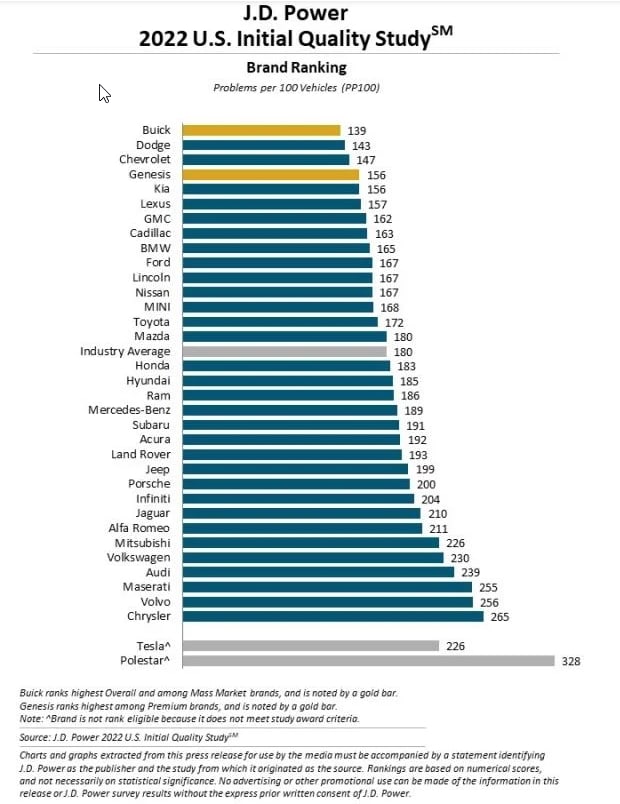
Buick and Genesis (gold bars) rank the highest overall amid mass market brands (Buick) and within the luxury segment (Genesis).
Photo: JD Power
“Given the many challenges automakers and their dealers had to face in the past year, it’s somewhat surprising that initial quality didn’t fall even more dramatically,” said David Amodeo, director of global automotive at J.D. Power. “In general, initial quality has shown steady improvement throughout the history of this study, so the decline this year is disappointing—yet understandable. Automakers continue to launch vehicles that are more and more technologically complex in an era in which there have been many shortages of critical components to support them.”
This year’s U.S. Initial Quality Study is based this year on responses from 84,165 purchasers and lessees of new 2022 model-year vehicles who were surveyed early in the ownership period. The study is based on a 223-question battery organized into nine vehicle categories: infotainment; features, controls and displays; exterior; driving assistance; interior; powertrain; seats; driving experience; and climate. The study is designed to provide manufacturers with information to facilitate the identification of problems and to drive product improvement.
The study was fielded from February through May 2022, meaning that responses are primarily based on ownership of 2023 model-year vehicles.
Vehicle Quality Slips in 2022
In 2022, the industry average was 180 problems per 100 vehicles. In 2021, it was 162 problems per 100 vehicles. A lower score reflects higher vehicle quality. The bottom line is that in 2021 the automotive industry was producing higher-quality vehicles than it is today in 2022.
And there are a number of reasons why this has occurred, but a commonly cited reason is that 2022 vehicles, on average, are the most technologically complex models produced.
“Supply chain disruption, especially the shortage of microchips, has caused automakers to seek alternative solutions to get new vehicles into purchasers’ and lessees’ hands,” Amodeo said. “In some cases, new vehicles are being shipped without some features installed. Communication with them about the changes in feature availability, as well as when such features will be reinstated, is critical to their satisfaction.”
The more complex the vehicle, the greater its reliance on microchips, and the greater the likelihood it has been negatively impacted by the microchip shortages.
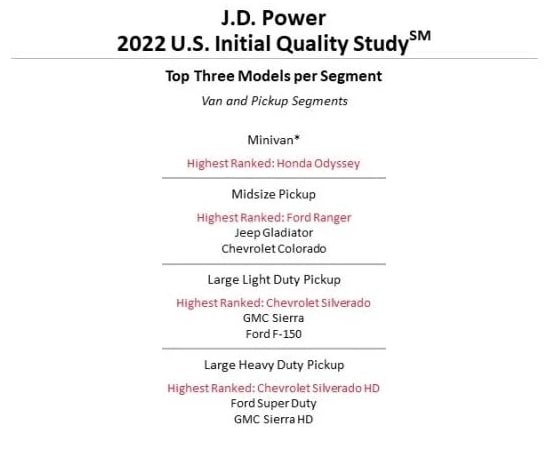
The Honda Odyssey ranked highest amid the vans segment.
Photo: JD Power
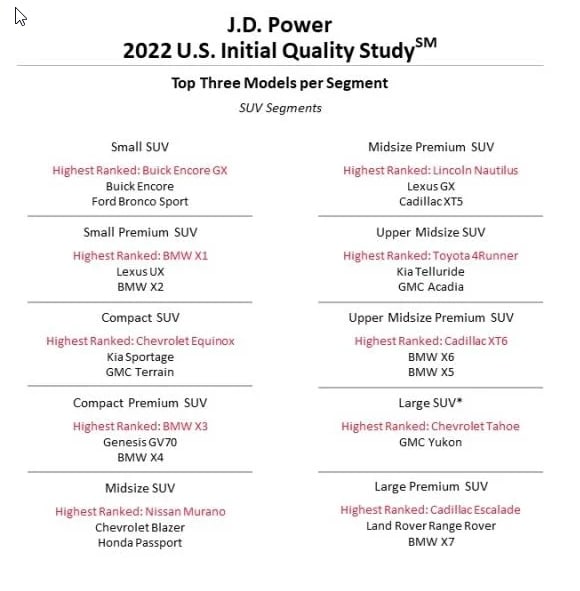
The Chevrolet Tahoe and Cadillac Escalade ranked the highest amid Large SUVs and Premium Large SUVs, respectively.
Photo: JD Power
BEV vs. ICE Models
According to J.D. Power, battery-electric vehicles (BEVs) and plug-in hybrid vehicles (PHEVs) are more problematic; Owners of BEVs and PHEVs cite more problems with their vehicles than do owners of vehicles with internal combustion engines (ICE). ICE vehicles average 175 PP100, PHEVs average 239 PP100, and BEVs—excluding Tesla models—average 240 PP100. (Tesla models average 226 PP100 and are shown separate from the BEV average because the predominance of Tesla vehicles could obscure the performance of the legacy automakers that have recently introduced BEVs.)
Driving assistance issues grow: Problems with advanced driving assistance systems (ADAS) declined in 2021 but have increased in 2022. The most problematic ADAS system is lane departure warning/lane-keeping assistance with 4.1 PP100.
The infotainment category continues to be the most problematic, with an average of 45.0 PP100, which is 19.5 PP100 more problems than the next-highest category.
The Honda Odyssey ranked highest amid the vans segment.
Photo: JD Power
Will the 2023 Study Repeat 2022?
With the supply constraints for microchip anticipated to continue into next year, it will be interesting to see whether this trend continues in the 2023 J.D. Power Initial Vehicle Quality study.
Originally posted on Automotive Fleet
Subscribe to Our Newsletter
More Small Fleet


Developing Budget-Friendly Driver Safety Programs
From driver training and safety meetings to one-on-one coaching and incentive programs, several small fleets share how they have developed a safety culture with their drivers using low- to no-cost resources.
Read More →
Sponsored•March 9, 2026
Boosting Last-Mile Fleet Uptime, Safety, and Value with AI Vehicle Inspections
AI-powered inspections are transforming last-mile fleets by replacing manual checks with highly accurate automated scans that detect defects in seconds. By giving fleet operations visibility into the daily condition of their vehicles, you can identify trends over the vehicle’s lifecycle that enable improved procurement decisions, route management, driver training and accountability.
Read More →
Five Ways Seat Belts Help Prevent Injuries
There are five ways seat belts protect occupants from injuries, according to the Tennessee Department of Safety and Homeland Security.
Read More →
Sponsored•January 14, 2026
It’s here: The 2026 Fleet Technology Trends Report
What does AI mean for fleets? Get the answer — and learn other top tech trends.
Read More →
Small Fleets, Big Impact: How Independent Drivers Power Wreaths Across America
Check out how small fleets and independent drivers power Wreaths Across America each December and why their impact matters more than ever.
Read More →
VMS Survey Finds 65% of Small Fleet Managers Run Operations Alone
A new VMS survey shows small fleet managers are stretched thin, with most handling operations solo and eager to adopt digital tools for relief.
Read More →
Tips for Driving Safely on Halloween Night
This video features a reminder from the Connecticut Department of Transportation (DOT) and the Connecticut Police Chiefs Association, urging drivers to prioritize safety this Halloween.
Read More →
AI, Access, and Uptime: VMS’s Next Chapter with David Prusinski
VMS’s new Co-CEO, David Prusinski, shares how an AI-first approach will give small fleets and repair shops the tools to compete like big players.
Read More →
Fleet Managers Share Winter Prep Tips: It's Never Too Early!
Three fleets share best practices to prep vehicles for winter and prevent downtime when the cold sets in.
Read More →