




Improving Order-to-Delivery Times: You Want That Truck When?
When it comes time to acquire a new truck, small fleets need it "yesterday." Here are seven tips to help shorten the order-to-delivery process.
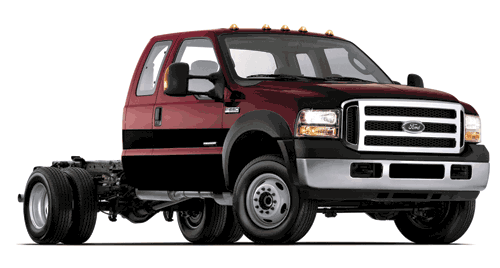
For commercial trucks, use body company truck pools if possible.
Photo: Ford Motor Co.
Is it time to order your new work truck? Concerned about order-to-delivery times? Check out these seven tips:
The end user should plan at least 90 days in advance of when a vehicle is needed. Some advanced planning by the end user will save hundreds and maybe thousands of dollars in acquisition costs by not having to buy a vehicle out of stock instead of using a factory order.
Have the dealer or fleet management company check the manufacturer's downtime at the plant. This can be invisible to the end user, but can add weeks to the total delivery time.
Before ordering a specific model, have the dealer or fleet management company double-check with the manufacturer to see if any options or standard components are on hold or in short supply. This can hold up an order for weeks or months.
For commercial trucks, use body company truck pools if possible. The fact that the truck is sitting on the ground and in stock at the body company can save eight to 12 weeks alone on total delivery time.
Use the vehicle manufacturer's vehicle pools if possible. One of the best-kept secrets is that both Ford and GM have pool vehicle access for select cars.
Make sure the dealer or fleet management company sends a purchase order immediately to the body company for any upfit that will be installed on a factory-ordered vehicle. They should tell the body company the approximate delivery date so that the body company can get the equipment ordered before the truck arrives. This alone will save many weeks or months.
Whenever possible, have truck equipment installed by a truck body company close to the delivering dealer. Though factory ship-thru systems are extremely convenient, placing a truck back into shipping traffic can add a week or two to the shipping time, especially for medium-duty units. In this way a truck can be upfit after it arrives at the end destination and doesn't need to be re-shipped. This works best with smaller orders of one to 10 units.
Glossary of Ordering and Shipping Terms
Bailment pool: A "pool" or inventory of already-built vehicles on consignment at body companies, awaiting sale and upfit by dealers or leasing companies.
Body company: A fabricator that manufactures and installs special equipment for vehicles. Also the location where a vehicle is shipped to be upfit with equipment not installed at the factory.
Completed vehicle: A fully manufactured truck, including the chassis, body and usable cargo area.
Factory order: A new vehicle order placed directly with the manufacturer by the dealer or leasing company to meet the user's exact specifications.
Incomplete vehicle: Vehicle chassis that is completed by adding specialized equipment.
Lead time: The anticipated length of time between an order's placement and delivery.
Ship Thru: The process of shipping a vehicle from the manufacturer to a body company for equipment installation. The completed vehicle is returned to the manufacturer and then sent to the delivering dealer.
Ship To: The vehicle is shipped from the manufacturer to a body company. The completed vehicle is then transported directly to the delivering dealer or customer location.
Upfitting: The addition of equipment on a vehicle not installed by the manufacturer.
More Small Fleet


Developing Budget-Friendly Driver Safety Programs
From driver training and safety meetings to one-on-one coaching and incentive programs, several small fleets share how they have developed a safety culture with their drivers using low- to no-cost resources.
Read More →
Boosting Last-Mile Fleet Uptime, Safety, and Value with AI Vehicle Inspections
AI-powered inspections are transforming last-mile fleets by replacing manual checks with highly accurate automated scans that detect defects in seconds. By giving fleet operations visibility into the daily condition of their vehicles, you can identify trends over the vehicle’s lifecycle that enable improved procurement decisions, route management, driver training and accountability.
Read More →
Five Ways Seat Belts Help Prevent Injuries
There are five ways seat belts protect occupants from injuries, according to the Tennessee Department of Safety and Homeland Security.
Read More →
It’s here: The 2026 Fleet Technology Trends Report
What does AI mean for fleets? Get the answer — and learn other top tech trends.
Read More →
Small Fleets, Big Impact: How Independent Drivers Power Wreaths Across America
Check out how small fleets and independent drivers power Wreaths Across America each December and why their impact matters more than ever.
Read More →
VMS Survey Finds 65% of Small Fleet Managers Run Operations Alone
A new VMS survey shows small fleet managers are stretched thin, with most handling operations solo and eager to adopt digital tools for relief.
Read More →
Tips for Driving Safely on Halloween Night
This video features a reminder from the Connecticut Department of Transportation (DOT) and the Connecticut Police Chiefs Association, urging drivers to prioritize safety this Halloween.
Read More →
AI, Access, and Uptime: VMS’s Next Chapter with David Prusinski
VMS’s new Co-CEO, David Prusinski, shares how an AI-first approach will give small fleets and repair shops the tools to compete like big players.
Read More →
Fleet Managers Share Winter Prep Tips: It's Never Too Early!
Three fleets share best practices to prep vehicles for winter and prevent downtime when the cold sets in.
Read More →