




How One Concrete Company Plans to Pass the Family Business to its Fifth Generation
Justin Ozinga, now the fourth generation family member to be appointed president of the business, talked to CONEXPO-CON/AGG Radio about the challenge of keeping a family business a family business.
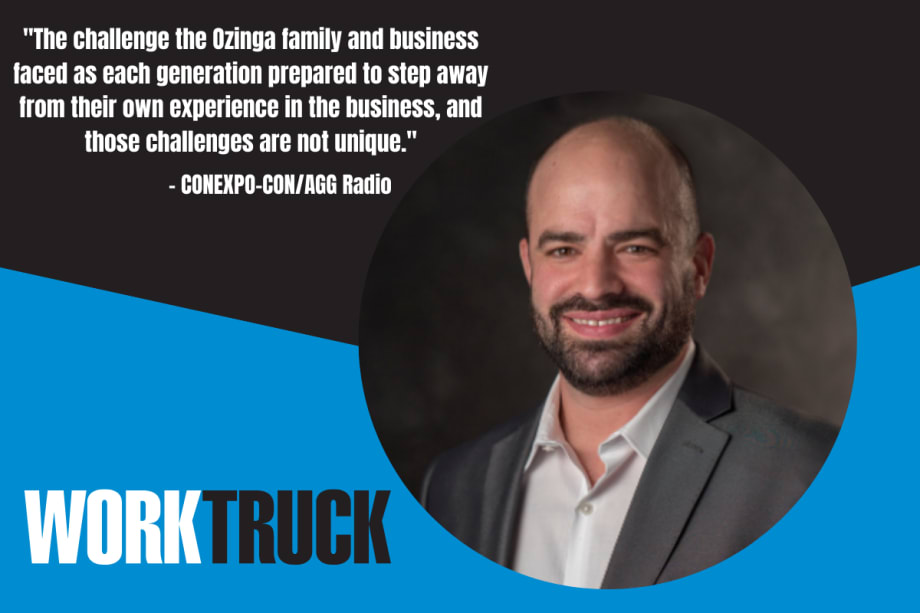
Justin Ozinga said that three of those fifth-generation kids have received Ozinga paychecks from work in the summer, and all the family members are excited about the interest so far.
Chances are, if you’ve ever plied the expressways within a couple hours’ drive of Chicago, you’ve seen one of Ozinga Bros.’ trademark red-and-white, candy-striped cement trucks. Ozinga trucks have been carrying materials to and from homes and job sites since the company was founded in 1928, and today has 2,000 employees helping contractors out from southeast Wisconsin, central Illinois, across northern Indiana, and now Miami.
What some may find most surprising, however, is that Ozinga has been led by Ozingas ever since the beginning. Justin Ozinga, now the fourth generation family member to be appointed president of the business, talked to Missy Sherber, host of CONEXPO-CON/AGG Radio, about the challenge of keeping a family business a family business, and how he is working already to move the company to its fifth generation.
“When my grandfather and his two brothers took over the business, World War II started, and they actually had to close the business for a couple of years while they all joined the military. They opened up shortly thereafter and got into the ready-mix concrete business,” Ozinga told Sherber. “My grandfather told my dad, ‘Let me know if you’re interested in this ready-mix business, otherwise I’m going to sell it.’ My dad was in college at the time, and he said ‘Yes, for sure, I’m interested.’ I think he was only 22 years old, and he took over as the general manager of the ready-mix concrete business, otherwise it was going to be sold!”
The challenge the Ozinga family and business faced as each generation prepared to step away from their own experience in the business, and those challenges are not unique. Keeping a business afloat and in the family is a challenge that has been studied and written about extensively for decades, including in this 1976 piece on change management from the Harvard Business Review, and more recently in another 2020 piece by Forbes. The passing of a company from one generation to another even threatened to fell one of the world’s most famous family-owned companies, Ford Motor Company, as legendary automotive journalist Brock Yates wrote about in the January 1988 issue of Car and Driver.
Ozinga joked with Sherber that when his dad and dad’s cousins passed the company down to him and his brothers, the previous generation of the family “breathed a sigh of relief.”
“We took that very serious, and that’s a burden we carry, in a good way, that we definitely want to pass it on down to the fifth generation ourselves,” Ozinga said. “There are 32 kids in the fifth generation that are 18 and under. That’s all the children of my five brothers, myself, and my cousin Jeff.”
Ozinga explains that three of those fifth-generation kids have received Ozinga paychecks from work in the summer, and all the family members are excited about the interest so far.
One of the reasons Ozinga attributes to the longevity of the Ozinga business across multiple generations now is a family-long outlook of not owning the business but being stewards of the business.
“That’s how we really feel about it, that it’s ours for a time, we’ve been given this enormous blessing, and we want to make the most of it and do the most with it,” Ozinga said. “When we have that mentality, it’s easy not to get wrapped up in the hype of how much work you accomplish, or how much money you’re making or not making, or how many employees you have. None of that really matters. All that matters is the people and the impact you’re really having on them.”
Another strategy Ozinga describes has less to do with managing the business and planning succession there, and much more to do with managing the family itself.
“With all the nephews and nieces, we try to get them all together at least once a month, just so they can grow up getting to know each other and learn how to handle different emotions from their cousins,” Ozinga said. “That’s all intentional. We want to keep them close in case any of them want to join the business. It’s so there’s a lot of history there, and they’re not just meeting each other for the first time.”
More Operations
Family Ties Inside the Fleet Families Building Careers Across Generations
Three fleet families share what it really takes to work together, learn across generations, and keep business from following them home.
Read More →
Shades of Fleet Call for Voices: Fleet's Hidden Heroes
Fleet’s hidden heroes are often the ones keeping everything moving behind the scenes. September’s Shades of Fleet is looking for dispatchers, coordinators, parts specialists, and other support pros to share their stories.
Read More →
Truck Centers, Inc. Celebrates National Truck Driver Appreciation Week with $1,000 Fuel Card Giveaways
During National Truck Driver Appreciation Week, Truck Centers, Inc. is offering customers a chance to fuel up for free. Customers at all Truck Centers locations can enter to win one of four $1,000 fuel cards from Sept. 14 - 18.
Read More →
Fleet Guides, AI Time-Savers, Truck Tariffs & Fuel Strategy Lead the News
This week’s Truck Chat Cheat Sheet covers new fleet vehicle guides, practical AI use cases, U.S.-Canada truck production, mixed-energy strategy, and more.
Read More →
What Fleet Employers Are Missing When Hiring Veterans
What if some of the strongest candidates for fleet are already out there, but their experience is written in a language our industry does not always recognize?
Read More →
Automotive Fleet Opens 2026 Personal Use Survey for Commercial Fleet Managers
Less than two weeks left! Commercial and corporate fleet managers are invited to share how their organizations handle company vehicle personal-use policies, charges, and driver eligibility.
Read More →
What Resilient Fleets Do Differently When Conditions Change
Fleet resilience is about more than reacting to disruption. Lauren Fletcher talks with AP Fleet’s Alex Coveney about flexibility, planning, scaling, and what helps fleets adapt when business conditions shift.
Read More →
If We Want the Next Generation in Automotive, We Have to Give Them a Reason to Care
The automotive industry talks constantly about its workforce shortage. But before we can recruit the next generation, we may need to do a better job giving kids a reason to care about automotive in the first place.
Read More →
Ram ProMaster City Under $40K, Truck Tariffs, and AI Maintenance Lead the News
A sub-$40K commercial van, tariff questions, AI-powered maintenance, and a new EV production strategy headline this week’s Truck Chat Cheat Sheet.
Read More →
Bob Adamsky Shares the Fleet Lessons You Usually Learn the Hard Way
After more than 30 years in fleet, Arrow International’s Bob Adamsky has learned that the job is about far more than vehicles. He shares the lessons he wishes every fleet manager could learn a little earlier.
Read More →