




Efficient Driving Equals Fleet Savings
We all know that idling and running the air conditioner can negatively affect a vehicle’s fuel economy, but a new study backs those claims with hard numbers.

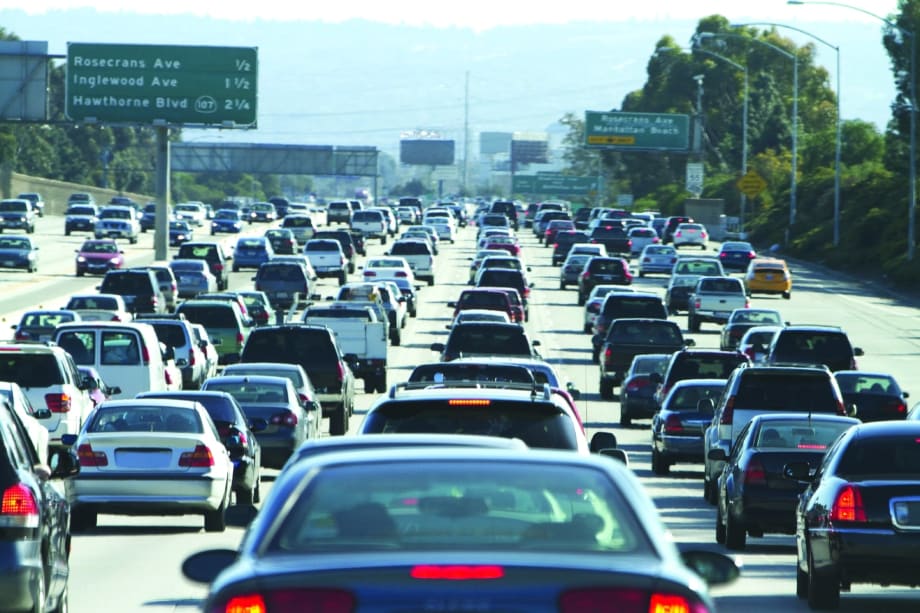
Photo: ©istockphoto.com/MCCAIG

Photo: ©istockphoto.com/MCCAIG
Ignoring fuel-savings strategies such as vehicle maintenance, driver training and route selection can reduce a vehicle’s cumulative fuel efficiency by about 45%, according to a study from the University of Michigan Transportation Research Institute (UMTRI).
Without any such strategies in place, the study found that a vehicle that should obtain 36 mpg will end up earning less than 20 (see table below). Fortunately, each of these factors are within a fleet manager’s and driver’s control.

Source: UMRTI 2011 study
The table shows how much efficient driving and other strategic fleet decisions can impact a vehicle’s fuel efficiency. This 36-mpg vehicle — one of the most efficient internal-combustion engine models in the U.S. at the time of the study — ends up getting only 19.8 mpg after calculating in excessive idling, route selection and other factors.
UMTRI’s analysts call these efficient driving strategies “eco-driving.” They break down the various factors that affect fuel efficiency by looking at three areas: operational decisions such as aggressive driving, tactical decisions like route selection, and strategic decisions such as vehicle maintenance.
Operational Decisions: Driving Behavior
Idling, low and high speeds, cruise control, air conditioning and aggressive driving all play a negative role on a vehicle’s fuel economy. Depending on engine size, idling uses a quarter- to a half-gallon of fuel per hour. While people are often under the impression that it’s better to idle for a minute or two rather than restart the vehicle, “it only takes a few seconds worth of fuel to restart your engine,” according to the Environmental Protection Agency (EPA).
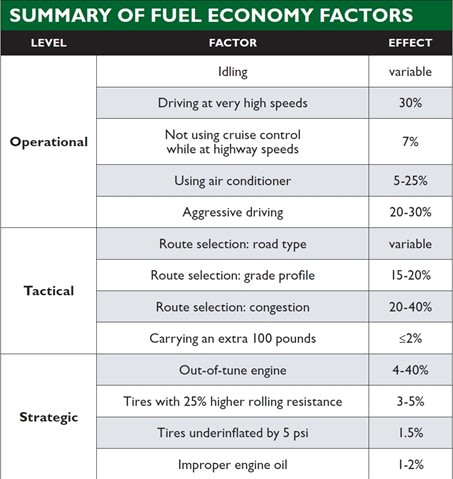
Utilizing cruise control at highway speeds can improve fuel consumption by about 7%. Speed in general is like “an inverted U-shaped function” in terms of fuel efficiency, in which the lowest and highest speeds are the least ideal. For example, the study points out that a 2007 Honda Accord experienced its best fuel economy in a natural setting at 61 mph. Driving 30 mph below or above that speed resulted in at least a 30% decrease in fuel efficiency.[PAGEBREAK]
Turning on the air conditioner has been found to cause similar effects on fuel spend. It turns out that using the A/C can reduce mileage by as little as 5% and as much as 25%. While this is a wide range, the last component of operational decisions — aggressive driving — consistently affects fuel economy by an average of 31%. However, between the 10th and 90th percentile, the mpg achieved among drivers in the same vehicle varies by about 20%.
The table below breaks down each of the efficient driving strategies, which total for an average, cumulative effect on fuel efficiency by 45%.
Source: UMRTI 2011 study
Tactical Decisions: Route Management and Rightsizing
Do you choose the long, flat route or the shortcut through the hills? Would there really be a noticeable difference on fuel efficiency? According to the UMTRI study, in cases where two routes were taken to the same destination, the flat route resulted in a 15-20% improvement in fuel economy.
Heavy traffic is an even greater concern. Going from “free flow” traffic to “forced or breakdown flow” can reduce fuel efficiency by 20-40%. But the most significant drop occurs when traffic transitions from an “unstable flow” to the final category of a “forced or breakdown flow.” These traffic-level classifications suggest that light and medium traffic don’t affect fuel efficiency as much as gridlock.
In choosing the right vehicle for your business, be sure to select the best model variant for the job. The UMTRI study shows that the mean range for cars that have two or more model variants is 4.3 mpg, and 4.9 mpg for light-duty trucks. And while these ranges might not seem like much, that’s 18% of the average fuel economy of all vehicles. So, do you really need that crew cab?
Finally, think about what you actually need to carry in your vehicle for each trip. According to the EPA, for every 100 pounds added to a vehicle, fuel efficiency is reduced by up to 2%. UMTRI also estimates that the average U.S. adult weight-gain — about 24 pounds from 1960 to 2002 — has reduced the overall fuel economy by about half a percentage point.
Strategic Decisions: Vehicle Maintenance
Failing to properly maintain the engine, check the tires or use the correct engine oil can also hurt fuel efficiency. The study quotes a 2011 EPA study which found that “fixing a car that is noticeably out of tune or has failed an emission test can improve its gas mileage by an average of 4%, though results vary based on the kind of repair and how well it is done.” As well, the EPA says that fixing a faulty oxygen sensor can improve mileage “by as much as 40%.”
For every 1 psi drop in tire inflation, the vehicle’s fuel economy will drop an average of 0.3%. Using the wrong type of engine oil can decrease efficiency by 1-2%.
Reducing operational costs for your small business fleet requires a combination of driver training and route optimization. Achieving both will take time, but in the long run, making the most out of these decisions will definitely cost less than the gas you’re wasting.
More Small Fleet


Developing Budget-Friendly Driver Safety Programs
From driver training and safety meetings to one-on-one coaching and incentive programs, several small fleets share how they have developed a safety culture with their drivers using low- to no-cost resources.
Read More →
Boosting Last-Mile Fleet Uptime, Safety, and Value with AI Vehicle Inspections
AI-powered inspections are transforming last-mile fleets by replacing manual checks with highly accurate automated scans that detect defects in seconds. By giving fleet operations visibility into the daily condition of their vehicles, you can identify trends over the vehicle’s lifecycle that enable improved procurement decisions, route management, driver training and accountability.
Read More →
Five Ways Seat Belts Help Prevent Injuries
There are five ways seat belts protect occupants from injuries, according to the Tennessee Department of Safety and Homeland Security.
Read More →
It’s here: The 2026 Fleet Technology Trends Report
What does AI mean for fleets? Get the answer — and learn other top tech trends.
Read More →
Small Fleets, Big Impact: How Independent Drivers Power Wreaths Across America
Check out how small fleets and independent drivers power Wreaths Across America each December and why their impact matters more than ever.
Read More →
VMS Survey Finds 65% of Small Fleet Managers Run Operations Alone
A new VMS survey shows small fleet managers are stretched thin, with most handling operations solo and eager to adopt digital tools for relief.
Read More →
Tips for Driving Safely on Halloween Night
This video features a reminder from the Connecticut Department of Transportation (DOT) and the Connecticut Police Chiefs Association, urging drivers to prioritize safety this Halloween.
Read More →
AI, Access, and Uptime: VMS’s Next Chapter with David Prusinski
VMS’s new Co-CEO, David Prusinski, shares how an AI-first approach will give small fleets and repair shops the tools to compete like big players.
Read More →
Fleet Managers Share Winter Prep Tips: It's Never Too Early!
Three fleets share best practices to prep vehicles for winter and prevent downtime when the cold sets in.
Read More →