




Delivery Fleet Gets $23K for Hybrid Truck
Through a California hybrid incentive program, this nursery supply business received a $23,000 voucher to put toward a new Hino hybrid truck.

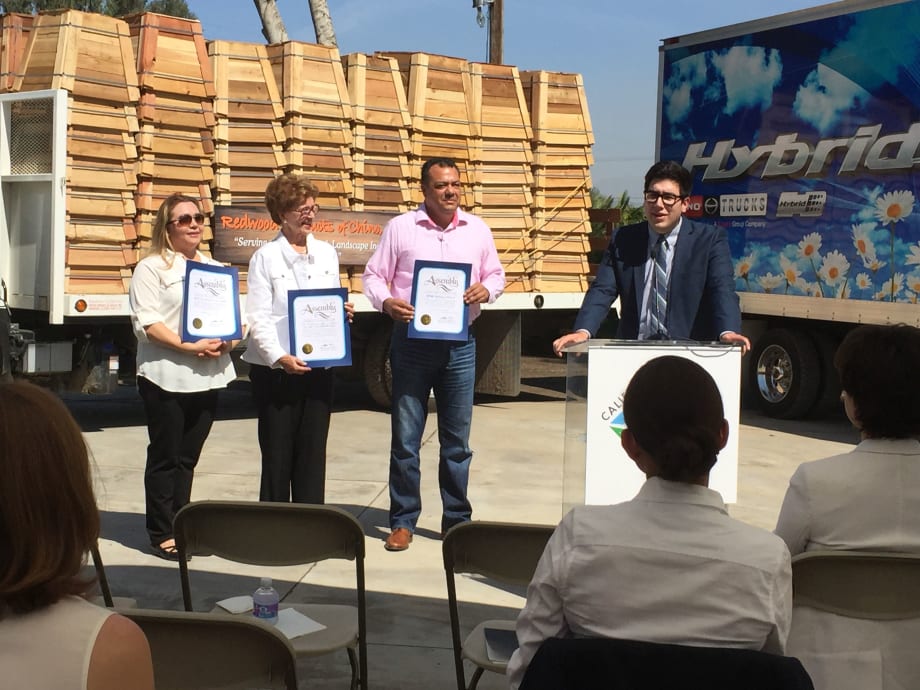
A ceremony celebrated the 2,000th recipicent of HVIP's voucher program: (l to r) Marcie Rodriguez, Redwood Products, Barbara Riordan, CARB, and Hicidro Campa, Rush Truck Centers
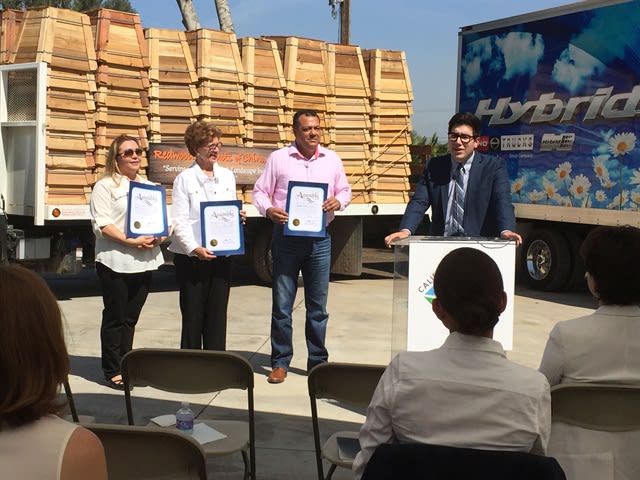
A ceremony celebrated the 2,000th recipicent of HVIP's voucher program: (l to r) Marcie Rodriguez, Redwood Products, Barbara Riordan, CARB, and Hicidro Campa, Rush Truck Centers
Redwood Products of Chino, Inc., a nursery supply manufacturing business, wanted to purchase a smaller fleet truck that would be easier to maneuver.
Based in Chino, Calif., the company’s 10-truck fleet consisted of heavy-duty Peterbilt trucks, which transport wood chips, mulch and other products to nurseries and the landscape industry.
When looking at trucks, Jaime Carlos, owner of Redwood Products, found out about a grant program for alt-fuel trucks, including the Hino hybrid truck.
“The employees at Rush Truck Centers mentioned applying for the grant program to provide funding for the Hino hybrid truck,” says Marcie Rodriguez, vice president of Redwood Products. “They handled the paperwork and took care of the majority of the process.”
Since its launch in 2010, the California Hybrid and Zero-Emissions Truck and Bus Voucher Incentive Project (HVIP) has provided more than $63 million to help California fleets purchase 1,800 hybrid trucks and buses — and more than 430 zero-emission trucks and buses, according to the California Air Resources Board (CARB). Funding is primarily supported through California Climate Investments.
“Cleaner trucks mean fewer unhealthy diesel emissions,” according to a CARB press release.
Redwood Products received the 2,000th voucher from HVIP, the nation’s first program to directly reduce the upfront cost of hybrid or zero-emission trucks and buses.
Grant Process
The $23,000 voucher covered close to one-third of the price for Redwood’s new Hino hybrid truck, according to CARB.
“It’s a simple process,” says Hicidro Campa, a sales representative at Rush Truck Centers who worked with Redwood Products. “We take some of the customer’s information, including identification documents, which link him or her to the business. Then we submit the information to the HVIP division of the state of California.”
Once the business is approved, Rush Truck Centers receives the voucher and delivers the truck to the customer. The voucher is usually approved with a few days — at most a week, according to Campa.
“Customers can usually use the voucher credit as a down payment for the Hino truck, but it depends on their credit,” says Campa.
With the voucher, a customer can save around $4,000 to $5,000 on a Hino hybrid truck versus buying a non-hybrid Hino of the same model, according to Campa.
So far, Campa has sold 10 Hino hybrid trucks through the HVIP voucher program. “I have worked with many different types of fleets, from construction to produce delivery,” he says. “People like the trucks; they are green and there’s fuel savings.”
Most of HVIP’s vouchers have been awarded to small fleets like Redwood Products. The program provides vouchers of up to $30,000 for eligible hybrid trucks and buses on a first-come, first-serve basis — as well as up to $95,000 for California purchasers and lessees of zero-emissions trucks and buses, according to CARB.
Customer Satisfaction
After running the Hino for a few months, Redwood’s employees are happy with the company’s first hybrid vehicle. “It’s easier to drive and maneuver,” says Rodriguez.
Because the Hino is smaller than the rest of Redwood’s Peterbilt trucks, the Hino hybrid can make more deliveries per day. Currently, each Peterbilt truck travels between 50 to 100 miles per day throughout Southern California.
Additionally, the Hino hybrid is more cost effective and gets lower emissions.
“We think the Hino will use about 40% less fuel than our bigger trucks,” says Rodriguez.
More Small Fleet


Developing Budget-Friendly Driver Safety Programs
From driver training and safety meetings to one-on-one coaching and incentive programs, several small fleets share how they have developed a safety culture with their drivers using low- to no-cost resources.
Read More →
Boosting Last-Mile Fleet Uptime, Safety, and Value with AI Vehicle Inspections
AI-powered inspections are transforming last-mile fleets by replacing manual checks with highly accurate automated scans that detect defects in seconds. By giving fleet operations visibility into the daily condition of their vehicles, you can identify trends over the vehicle’s lifecycle that enable improved procurement decisions, route management, driver training and accountability.
Read More →
Five Ways Seat Belts Help Prevent Injuries
There are five ways seat belts protect occupants from injuries, according to the Tennessee Department of Safety and Homeland Security.
Read More →
It’s here: The 2026 Fleet Technology Trends Report
What does AI mean for fleets? Get the answer — and learn other top tech trends.
Read More →
Small Fleets, Big Impact: How Independent Drivers Power Wreaths Across America
Check out how small fleets and independent drivers power Wreaths Across America each December and why their impact matters more than ever.
Read More →
VMS Survey Finds 65% of Small Fleet Managers Run Operations Alone
A new VMS survey shows small fleet managers are stretched thin, with most handling operations solo and eager to adopt digital tools for relief.
Read More →
Tips for Driving Safely on Halloween Night
This video features a reminder from the Connecticut Department of Transportation (DOT) and the Connecticut Police Chiefs Association, urging drivers to prioritize safety this Halloween.
Read More →
AI, Access, and Uptime: VMS’s Next Chapter with David Prusinski
VMS’s new Co-CEO, David Prusinski, shares how an AI-first approach will give small fleets and repair shops the tools to compete like big players.
Read More →
Fleet Managers Share Winter Prep Tips: It's Never Too Early!
Three fleets share best practices to prep vehicles for winter and prevent downtime when the cold sets in.
Read More →