





Related Article: Two IARA Presidents Take Stock of Alliance Legacy
At the Beginning and Through the Decades
IARA 20th Anniversary Issue: Industry observer, media figure, and conference host Charlie Vogelheim has circulated throughout the automotive world, qualifying him to sum up the legacy of the IARA.
December 7, 2021
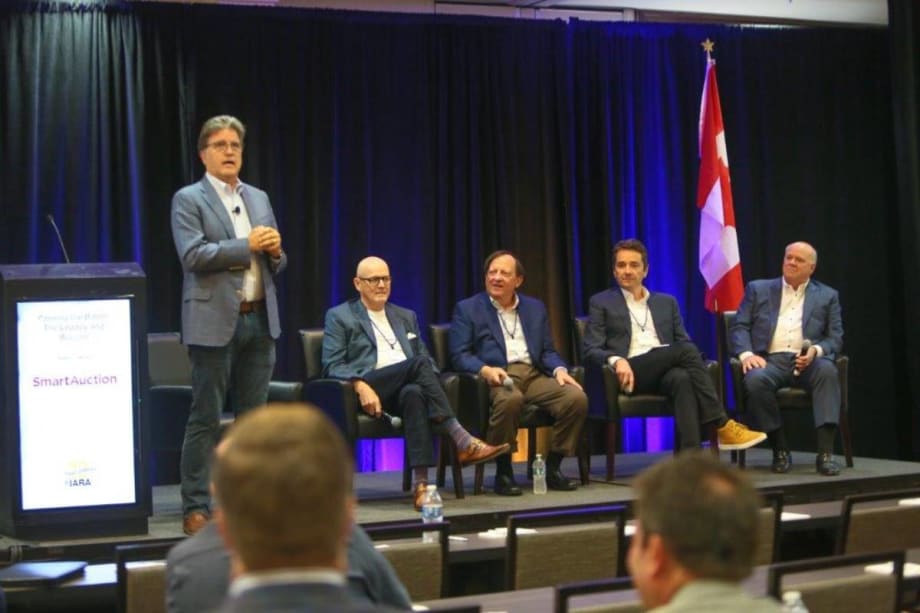
Charlie Vogelheim (L) hosted a history-making panel on Aug. 26, 2021 during the 20th anniversary IARA Summer Roundtable: Former KAR Global CEO and current Executive Chairman and Chairman of the Board Jim Hallett, former Cox Automotive CEO and current CEO of the Cox Family Office Sandy Schwartz, new KAR Global CEO Peter Kelly, and new Cox Automotive CEO Steve Rowley made a rare joint appearance to discuss the recent leadership transitions at the two legacy vehicle auction conglomerates.
Photo: IARA
5 min to read
The story of the International Automotive Remarketers Alliance could be told from many angles by different characters, but Charlie Vogelheim clearly would be the narrator.
The former editor of Kelley Blue Book and J.D. Power executive was among a group of industry professionals lunching together at a restaurant in Orange County, California, in 1998 to discuss all matters remarketing. Although Vogelheim was not an IARA founder, the confabs he hosted with Chuck Parker of Bobit Business Media helped coalesce a group that launched the IARA in 2001.
“The origin was one of open communication and sharing ideas,” he said. “It’s hard to replicate that if you’re not doing it in person.”
A Broad, Engaging Voice
The lunches encouraged the participants to pursue a trade group that could contribute to the automotive remarketing industry from the consignors’ point of view and complement the presence of the National Auto Auction Association (NAAA). One distinction of the IARA is that it wasn’t affiliated with major sponsors, companies, or other groups, enabling it to evolve with an independent and general approach to the remarketing sector.
“I remember being a little frustrated when the IARA started its annual Summer Roundtable, because at that time I didn’t need another event to attend,” Vogelheim recalled. “But my frustration turned into an appreciation that it was very worthwhile because of the variety of its attendees. It’s now well attended by representatives from groups associated with all aspects of remarketing. It always worked well with the Conference of Automotive Remarketing, where the IARA held its meetings.”
Such events have led to broad, ongoing conversations about many changing aspects of automotive remarketing through the years, Vogelheim said, such as auction lanes, consignment, digital (online) sales, and electric vehicles. “I think it’s remarkable how the IARA has carried this tradition forward through 20 years.”
By generating dialogue and communication between different parties, the IARA and its annual Summer Roundtable conferences have been able to tackle many pressing issues, such as the ongoing OEM chip shortages, shifting vehicle values, and technological changes in drivetrains and electrification, Vogelheim said.
A History of Balancing Acts
In looking at the history of the IARA, the alliance has advanced from giving a voice to consignors that didn’t seem obvious at first, to a broader, established organization reaching multiple segments of automotive remarketing, Vogelheim said. “Many early members were companies that had valuable partnerships and valuable customers in the remarketing industry. As things changed, we saw more national footprints from regional areas.”
That spurred the IARA to develop commonly practiced standards. “Whether it has to do with CRs or arbitration, these are issues that affect all remarketers. Having a shared voice has benefited the development of standards.”
Tying into many of these topics has been the IARA’s emphasis on remarketing education, especially its Certified Automotive Remarketer (CAR) program, which Vogelheim calls “admirable” for its duration and relevance. “CAR gives members the opportunity to be involved in the wider industry that may not be part of their day-to-day work.”
Another key success of the IARA has been its ability to handle consolidation in the industry by balancing the influence of different types of businesses and partnerships, said Vogelheim, referring to one of the original motives in founding the IARA. Many auction operations benefit from having many outlets and locations.
“As auctions consolidated, they started to use more structured processes,” he recalled. “The consignors felt decisions were being made internally without their voice and wanted to assert their concerns over different methods and how they were handled on a national scale. By balancing corporate and independent auctions, the IARA acted as a mediator of difficult conversations.”
Pivots, Opportunities & Challenges
Looking ahead, Vogelheim sees more potential in digital tools and communications that can be used to efficiently remarket vehicles. Technology has been growing steadily as more entities accept and adapt to it. The pandemic accelerated the push toward digital online marketplaces, providing data and results to help auctions assess their business.
“This provides an opportunity for all aspects of remarketing to evaluate how business has been done,” he said. “They can review efficiencies and measures of success while seeing how it affects revenues and profits.”
Vogelheim predicts faster, digital interactions will provide more accuracy and information about all aspects of vehicle sales, leading to a better understanding of arbitrage and vehicle values in different regions and during different seasons. “It’s adding a level of sophistication to the entire vehicle remarketing process and pricing.”
One challenge ahead for the IARA is attracting future participation and support of remarketing executives, Vogelheim said.
“President Paul Seger (2019-2021), board directors, committees, and staff get credit for putting together panels we can learn from. He represents a company and a fleet with a lot of vehicles. I see a lot of quality people at the IARA, but I also see the number of companies dwindling because of consolidation and that don’t always support the remarketing executive. I see a similar issue in fleet industries. The fleet executive is not always a respected position. I think the IARA is doing a good job of having key people involved.”
The IARA also could bolster its ranks from younger generations in the industry that are driving many of the changes, Vogelheim said. As customers and decision makers, they are 100% digital-oriented when they enter the workforce and industry.
“It’s a testament to the core values of the IARA and those who have supported them that they have sustained those values for 20 years,” he said, citing a constant focus on quality education. “The IARA needs to be a continued voice offering relevant information.” ■
Note: This article appeared in the IARA 20th Anniversary Commemorative Issue published in November 2021.
Topics:Fleet ConsignorsInternational Automotive Remarketers AllianceConsignors20th AnniversaryFleet RemarketingSmall Fleet
Originally posted on Vehicle Remarketing
Subscribe to Our Newsletter
More Small Fleet


Developing Budget-Friendly Driver Safety Programs
From driver training and safety meetings to one-on-one coaching and incentive programs, several small fleets share how they have developed a safety culture with their drivers using low- to no-cost resources.
Read More →
Sponsored•March 9, 2026
Boosting Last-Mile Fleet Uptime, Safety, and Value with AI Vehicle Inspections
AI-powered inspections are transforming last-mile fleets by replacing manual checks with highly accurate automated scans that detect defects in seconds. By giving fleet operations visibility into the daily condition of their vehicles, you can identify trends over the vehicle’s lifecycle that enable improved procurement decisions, route management, driver training and accountability.
Read More →
Five Ways Seat Belts Help Prevent Injuries
There are five ways seat belts protect occupants from injuries, according to the Tennessee Department of Safety and Homeland Security.
Read More →
Sponsored•January 14, 2026
It’s here: The 2026 Fleet Technology Trends Report
What does AI mean for fleets? Get the answer — and learn other top tech trends.
Read More →
Small Fleets, Big Impact: How Independent Drivers Power Wreaths Across America
Check out how small fleets and independent drivers power Wreaths Across America each December and why their impact matters more than ever.
Read More →
VMS Survey Finds 65% of Small Fleet Managers Run Operations Alone
A new VMS survey shows small fleet managers are stretched thin, with most handling operations solo and eager to adopt digital tools for relief.
Read More →
Tips for Driving Safely on Halloween Night
This video features a reminder from the Connecticut Department of Transportation (DOT) and the Connecticut Police Chiefs Association, urging drivers to prioritize safety this Halloween.
Read More →
AI, Access, and Uptime: VMS’s Next Chapter with David Prusinski
VMS’s new Co-CEO, David Prusinski, shares how an AI-first approach will give small fleets and repair shops the tools to compete like big players.
Read More →
Fleet Managers Share Winter Prep Tips: It's Never Too Early!
Three fleets share best practices to prep vehicles for winter and prevent downtime when the cold sets in.
Read More →