





Explore More:Safety Pointers Before You Get Behind the Wheel
12 Truths About a No-Accident Fleet Safety Culture
Daily safe practices are a core business proposition for any fleet operation and should permeate the entire organization.
December 7, 2023
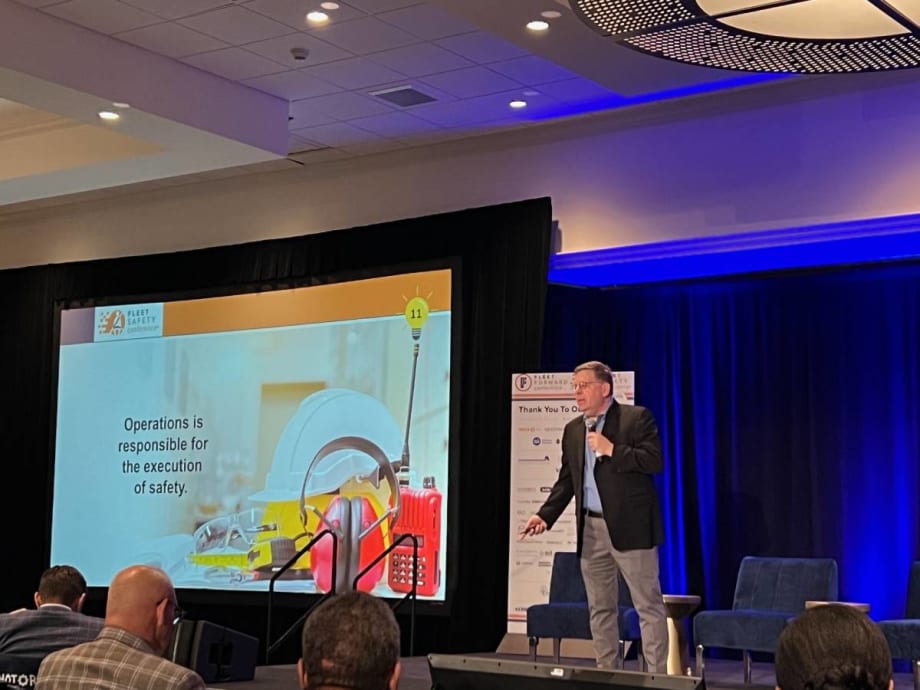
Brian Fielkow, executive vice president of Risk Resources, told an audience Nov. 8 that fleet managers can’t keep doing the same thing on fleet safety time and again and expecting different results.
Photo: Martin Romjue / Bobit
5 min to read
Fleet managers should be ready to answer four key questions when sizing up their safety practices and overall approach: How strong is your safety culture? Is your team living and breathing safety? Are we really living our values? Are we truly providing safety leadership?
The correct answers to those questions can be derived from 12 core principles that Brian Fielkow, executive vice president of Risk Resources, outlined on Nov. 8 during a keynote presentation at the Fleet Safety Conference held in Santa Clara, California.
“Customers don’t want to do business with rogue operators,” Fielkow said. “Safety is a hard-core business proposition. You must think differently about safety; we can’t keep doing the same thing time and again and expecting different results.”
12 Safety Culture Tips
While priorities shift and checklists change, and sometimes compete for each other, safety should stand solid no matter how an organization evolves, Fielkow said before listing the 12 ways fleet managers can develop and instill a strong and consistent fleet safety culture:
NO. 1:Safety at core.
Nothing can compete with a set of immutable, non-negotiable values that should include fleet safety. Productivity and production pressure can never trump safety.
NO. 2: What fleets call an accident is not an accident.
Very few things are accidents. Accidents happen by chance and cannot be prevented. Instead, they should be called crashes or incidents because they are “behavior based and preventable,” he said. “Get accident out of your vocabulary. Call it a crash or an incident.”
NO. 3: 99% is not good enough.
If you are an actuary, you look at crashes and probability. Zero is a mindset. You may not get there but you need to not accept preventable crashes.
NO. 4: If you think safety is expensive, consider the cost of the opposite.
Crashes and incidents can result in deaths, in addition to higher insurance costs and expenses, legal problems, bad morale, loss of customers, retraining and rehiring employees, and a competitive disadvantage. A consistent safety program is priceless compared to the loss of life and permanent disability.
NO. 5: Safety extends beyond compliance.
Just because you’re compliant, does not mean you are safe. If a driver is sick or fatigued, don’t drive. That concept is not found in any regulation, but it’s behavior that a fleet safety program can discourage or prohibit.
NO. 6: Safety is leader driven and will not bubble up organically.
Safety is core to operational excellence.
NO. 7: Safety is employee owned if it’s leader driven.
The most important group is front line opinion leaders, or champions. If you bring in the front-line drivers and employees, an operation can change for the better. Quoting McKinsey & Company, Fielkow said, “A blind spot seems to be the failure to involve frontline employees and their managers in the effort.”
“Let’s get out of the habit of saying good-bye. I’m lukewarm to exit interviews. Figure out how to say hello. Building bridges instead of breaking bridges.”
By building bridges to new employees, a fleet operation can build a stronger safety culture. “Orientations are like fire hoses. People can’t retain that much in a week. Compare that to integration. It takes six months to a year to properly integrate an employee into your environment. What happens on day 45, day 60? It takes that long to decide whether you want them to be there, or they want to be there.”
NO. 8: Move from a blame culture to a just culture.
“When things go wrong, and incidents and mistakes happen, this idea of progressive discipline leads to mistakes. You are human; humans make mistakes: Was it an honest mistake or reckless behavior?”
NO. 9: Cultivate unconditional respect for process.
“We’re drowning in a sea of papers and PDFs. What holds everything together? Professionals follow procedures. They do the right thing when no one is looking. At the core of incidents is a lack of respect for processes. We need better processes, not more.”
If a process is written at a high school or collegiate level, then it’s not readable to most employees. A checklist provides consistency, whether it’s for the “first flight or the 5,000th flight,” Fielkow said, invoking an aviation comparison.
Categorize life critical violations, such as: If an act is likely to kill or maim an employee; using a handheld cell phone while driving; working while drunk or stoned; failing to report accidents; near misses; vehicle damage; reckless driving; pulling unauthorized equipment; improperly securing a load. “Isolate behaviors that are acute in your operation,” he said.
NO. 10: Dismiss severity.
If you run a safe operation, you cannot get caught up on severity. Whether an outcome is severe or not is a function of luck. Focus on behavior and retrain after a so-called minor incident. A fleet operation cannot measure safety success by a lack of crashes.
NO. 11: Tear down the silos.
“If we run large organizations, operations is responsible for safety,” Fielkow said. “You can’t delegate to a department. Safety is not a department, it’s a way of life. Who’s responsible for safety in this organization?”
NO. 12: Overcome the fear of change.
“The ability to drive change is a matter of trust; the more they trust you, the more they will change,” he said. “The champion is no good unless there is clear leadership support. Put people first. The more you capture the power of front-liners to drive change, the more you’ll get it. A top-down memo on Monday won’t work. Employees won’t support it unless they are included. Bring them in.”
Originally posted on Automotive Fleet
Subscribe to Our Newsletter
More Small Fleet


Developing Budget-Friendly Driver Safety Programs
From driver training and safety meetings to one-on-one coaching and incentive programs, several small fleets share how they have developed a safety culture with their drivers using low- to no-cost resources.
Read More →
Sponsored•March 9, 2026
Boosting Last-Mile Fleet Uptime, Safety, and Value with AI Vehicle Inspections
AI-powered inspections are transforming last-mile fleets by replacing manual checks with highly accurate automated scans that detect defects in seconds. By giving fleet operations visibility into the daily condition of their vehicles, you can identify trends over the vehicle’s lifecycle that enable improved procurement decisions, route management, driver training and accountability.
Read More →
Five Ways Seat Belts Help Prevent Injuries
There are five ways seat belts protect occupants from injuries, according to the Tennessee Department of Safety and Homeland Security.
Read More →
Sponsored•January 14, 2026
It’s here: The 2026 Fleet Technology Trends Report
What does AI mean for fleets? Get the answer — and learn other top tech trends.
Read More →
Small Fleets, Big Impact: How Independent Drivers Power Wreaths Across America
Check out how small fleets and independent drivers power Wreaths Across America each December and why their impact matters more than ever.
Read More →
VMS Survey Finds 65% of Small Fleet Managers Run Operations Alone
A new VMS survey shows small fleet managers are stretched thin, with most handling operations solo and eager to adopt digital tools for relief.
Read More →
Tips for Driving Safely on Halloween Night
This video features a reminder from the Connecticut Department of Transportation (DOT) and the Connecticut Police Chiefs Association, urging drivers to prioritize safety this Halloween.
Read More →
AI, Access, and Uptime: VMS’s Next Chapter with David Prusinski
VMS’s new Co-CEO, David Prusinski, shares how an AI-first approach will give small fleets and repair shops the tools to compete like big players.
Read More →
Fleet Managers Share Winter Prep Tips: It's Never Too Early!
Three fleets share best practices to prep vehicles for winter and prevent downtime when the cold sets in.
Read More →