




Under Pressure: 5 Tips to Keep Tire Pressure Optimal
One thing is consistent when it comes to truck tire maintenance: tire inflation has been, and always will be, a top concern for fleets. What can you do to keep your tire pressure optimal for your needs?
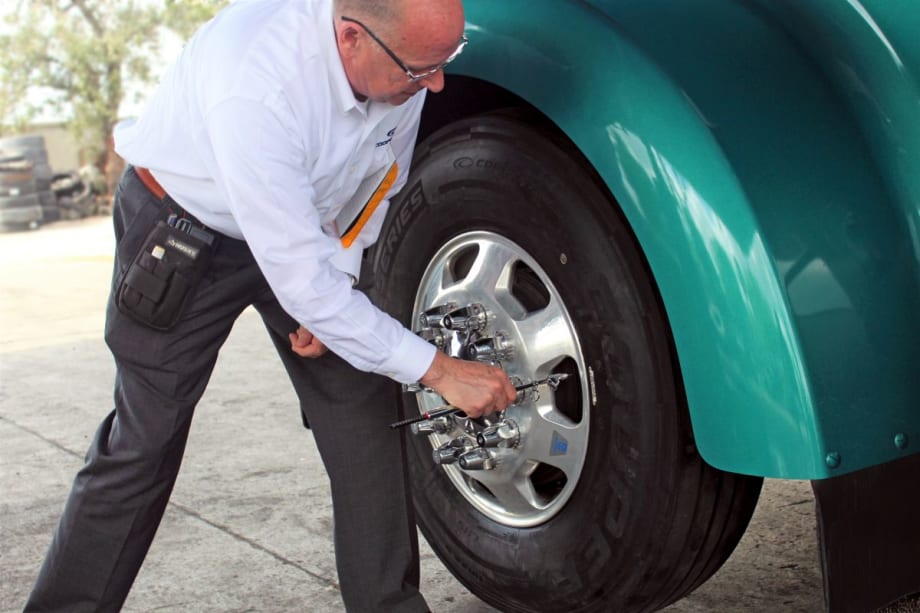
The way to extend your budget on tires is to get the most miles, coupled with the most retreads.
Photo: Cooper Tire
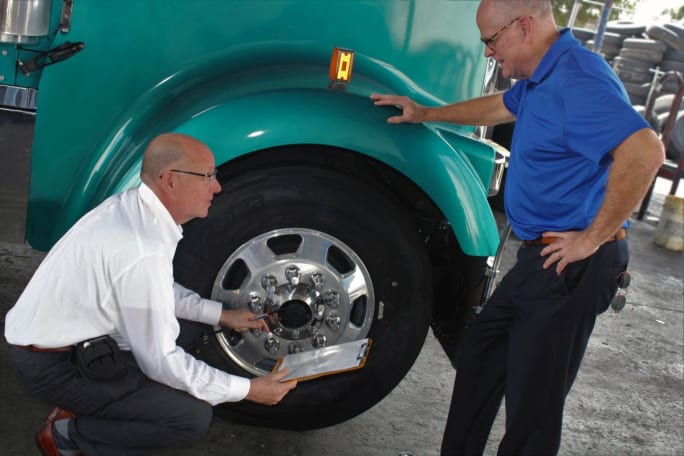
How drivers take care of their tires can be easily tracked when the truck returns to the terminal.
Photo: Cooper Tire
One thing is consistent when it comes to truck tire maintenance: tire inflation has been, and always will be, a top concern for fleets.
It’s been talked about for as long as I’ve been around commercial tires, and that’s close to 40 years. But, keeping consistent inflation levels seems to be a moving target.
When I’ve done yard checks with large fleets, I’ve seen the good and the bad. And, likewise, with drivers. They have a huge impact since they’re supposed to check tires daily – with a gauge, not a thumper.
The best fleets have tire inflation well under control, with drivers that are onboard with the need for accurate pressure checks - maximizing tire life and keeping tire costs under control.
Since quality tires that are properly maintained can help keep your operating costs under control, inflation maintenance is a tremendous opportunity to reduce costs.
Here’s what you can do to ensure a top-tier tire inflation program:
1. Use Calibrated Gauges
Every shop has gauges, and many drivers do as well. But the question is, are they accurate? Gauges get dropped, and even if they don’t look like it, they’re sensitive pieces of equipment. I’ve tested shop gauges against a master gauge in the past and have found psi readings can be off by 2 to 15 psi.
If you’re not testing each gauge and recalibrating them monthly against a master, there is a good chance you’re inflating tires to the wrong level. You should have a psi test station set up, along with a master gauge in a highly visible area of the shop. Your techs and drivers need to use it.
Some fleets have drivers swap out their gauges for a calibrated gauge once a month. You can’t have a good tire program if you can’t trust your gauges.
2. Start with the Chart
Cooper Tire, like most major manufacturers, provides load-inflation tables based upon Tire and Rim Association guidelines.
With a typical 6x4 legal load, there will be 34,000 pounds being carried by eight drive tires, or 4,250 pounds per tire. Using the table, you’ll see that the drive tires can support that load at as little as 75 psi fully loaded. This is even more important if you’re operating complex multi-axle equipment since the load per tire tends to go down.
Even in the most challenging applications, axle weight limits max out at 20,000 pounds per axle or 5,000 pounds per tire for drive and trailer. A 295/75R22.5 can carry that load at 95 psi. An 11R24.5 size tire can carry that load with as little as 75 psi. Yet, many fleets run a standard inflation pressure at 100 psi because they tell us, "That’s what we’ve always done. It’s easy for our drivers to remember, and it gives us more margin for error if a tire leaks."
So what’s the optimal pressure? Like so many things in life, the answer depends on several factors.
Every tire has a personality. Likewise, every fleet has a personality.
The most cost-effective tire programs come from matching the right tire to the proper application at the correct inflation pressure. It takes a little time and some discipline, but the effort will pay off.
We need to think differently about air pressure. The reality is, the tire doesn’t support the load, the air does. The tire only contains the air. Through inflation pressure, you’re primarily trying to manage two things, the shape of the tire footprint and the amount of sidewall deflection.
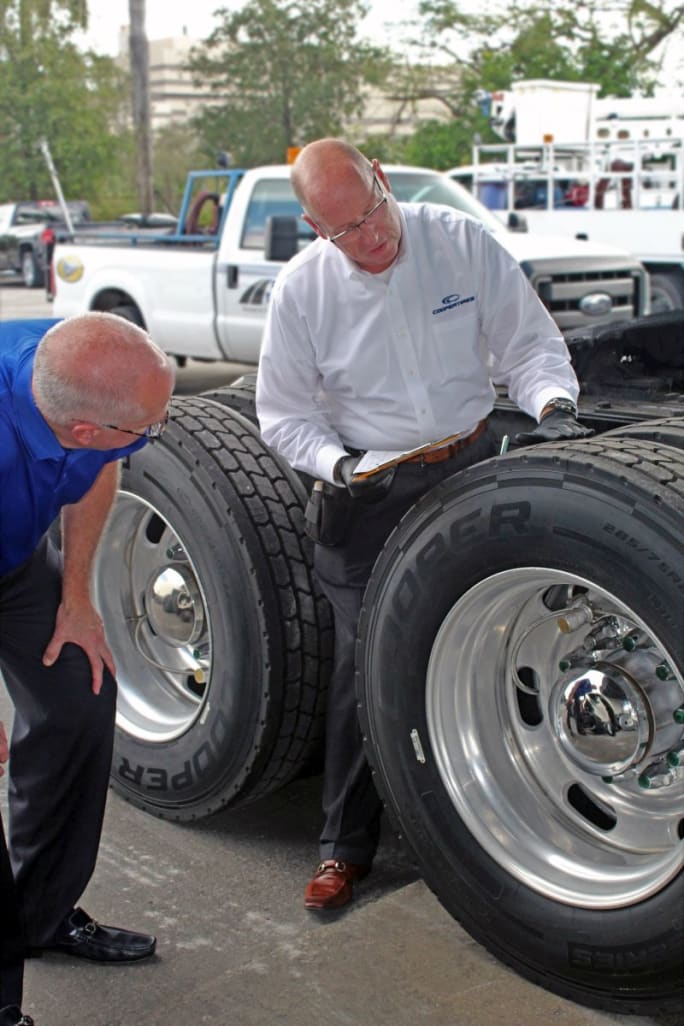
The most cost-effective tire programs come from matching the right tire to the proper application at the correct inflation pressure.
Photo: Cooper Tire
Overinflation can pose several problems. The biggest is premature removal and ride disturbance due to irregular wear since you’re not getting the optimal footprint patch to the road. With the weight concentrated on a relatively small contact patch in the crown of the tire, the shoulders will scrub their way into and then out of the contact patch, causing rapid and uneven edge wear. You’re also likely to see significant heel-toe wear.
Perhaps the most common and costly effect of overinflation in a work truck application is, "road rash" or the chipping of tread rubber in the center ribs. In severe cases, steel belts may become exposed. Exposed steel belts increase the likelihood of having the casing rejected for retreading or, worse yet, taken out of service by the highway patrol. At the very least, the resulting ride disturbance and general ugliness often result in early removal despite having as much as 30 to 40% useable tread remaining.
These problems are especially prevalent in mixed service applications running open shoulder drive tires. Next, with such a small contact patch, you’re compromising traction, and that comes into play, not only in winter but in muddy off-highway operation. You may also see an increase in the occurrence of impact breaks since the tire sidewalls have less flex.
Finally, you’re impacting fuel economy.
I always tell fleets that they need to break the cycle and run tires at their proper inflation level. Only then can you get the true performance engineered into the tire, and that will pay you back in the form of a lower cost of ownership.
What’s the impact if you don’t follow the chart? It’s big. While operations vary significantly, running tires that are just 10% underinflated may cause you to remove them from service 10% early. At 20% underinflated, tread life may be reduced by as much as 25%.
3. Audit Inflation Levels
Yard checks are a pain, but they’re a necessary evil. If you’re serious about getting your tire costs in check, you need to benchmark where you’re at with tire inflation and identify problem areas. Only then can you take steps to improve your program.
For example, what percent of your duals – both on your tractor and trailer – have inflation pressures within 5 psi of each other?
Did you know that just a 5 psi difference in inflation between duals is the equivalent of one tire having a circumference that is 5/16-inches smaller? That means during every rotation cycle, the smaller circumference tire must scuff ahead to keep up with the tire with more inflation.
These tires rotate around 500 times per mile, so simple math means 500 multiplied by 5/16-inches translates to 156.3-inches per mile, or 13 feet per mile.
Imagine dragging a tire 13 feet every mile, under load. How many feet is that per day or per year? That illustrates clearly why you will see increased tire wear with improper pressure.
4. Tire-Related Concerns Beyond Air Pressure
Another area to watch is with retreads. It’s back to circumference. In some cases, fleets will get identical retreads back from their retreader, but the casings may be different.
Each brand and model may have a slightly different diameter so, while two tires will look identical when you get them back from the retreader, one may be significantly taller than the other. This is why we recommend using a circumference band, good measuring tape, or have a height gauge mounted in the shop to check circumference. Otherwise, you may be putting together duals that should be identical but are mismatched in height, and that will cause one tire to wear prematurely.
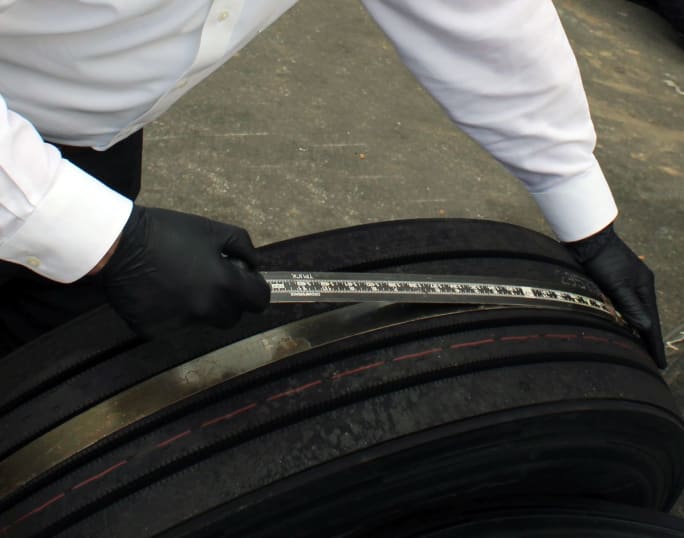
While operations vary significantly, running tires that are just 10% underinflated may cause you to remove them from service 10% early.
Photo: Cooper Tire
5. Incentivize Drivers
With today’s advanced trucks, it’s possible to gauge how well a driver works the truck – hard braking, quick starts, and fuel economy can all be tracked and trends seen. And, many fleets provide bonuses for drivers who practice less aggressive driving and take an active role in proper tire inspection and maintenance.
We’ve seen progressive fleets offer bonuses for tire wear and proper tire inflation. And why not? If the driver keeps tire inflation at the proper level, and does fingertip diagnostics on each tire during pre-trip inspections, tires will have longer lives.
How drivers take care of their tires can be easily tracked when the truck returns to the terminal.
If these tips are followed, and you’re running the correct tires for your application, you stand a solid chance of pulling the drive tires at 2/32nds, and the steers at 4/32nds. And your casings should be in great shape for retreading. The way to extend your budget on tires is to get the most miles, coupled with the most retreads.
Proper tire selection is one key to doing that, but it’s the maintenance practices – especially proper tire inflation -- that keeps your tractors and trailers operating as efficiently and safely as possible.
About the Author: Jason Miller is Cooper Tire's National Fleet Channel Sales Manager. He has worked in all aspects of the tire industry, mastering complex tire programs for some of the largest fleets in North America. A member of the Technology and Maintenance Council (TMC) of the American Tucking Associations, Jason is also a TIA Certified Tire Instructor and former ASE certified technician.
More Maintenance
Les Schwab Expands Commercial Tire Footprint Into Arizona
Les Schwab Tires has expanded into Arizona with two commercial tire locations in Phoenix and Tucson, strengthening its fleet service footprint in the Southwest.
Read More →
Volvo Trucks’ 'Lock and Leave' Software Updates Go Live Across North America
Unattended over-the-air software updates are now available in Volvo trucks across the U.S. and Canada. The new capability lets trucks stay current with the latest software without interrupting operations or requiring a dealership visit.
Read More →
Why Technician Appreciation Can’t Be a Once-a-Year Thought
For fleets trying to keep skilled technicians, recognition cannot begin and end with Technician Appreciation Week. Learn what year-round appreciation really looks like and why the everyday technician experience matters just as much as pay when fleets are trying to keep good people.
Read More →
How Faster Driver Reporting Can Keep Small Truck Problems Small
When minor damage, warning lights, or equipment issues are reported late, small problems can quickly become bigger maintenance headaches. Conversational AI can help shorten the path from what a driver notices in the field to the person who can act on it.
Read More →
BendPak’s Ranger Wheel Service Equipment Achieves North American Safety Certification
BendPak’s full line of Ranger tire changers and wheel balancers has been ETL certified to UL and CSA standards to improve operator safety.
Read More →
Isuzu & U.S. Department of Labor Celebrate Milestone for Veterans Apprenticeship Program
The Isuzu Veterans Apprenticeship Program (IVAP) signing ceremony highlighted Isuzu’s long-term commitment to veterans, Isuzu dealers, and the skilled workforce supporting its customers and the commercial transportation industry.
Read More →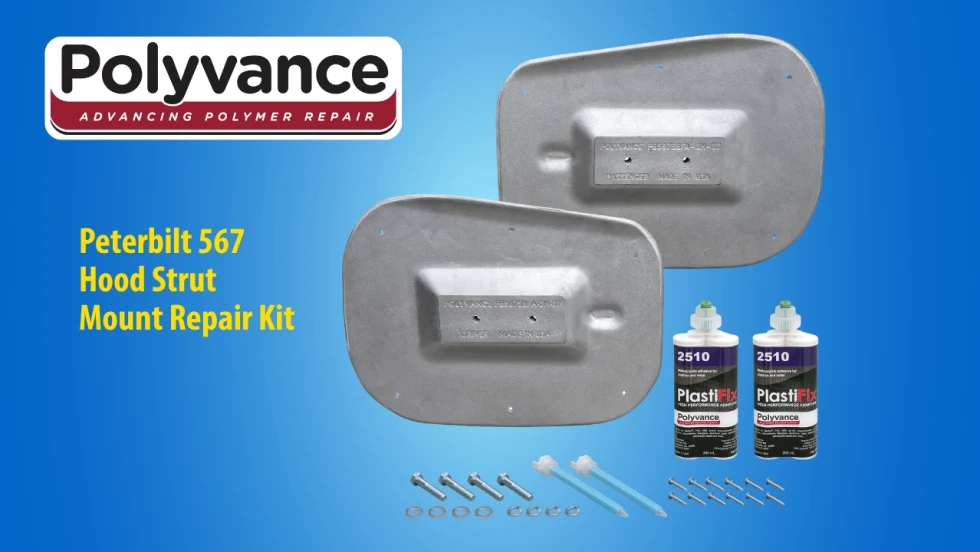
Polyvance Introduces New Peterbilt 567 Hood Strut Mount Repair Kit
Polyvance has launched a repair solution for Peterbilt 567 hood struts, helping truck owners and repair facilities avoid costly hood replacements.
Read More →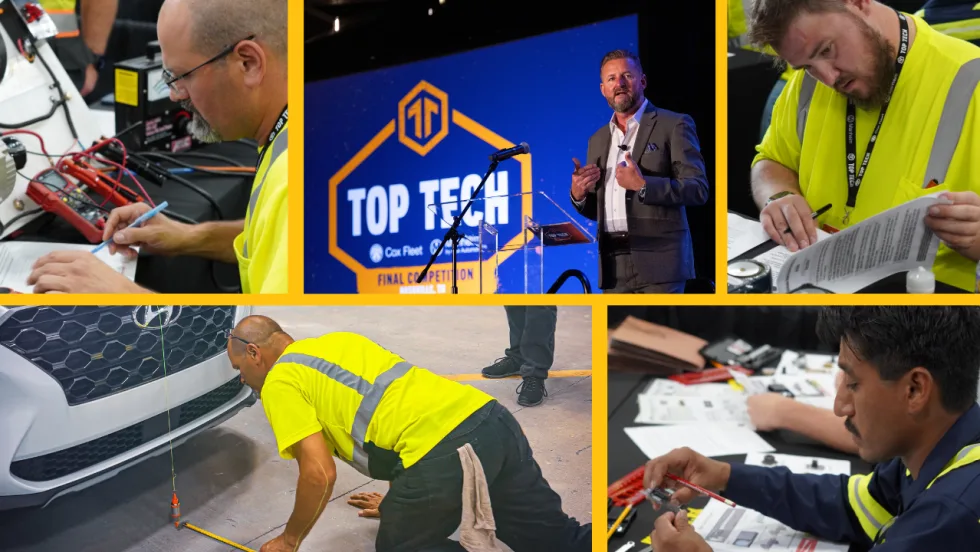
Cox Automotive Celebrates Technical Excellence at 2026 Top Tech Finals
The top technicians from Cox Fleet and Manheim tested their skills in Nashville, Tennessee, at Cox Automotive’s 2026 Top Tech Finals. The overall winners will advance to compete at the American Trucking Association’s TMC SuperTech competition.
Read More →
Grote Industries Appoints Vice President of North American Operations
Grote Industries has appointed Patrick Smith as vice president of North American operations as it celebrates 125 years of innovation and manufacturing excellence. He has more than 20 years of manufacturing leadership experience.
Read More →
Winter Fleet Prep: Expert Tips to Keep Vehicles Running Smoothly
Cold weather can expose weak batteries, tires, fuel systems, and maintenance gaps fast. Use this winter fleet checklist to prepare trucks and drivers before temperatures drop.
Read More →