Drones are popping up everywhere, including in package delivery fleets. Workhorse Group is currently in the testing phase with its drones for use with the company’s electric delivery trucks.
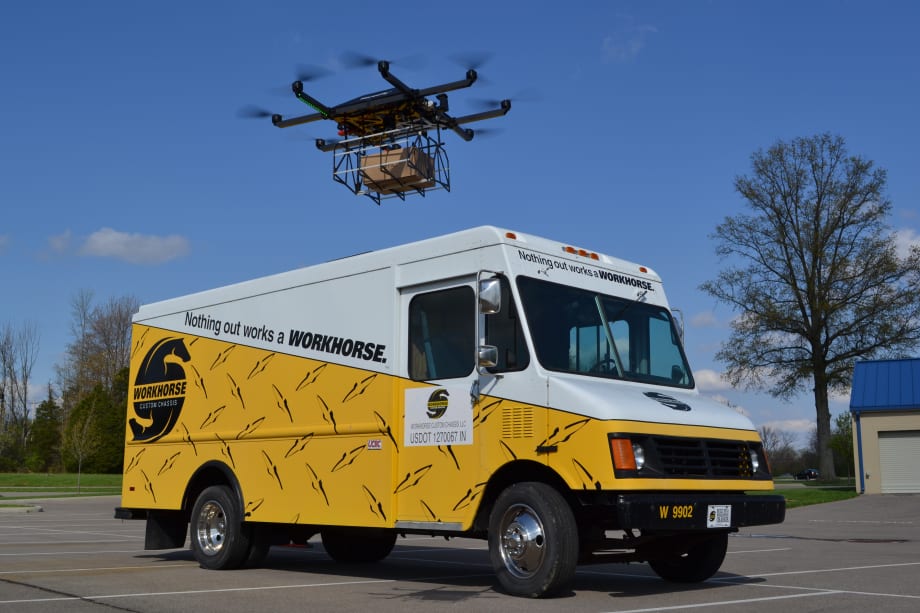
Once approved by the FAA, Workhorse will release a version of the E-GEN hybrid-electric truck that has been specifically designed to incorporate HorseFly. (PHOTO: WORKHORSE)
3 min to read
Once approved by the FAA, Workhorse will release a version of the E-GEN hybrid-electric truck that has been specifically designed to incorporate HorseFly. (PHOTO: WORKHORSE)
Delivery fleets are on the verge of a shift in how some packages are going to be delivered. The future of package delivery is going electric and incorporating drones.
Ad Loading...
Steve Burns, CEO of Workhorse Group, is on a mission to be the first to get an electric truck with a drone to deliver packages on the road, while meeting the “line of sight” requirement set by the Federal Aviation Administration (FAA).
Ad Loading...
Currently, the drones are still in the testing phase, but Workhorse’s electric vehicles are on the road. Also, drivers can rest assured, according to Burns, “Our drone is designed not to replace a driver but rather make a driver more productive.”
Going Electric
Workhorse’s hybrid-electric delivery trucks (Workhorse E-GEN) are currently deployed by UPS. Once approved by the FAA, Workhorse will release a version of the E-GEN truck specifically designed to incorporate the HorseFly delivery drone.
The E-GEN Drive uses a combination of battery power and a small internal combustion engine to more than four times the miles per gallon attained by a typical fleet vehicle. In addition to dramatically increasing the fuel economy, the E-GEN trucks are designed to virtually eliminate the heavy maintenance usually associated with heavy, stop-and-go vehicles.
The E-GEN drivetrain is propelled by a 200 kW Sumo electric motor/generator with a 60 kWh pack built with Panasonic 18650 Li-Ion cells.
According to Workhorse, it’s powerful enough to eliminate the need for a transmission and, if the battery state of charge falls below a predetermined level, and the vehicle is in PARK, a small internal combustion engine (ICE) automatically turns on and powers a generator to recharge the battery to its required level, thereby eliminating range anxiety.
Ad Loading...
Steve Burns, CEO of Workhorse Group, is on a mission to be the first to get an electric truck with a drone to deliver packages on the road, while meeting the “line of sight” requirement set by the FAA.
Flying Delivery
Workhorse’s drone — an “octocopter” called HorseFly — has a 10-pound payload capacity. Given a package and a delivery destination, it lifts off from the vehicle roof, navigates to an address using GPS and is guided down safely by a human pilot in a remote location; it then returns to the truck roof for recharging.
In December 2015, the FAA granted Workhorse Exemption No. 13564 (Regulatory Docket No. FAA-2015-3055) following the company’s petition requesting Section 333 exemption to test its HorseFly unmanned aerial system (UAS), stating, in part “in consideration of the size, weight, speed, and limited operating area associated with the aircraft and its operation, the Secretary of Transportation has determined that this aircraft meets the conditions of Section 333.... [T]he UAS operation enabled by this exemption is in the public interest.”
Two of the main hurdles in delivering packages via drone are technology and regulation.
“After several years of effort and great help from the University of Cincinnati Aerospace, we feel we have solved the technological hurdles. But, all commercial use of drones is prohibited by the FAA in the United States,” Burns said.
Ad Loading...
Currently, Workhorse is testing HorseFly in U.S. airspace while the company collects data.
“This exemption has been invaluable to us as we continue to refine our system under real-life delivery of packages to homes and businesses,” Burns continued.
Benefits of drone delivery include a reduction in delivery expense.
“Drone delivery can be up to 50 times less expensive compared to conventional methods of delivery, such as a person in a large diesel truck delivering the same package. A drone also has the benefits of zero emissions and virtually zero maintenance,” Burns said.
When might delivery by drone become a reality?
Ad Loading...
“We are hoping the FAA will come out with the definitive set of rules/laws toward the end of this year. But, as with any government agency, timing is difficult to predict,” Burns said. “I think delivery drones are as significant an invention toward the delivery of goods as the invention of the internal combustion engine more than 100 years ago.”
The HorseFly Drone
Workhorse Group is developing HorseFly, an eight-rotor “octocopter,” designed to be used in tandem with its EPA-approved electric truck.
HorseFly is given a package and a delivery destination by a delivery driver, using a touchscreen interface in the delivery truck. It launches itself from the delivery vehicle and ascends to a safe cruising altitude, then navigates to the desired delivery point autonomously using GPS navigation.
When HorseFly reaches the GPS delivery destination, a human pilot in a remote location monitors the descent with a multi-camera video feed and executes the package drop-off. HorseFly then ascends back to a safe cruising altitude. It then navigates to the new location of the delivery truck, and uses infrared (IR) tracking to land and dock with the truck.
HorseFly then recharges its battery using the onboard battery of the electric vehicle.
Stellar Industries has acquired Midwest Fire, a custom fire apparatus manufacturer headquartered in Luverne, Minnesota, with nearly four decades of specialized apparatus experience.
If you have Altec, Chrysler, Ford, Heil, General Motors, International, Mack Trucks, Paccar, Rivian, Royal Truck, Toyota, US Truck Body, or Volvo Trucks vehicles in your fleet, you should check these important recalls issued by the National Highway Safety Administration.
As part of the “130 Years of Trucks” anniversary year, Mercedes-Benz Trucks is participating in the Deutschlandfahrt 2026 with selected historic vehicles, including the original Daimler Motor Truck from 1899.
The 2027 ProMaster City arrives in the first quarter of 2027 with a starting price, including destination charges, under $40,000, which Ram Professional said is the lowest MSRP in the commercial van segment.
CAS Automotive has launched Damaged Equipment, an on-demand remarketing service created to help businesses, insurers, dealers, and fleet operators sell damaged, surplus, aging, and end-of-life commercial equipment.
Two Mack Pioneer models will haul steel arena infrastructure across PBR Teams League and premier Unleash The Beast seasons. This marks Mack Trucks’ first partnership with a Western sport.
During a special vocational truck event last week, Kenworth featured the T880e, the T880S, and the C580. Here is an overview, but follow the link inside the article to get full coverage.
Range Zero Emissions’ new partnership with Hyundai Translead will provide sales, service, and aftermarket support for the XCIENT Fuel Cell Truck, allowing full West Coast coverage of the medium-heavy duty commercial EV market.
Hankook Tire is significantly expanding its manufacturing presence in Clarksville, Tennessee. In this video, Rob Williams, President of Hankook Tire North America, discusses how the operation has grown since opening in 2017 and what the expansion means for dealers, fleets, employees, and the local community.