Hydrogen Fuel Cell Power Arrives for Medium-Duty Trucks
Hydrogenics' new product, Celerity, a hydrogen fuel cell power system built for the medium- and heavy-duty truck and bus markets, is an all-inclusive system designed to reduce total cost of ownership.
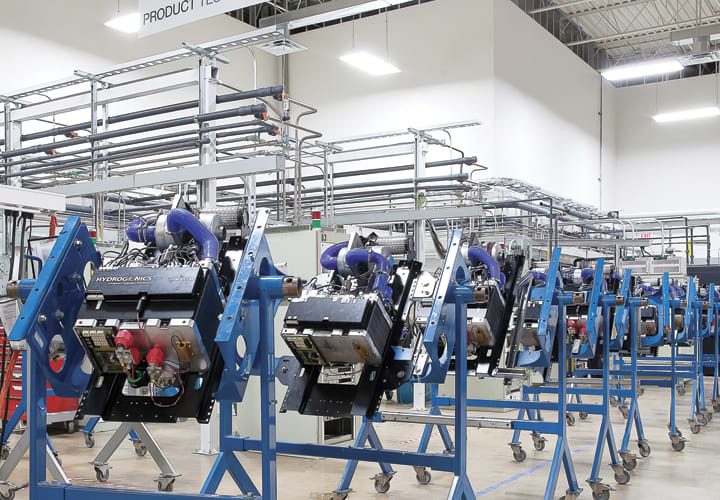
The Celerity system is built on low-pressure, non-humidified stack technology.
Photo: Hydrogenics
6 min to read
As automakers begin to launch hydrogen fuel-cell vehicles, Hydrogenics' new Celerity system promises medium- and heavy-duty truck fleets the opportunity to join the fuel-cell fray.
Ad Loading...
Built on the low-pressure, non-humidified stack technology Hydrogenics has been developing for the past 15 years and used in its other systems, Celerity is an all-inclusive hydrogen fuel-cell system designed for the medium- and heavy-duty truck and bus markets.
Ad Loading...
"It has both the right technical characteristics and the optimal technical characteristics, in terms of form factor and voltage, current, and packaging," said Rob Del Core, business development director at Hydrogenics. "Everything is in there that's needed to make fuel cell work. For example, the fuel cell stacks and the air delivery blowers are inside an IP-rated enclosure, so no external air delivery system is required. Everything else that an OEM would have to integrate is inside already."
Developing the Product
Del Core, a 14-year veteran of the fuel cell industry, closely worked on the development of Celerity from its inception.
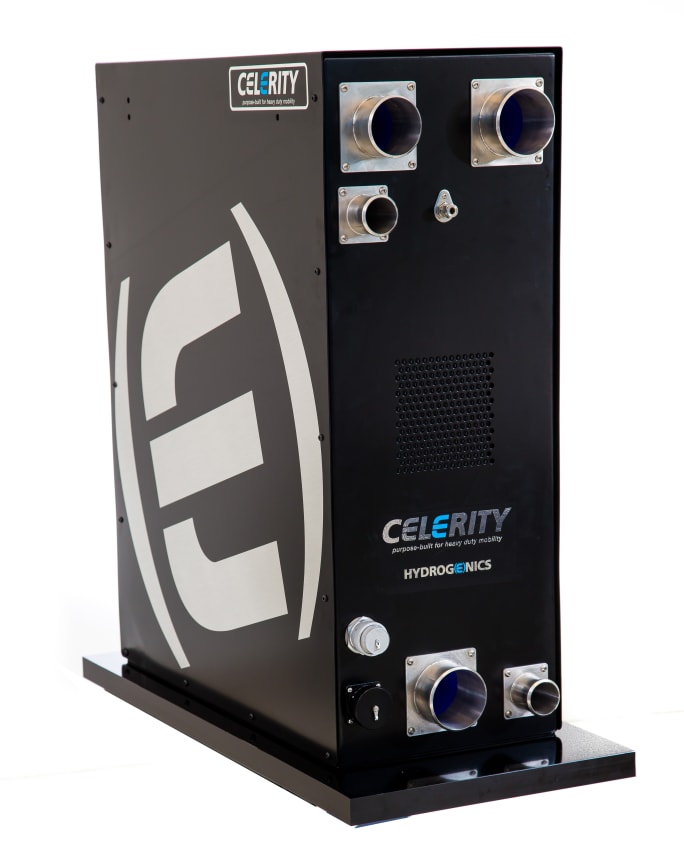
Celerity can either be placed in the engine bay or mounted behind the cab of the vehicle
Photo: Hydrogenics
The idea of Celerity began with Hydrogenics' desire to close the gap in the medium- and heavy-duty truck market in the U.S. and globally.
Del Core worked seven years at Hydrogenics before leaving to join a system integration company in San Diego, managing a technical team to develop eight fuel-cell buses for the 2012 Summer Olympics in London. He rejoined Hydrogenics with a mandate to expand the U.S. heavy-duty vehicle market, which led to the development of Celerity.
"I found that there was no dedicated power system to power medium- and heavy-duty buses and trucks," he said. "There were fuel-cell systems out there, but you really had to do a lot of work to integrate them and make them work in the application. Of course, that drives the cost of the overall fuel cell vehicle up. You have to do more to make it work and tie more pieces together."
Ad Loading...
With Hydrogenics' management supporting his vision of an all-inclusive hydrogen fuel-cell system, Del Core created a spec of the system before pushing forward with product development.
Del Core and his team developed Celerity with the intention of cutting out the non-recurring engineering required to make a fuel cell vehicle.
"By putting in a lot of the pieces and taking away the headache from the integrator and the OEM, so they can actually get their fuel-cell product to market faster without having to go through the development expense, it's all about reducing cost and accelerating the time to market, making it easier for OEMs to get fuel-cell vehicles to market quickly, and, at the same time, enable people to get to market much more quickly," Del Core said.
Making Installation Simple
According to Del Core, there are only a few steps needed to install Celerity: bolt the system into place with a thermal management, connect both the hydrogen fuel source and the high-voltage cables that take the voltage out of the fuel cell, and use an SAE J1939 CAN protocol to communicate to the system.
"An OEM or an integrator can take Celerity and mount it in the desired location on its vehicle, and do what they do best, which is designing and integrating the rest of the vehicle. All the detail about what goes on inside the fuel cell is taken care of by Hydrogenics," Del Core said.
Ad Loading...
Celerity can either be placed in the engine bay or mounted behind the cab of the vehicle, so that fleet managers can have the option of leaving room in the engine bay for storage of other equipment.
With a configuration intended to be simple to integrate, Celerity can be installed in any medium- or heavy-duty truck or bus designed for electrification.
"There's no limitation. If you're re-powering a vehicle, even if you're taking an old diesel-powered vehicle or conventional-powered vehicle and you want it to be powered with a zero emission drive, Celerity can be used for that project," Del Core said.
At a Glance
Hydrogenics' self-contained Celerity system:
Is built on the low-pressure, non-humidified stack technology Hydrogenics has been developing for the past 15 years and used in its other systems
Has a 60 kW net power output.
Is 300 volts at full power, with a maximum output of around 200 amps.
Is expected to be demonstrated beginning in 2015.
Charging Power
Celerity has a 60 kW net power output, determined by Hydrogenics as the optimal power granularity for medium- and heavy-duty trucks and buses through an extensive market study and experience of vehicles and their configurations.
"It can cover 80 percent of the needs of the market, and also offered a very good granularity for multiplying," Del Core said. "Essentially, by having 60 kilowatts, it offers more options to the OEM in terms of how they want to scale."
Ad Loading...
The system's voltage is 300 volts at full power, with a maximum output of around 200 amps. According to Del Core, if more power is needed, Celerity's design allows users to add another battery module and increase power accordingly.
Del Core added that Celerity can be used in fuel-cell hybrid vehicles either as a prime power source or as a range extender, depending on the market need it serves.
"Essentially, it would be in a hybridized system," he said. "You would have an energy storage system as part of your hybrid vehicle. The fuel cell can interact with the energy storage by maintaining charge, maintaining a certain speed level, or blending power with your drive system to service your duty cycle and your route."
Hydrogenics is also offering Celerity Plus, a bundled solution between the fuel cell and the Siemens ELFA drive system. According to Del Core, the Siemens ELFA drive is a proven hybrid drive system with significant deployment worldwide.
"Celerity Plus takes it a step further to make the overall vehicle development and integration a lot easier for the OEM," Del Core said.
Ad Loading...
Benefitting from Fuel Cells
Ultimately, according to Del Core, the Celerity system can help fleets reduce both emissions and total cost of ownership.
"For OEMs that are building their fuel cell vehicles in this case, it's all about getting to market much more quickly, reducing non-recurring engineering so they can offer their vehicles at a reduced price. Of course, that benefit gets passed on to the fleet owners. For the fleet operators, having a vehicle that has a simpler architecture, makes it easier to maintain. Not to mention that there's reduced maintenance and higher reliability," Del Core said.
Celerity, which Hydrogenics unveiled in October, is currently available for purchase. According to Del Core, fleets in areas such as transit, parcel delivery, and refuse have expressed interest in the new system.
"We got a lot of great feedback from the market, from OEMs and transit properties as well," he said. Demonstrations for the Celerity product are expected to begin in 2015.
Also working in the Celerity's favor, according to Del Core, is increased consumer interest in hydrogen vehicles in general and increasing government funding availability in deploying zero-emission heavy-duty vehicles.
Ad Loading...
"That's a real signal to the market that things are moving forward in the hydrogen space," he said.
As for the cost of Celerity, Del Core describes pricing as "competitive" and dependent on the specific order being placed.
"Pricing the installation would really depend on the OEM, because we actually would supply Celerity to the OEM, and they would integrate it into the vehicle. Hydrogenics provides competitive volume pricing to meet the goal of commercialization. Celerity is a product designed for mass production and volume sales," Del Core said.
Together, the Port Authority of New York and New Jersey and CALSTART will electrify drayage and terminal operations serving the East Coast’s busiest container port. A pair of incentive programs totaling $45 million has launched to accelerate adoption of zero-emission drayage trucks and terminal tractors.
A single Xos Hub has surpassed one gigawatt-hour of energy across more than 33,600 charging sessions in the field, demonstrating performance that supports Xos' expansion across new products and markets.
Carrier Transicold’s first engineless multi-temperature TRU helps fresh- and frozen-food fleets add supplemental cold storage capacity during seasonal peaks.
Narro Trucks officially launched its operations on Aug. 20 and hosted a ride and drive to showcase its electric truck, which will be produced in Virginia.
Samsung SDI is taking full control of its Indiana battery plant with GM, marking a major shift from the EV-focused joint venture Charged Fleet first covered in 2023.
CALSTART will provide free technical assistance services to drayage fleets serving the Ports of Seattle and Tacoma and looking to transition to cleaner technologies and help decarbonize freight hubs.
Electric work truck upfits bring new compatibility questions. Learn how parts availability, OEM guidance, power demands, and route planning can affect fleet performance.
Peterbilt Motors Company’s cooperative purchasing agreement with Sourcewell and its Canadian partner, Canoe Procurement Group, now includes including Peterbilt's battery-electric vehicle lineup.
Commercial adoption of the Kalmar Ottawa T2 EV terminal tractor continues to grow as customers add the zero-emission yard tractor to their fleets. WTC Group has placed an order for a Kalmar Ottawa T2 EV.
Learn more from PERC's Joel Stutheit, as he explains why propane autogas remains a practical alternative for fleets seeking to reduce emissions without sacrificing operational flexibility.