




Fuel Cards Can Save You Money
With comprehensive reporting, driver convenience and fuel savings of 15 percent or more, joining a fuel management program should be a no-brainer. Now the hard part –which program is best suited for your fleet?

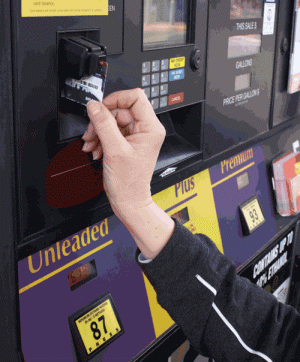
As the price of gasoline continues to rise, fleet operators are on the lookout for programs that can help control fuel costs. Fuel card plans offer timely and comprehensive reporting, security, expense monitoring and a large pool of fueling stations.
Using one comprehensive report, managers can track fuel purchase types, times and amounts. This type of detailed monitoring helps to maintain a fleet's fuel economy by curbing expenditures and reducing time spent with paperwork. Online account management services allow for easy access to data and downloadable records to the fleet's own database.
Most providers offer a wide range of capabilities and options for all fleet sizes and compositions including: security features, pricing, exception reports and account manageability. Fuel management programs allow you to eliminate paper receipts, monthly reconciliation and manual tax preparation. Also, to prevent unauthorized purchases and fuel consumption, each driver can have a unique PIN code that, in most cases, can be turned on and off.
Every transaction is tracked and reported back to the fleet manager with optional grade and gallon limits.
Survey Says
Several respondents to a survey conducted by Automotive Fleet magazine reported they were able to either reduce or realign their workforce after adopting a fuel card program, citing that the fuel reports had simplified work processes and sped up operations.
All the while, these fleet managers noted that they were now receiving checks, balances and documentation that were never before available. Many programs are either free to join or require a minimal fee upfront, and cost pennies per transaction. Those fees are recouped, and then some, with reduced paperwork and cost controls. AF's survey revealed that, on average, fleets that move from no fuel program to a managed fuel program realize savings of 15 percent on their overall fuel management costs. With today's escalating fuel prices there can be as much as 20 cents per gallon difference in price between premium and regular unleaded fuel. Thus, for a fill-up of 15 gallons, that could be $3 per tank.
For two tanks per week and 52 weeks in a year, a 50-vehicle fleet could incur an additional $15,600 to unnecessarily fuel its fleet with a higher grade of fuel.
Which Is Best For You?
Many fuel management companies will complete a full analysis of your company's assets and needs in order to design a custom program. With the growth of these fuel card programs, choosing the best fit for your fleet may seem like a daunting task.
For instance, which service can give you the ability to control purchases by type and cost direction – ultimately all done without added staff, assets or expenses? We've compared the major fleet fuel card programs to aid in your decision making process.

More Small Fleet


Developing Budget-Friendly Driver Safety Programs
From driver training and safety meetings to one-on-one coaching and incentive programs, several small fleets share how they have developed a safety culture with their drivers using low- to no-cost resources.
Read More →
Why Fleet Managers Are Replacing Departmental Vehicles with Shared Motor Pools
Departmentally assigned vehicles often create hidden costs through underutilization, poor visibility, and increased administrative burden. This white paper explores how shared motor pool strategies help fleets reduce costs, improve accountability, and optimize vehicle utilization.
Read More →
Boosting Last-Mile Fleet Uptime, Safety, and Value with AI Vehicle Inspections
AI-powered inspections are transforming last-mile fleets by replacing manual checks with highly accurate automated scans that detect defects in seconds. By giving fleet operations visibility into the daily condition of their vehicles, you can identify trends over the vehicle’s lifecycle that enable improved procurement decisions, route management, driver training and accountability.
Read More →
Five Ways Seat Belts Help Prevent Injuries
There are five ways seat belts protect occupants from injuries, according to the Tennessee Department of Safety and Homeland Security.
Read More →
It’s here: The 2026 Fleet Technology Trends Report
What does AI mean for fleets? Get the answer — and learn other top tech trends.
Read More →
Small Fleets, Big Impact: How Independent Drivers Power Wreaths Across America
Check out how small fleets and independent drivers power Wreaths Across America each December and why their impact matters more than ever.
Read More →
VMS Survey Finds 65% of Small Fleet Managers Run Operations Alone
A new VMS survey shows small fleet managers are stretched thin, with most handling operations solo and eager to adopt digital tools for relief.
Read More →
Tips for Driving Safely on Halloween Night
This video features a reminder from the Connecticut Department of Transportation (DOT) and the Connecticut Police Chiefs Association, urging drivers to prioritize safety this Halloween.
Read More →
AI, Access, and Uptime: VMS’s Next Chapter with David Prusinski
VMS’s new Co-CEO, David Prusinski, shares how an AI-first approach will give small fleets and repair shops the tools to compete like big players.
Read More →