





See Also: The Future of Fleet Payments: Expect the Unexpected
Yes, You Can Pay Tolls Without a Transponder
A new partnership between Parkopedia and Uproad facilitates a digital toll payment system, which uses license plate recognition to identify vehicles when they pass through a toll.
May 27, 2022
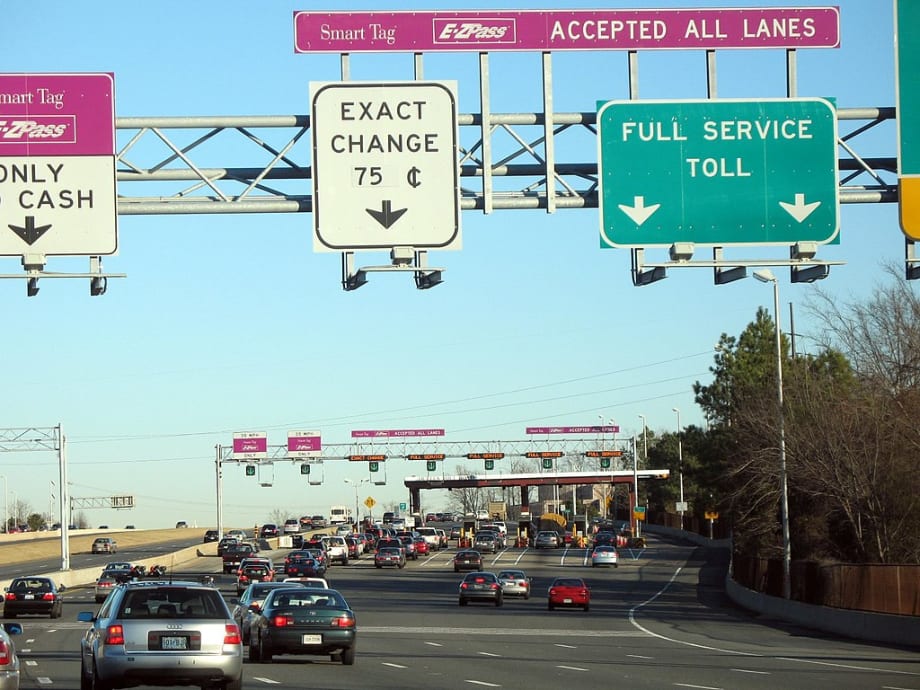
Parkopedia’s in-car payment platform will be a key enabler for the transition toward smart cities, where tolling systems are set to become the industry norm.
Photo via MPD01605~commonswiki under the Creative Commons Attribution-Share Alike 3.0 Unported license
2 min to read
Connected vehicles services provider Parkopedia and mobile tolling payment system Uproad have announced in a statement the integration of their platforms, automating the toll payment process.
The partnership enables access through tollways by unifying Parkopedia’s in-car payment platform with Uproad’s digital toll payment system, eliminating the need for a tolling transponder. Drivers only need to register once to enable license plate recognition to identify the vehicle every time it passes through a toll, triggering the automated payments that drivers now expect from their connected vehicles. Real-time notifications are also sent to the driver for each event, allowing for transaction transparency.
In addition to tolling, Parkopedia’s vehicle-centric payment platform allows drivers to pay for both on- and off-street parking, as well as EV charging, and ‘pay-at-the-pump’ fueling, via the vehicle’s infotainment system. The platform offers a solution to the time-consuming and expensive task of aggregating a large number of service suppliers and payment providers for automakers, uniting them into a single integrated solution.
Unique single sign-on capabilities, with full payment card industry (PCI) data security compliance, allows for consistency across all merchants and all commerce domains, bringing together a plethora of payment service providers without additional enforced customer authentication at the point of sale.
“Millions of U.S. drivers use toll roads and crossings every day," said Anthony Michael Ibrahim, director of business development and partnerships in North America at Parkopedia in the statement. "We are delighted to partner with Uproad to increase our payment platform’s tolling coverage across North America and provide drivers with the seamless, automated digital toll payments that they now expect from their connected vehicles. Uproad and Parkopedia are both providers of cutting edge driver convenience technology, and are committed to providing safe, transparent, and secure systems enabling positive user experiences for drivers.”
"This partnership marks an important chapter in Uproad's pursuit of providing drivers with a frictionless way to navigate toll road charges and pay tolls," added Sean Boyan, VP of business development at Uproad. "Parkopedia is a forward-thinking and dynamic industry leader, and we are truly excited to announce this partnership. Uproad covers about 90% of all U.S. toll roads, so we're confident that together we'll vastly improve many driver's toll road experiences."
Uproad is the latest addition to Parkopedia’s portfolio of payment services in the U.S. and Europe, joining recent additions such as parking operators Passport, APCOA, and OPnGO, and fueling partners ThinxNet and CarPay-Diem, further expanding the reach of the Parkopedia payment platform since its launch last year. The company's toll alerts and payments are currently available in 19 U.S. states, with further coverage to be added later this year.
Originally posted on Automotive Fleet
More Small Fleet


Developing Budget-Friendly Driver Safety Programs
From driver training and safety meetings to one-on-one coaching and incentive programs, several small fleets share how they have developed a safety culture with their drivers using low- to no-cost resources.
Read More →
Sponsored•March 9, 2026
Boosting Last-Mile Fleet Uptime, Safety, and Value with AI Vehicle Inspections
AI-powered inspections are transforming last-mile fleets by replacing manual checks with highly accurate automated scans that detect defects in seconds. By giving fleet operations visibility into the daily condition of their vehicles, you can identify trends over the vehicle’s lifecycle that enable improved procurement decisions, route management, driver training and accountability.
Read More →
Five Ways Seat Belts Help Prevent Injuries
There are five ways seat belts protect occupants from injuries, according to the Tennessee Department of Safety and Homeland Security.
Read More →
Sponsored•January 14, 2026
It’s here: The 2026 Fleet Technology Trends Report
What does AI mean for fleets? Get the answer — and learn other top tech trends.
Read More →
Small Fleets, Big Impact: How Independent Drivers Power Wreaths Across America
Check out how small fleets and independent drivers power Wreaths Across America each December and why their impact matters more than ever.
Read More →
VMS Survey Finds 65% of Small Fleet Managers Run Operations Alone
A new VMS survey shows small fleet managers are stretched thin, with most handling operations solo and eager to adopt digital tools for relief.
Read More →
Tips for Driving Safely on Halloween Night
This video features a reminder from the Connecticut Department of Transportation (DOT) and the Connecticut Police Chiefs Association, urging drivers to prioritize safety this Halloween.
Read More →
AI, Access, and Uptime: VMS’s Next Chapter with David Prusinski
VMS’s new Co-CEO, David Prusinski, shares how an AI-first approach will give small fleets and repair shops the tools to compete like big players.
Read More →
Fleet Managers Share Winter Prep Tips: It's Never Too Early!
Three fleets share best practices to prep vehicles for winter and prevent downtime when the cold sets in.
Read More →