




Toyota Introduces Camry Solara Coupe At 2003 New York Auto Show
The all-new Toyota Camry Solara coupe made its world premiere at a press conference at the 2003 New York Auto Show. According to the company, the Solara's product planning, technical and styling development was managed by Toyota Technical Center (TTC) in Ann Arbor, Mich., Calty Design Research in Newport Beach, Calif., and Toyota Motor Sales, U.S.A., Inc. Solara will be built exclusively at Toyota Motor Manufacturing, Kentucky in Georgetown. "With all aspects of the all-new Solara's development taking place in the United States, the total package was completed in less than two years," said Don Esmond, senior vice president and general manager, Toyota Division. "The final creation is a new Solara that is sportier, more powerful, more refined and larger, inside and out, than its predecessor." The 2004 Solara will be available in the SLE, SE and SE Sport grades, each with its own interior surface treatments. The SLE model will receive a rich wood-grain trim, while a brushed aluminum and silver finish trim will be applied to the SE grade. SE models equipped with an all-new Sports Package will feature an interior complete with black graphite-accented trim. Solara will be equipped with either a V6 or four-cylinder engine. The Solara's all-new 3.3-liter V6 will generate 225 horsepower at 5,600 RPM, an increase of 27 horsepower, and 240 lb.-ft. of torque at 3,600 RPM, 28 more lb.-ft. of torque than the current model. With both engines, Solara will be EPA-certified as an Ultra Low Emission Vehicle (ULEV). Solaras equipped with the V6 will be mated to an all-new five-speed automatic sequential transmission. According to the company, Solara's increased power will be smoothly transferred to the wheels via a performance-tuned suspension. Virtually every mounting and pivot point between the suspension and the body has been repositioned and recalibrated. Specially-tuned struts improve Solara's ride quality, while unique springs and front and rear stabilizer bars reduce body roll and pitch, resulting in a stable yet invigorating steering feel and response. Stopping power and feel is enhanced with standard four-wheel disc brakes. The styling concept of the all-new Solara integrates both convex and concave surfaces that flow dynamically down the length of the car to give Solara its characteristic shape and advanced style. An extensive and pronounced "V" character line begins at the grille to separate aggressive elongated "eye" shaped headlamps that enhance Solara's sporty image. Solara's front fascia is further complemented by fog lamps that provide a wider, aggressive look and stance, says the company. Like its exterior, the company says the Solara interior evokes a sporty and stylish image highlighted by a restyled instrument panel and center-mounted multi-function display featuring the time, outside temperature gauge, fuel consumption, average speed and elapsed time. Solara targets class leading fit and finish quality by narrowing gaps between interior surfaces by 0.5 millimeters or less, the design of an invisible front-passenger airbag, and chrome accents. Toyota says the 2004 Solara offers a 20 percent increase in interior storage space by providing for a new front console box, cupholders that double as additional storage, and a center console that offers dual storage units. Solara also offers built-in storage and cupholders in the rear quarter panel. The front console door, glove box and register knobs utilize silicone dampers for smooth operation. New for Solara are Satellite XM radio, and navigation system options. The Solara receives the latest generation in Toyota's DVD-based navigation systems. It features more than five million verified data points and its route searching capabilities are more than twice as fast as competitive systems. The Solara's 6.7-inch screen is among the biggest on the market today. A target of best-in-class safety features will be supported by Solara's use of standard front side-impact airbags, four-wheel ABS and independent rear seat headrests. Front and rear curtain side airbags also will be available. The new Sports Package, available on SE models, will include a special five-piece body kit, a unique dark-charcoal interior with black graphite trim, sport-fabric seats, exclusive sport gauges and meter colors, sport tires wrapped around 17-inch wheels, a leather-trimmed steering wheel and shift knob and distinctive aluminum pedals. The Sports Package also will feature a performance-tuned suspension that includes stiffer front and rear springs, as well as sport-tuned front and rear shock absorbers. The first generation Solara debuted in the fall of 1998 and was developed to target a new opportunity in the sport specialty segment. "The all-new Solara was engineered and designed in America for a variety of American tastes," said Esmond. "Consumer appeal in Solara will range from style, to design, to impressions, to excitement. The Solara buyer will want something extra in life regardless of their age or life stage." The first 2004 Solara model will roll off the line later this summer and will go on sale mid-August.
More Small Fleet


Developing Budget-Friendly Driver Safety Programs
From driver training and safety meetings to one-on-one coaching and incentive programs, several small fleets share how they have developed a safety culture with their drivers using low- to no-cost resources.
Read More →
Boosting Last-Mile Fleet Uptime, Safety, and Value with AI Vehicle Inspections
AI-powered inspections are transforming last-mile fleets by replacing manual checks with highly accurate automated scans that detect defects in seconds. By giving fleet operations visibility into the daily condition of their vehicles, you can identify trends over the vehicle’s lifecycle that enable improved procurement decisions, route management, driver training and accountability.
Read More →
Five Ways Seat Belts Help Prevent Injuries
There are five ways seat belts protect occupants from injuries, according to the Tennessee Department of Safety and Homeland Security.
Read More →
It’s here: The 2026 Fleet Technology Trends Report
What does AI mean for fleets? Get the answer — and learn other top tech trends.
Read More →
Small Fleets, Big Impact: How Independent Drivers Power Wreaths Across America
Check out how small fleets and independent drivers power Wreaths Across America each December and why their impact matters more than ever.
Read More →
VMS Survey Finds 65% of Small Fleet Managers Run Operations Alone
A new VMS survey shows small fleet managers are stretched thin, with most handling operations solo and eager to adopt digital tools for relief.
Read More →
Tips for Driving Safely on Halloween Night
This video features a reminder from the Connecticut Department of Transportation (DOT) and the Connecticut Police Chiefs Association, urging drivers to prioritize safety this Halloween.
Read More →
AI, Access, and Uptime: VMS’s Next Chapter with David Prusinski
VMS’s new Co-CEO, David Prusinski, shares how an AI-first approach will give small fleets and repair shops the tools to compete like big players.
Read More →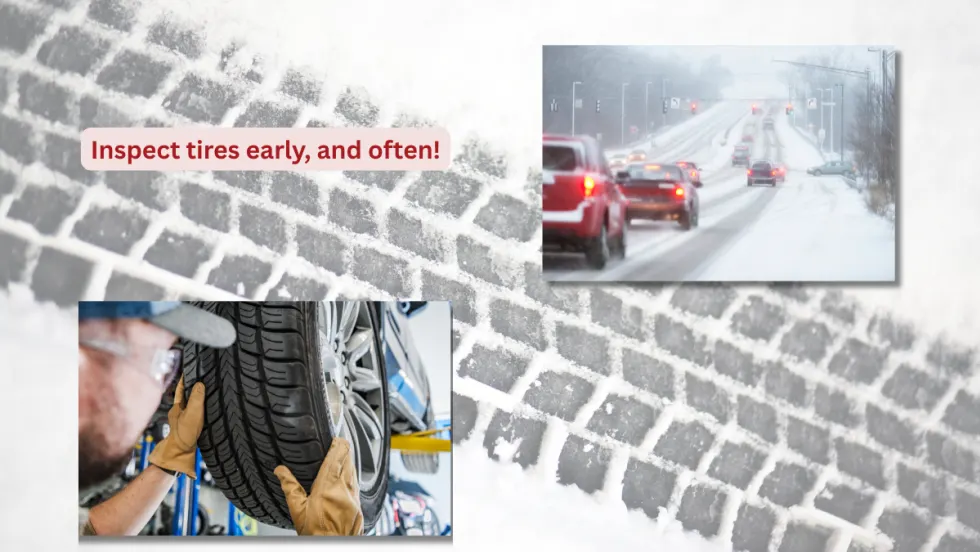
Fleet Managers Share Winter Prep Tips: It's Never Too Early!
Three fleets share best practices to prep vehicles for winter and prevent downtime when the cold sets in.
Read More →