




Toyota Celebrates 60 Years in the U.S.
Since its humble beginnings in a 3,000-square-foot, one-time Rambler dealership, Toyota has woven itself into the cultural fabric of America. Sixty years in, it encompasses a presence in every state, including 10 manufacturing facilities and nearly 1,500 Toyota and Lexus dealerships.
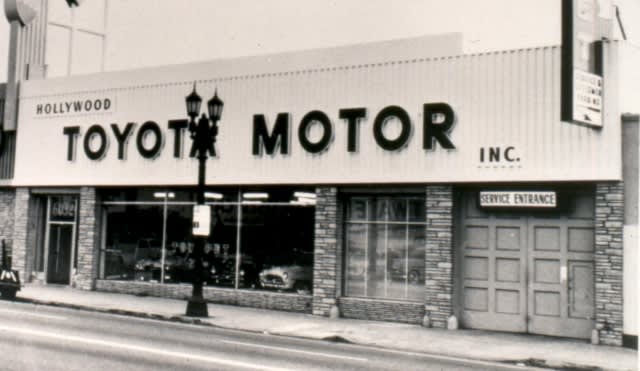
Photo of Toyota's first U.S. headquarters in Hollywood, Calif., courtesy of Toyota.
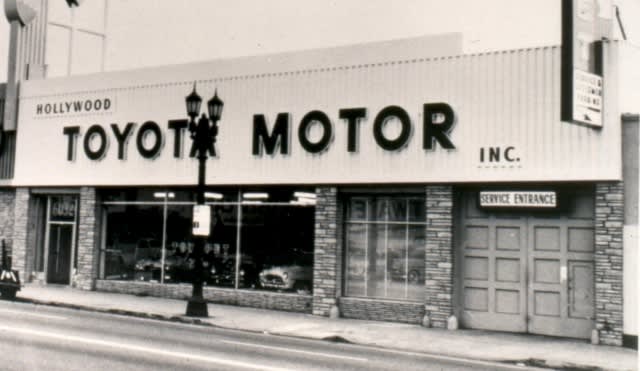
Photo of Toyota's first U.S. headquarters in Hollywood, Calif., courtesy of Toyota.
When Toyota launched its North American headquarters in a Hollywood, Calif., dealership on October 31, 1957, it was, no doubt, a frightening affair. Halloween notwithstanding, a Japanese car company making a foray into the U.S. market was a bold move 60 years ago. And, according to the automaker, its first vehicle the Toyopet Crown didn’t turn out to be a screaming success either.
But, since those humble beginnings in a 3,000-square-foot, one-time Rambler dealership, Toyota has woven itself into the cultural fabric of America. Sixty years in, it encompasses a presence in every state, including 10 manufacturing facilities (14 in North America), nearly 1,500 Toyota and Lexus dealerships, and 136,000 direct, dealer and supplier U.S. employees.
And, the company recently unified operations by bringing together its quality engineering, sales, marketing, financial services and corporate functions in one location at a new North America headquarters campus in Plano, Texas.
“Celebrating our anniversary isn’t just about the products we’ve sold the past 60 years,” said Toyota Motor North America CEO Jim Lentz. “It’s also about celebrating Toyota’s thousands of employees who will help the company embark on the next leg of its American journey and continuing to improve our products and services for our customers.”
To commemorate its 60th anniversary, Toyota rededicated a 50th anniversary time capsule originally dedicated at its former Torrance, Calif., headquarters in 2007. The capsule, which includes items like a 2000GT die cast matchbox edition model car, an original key for a 1977 Toyota Hilux truck and a Toyota Formula One racer scale model—will be re-opened on the 100th anniversary in 2057.
Plano Mayor Harry LaRosiliere, who attended the ceremony, said the capsule marks a new chapter for Toyota.
“As Toyota moved their North American corporate offices to Plano over the last three years, the entire region has experienced the positive impact of their team members unique character and culture. The entire organization exhibits a sense of purpose, innovation, and family. We are proud they call Plano home, and we are honored to be part of today’s anniversary celebration,” LaRosiliere said. “We look forward to the next 60 years with Toyota in the City of Plano.”
Toyota’s American journey has been fueled by the cars it makes.
In the 1950s that meant the Toyopet Crown and the now-legendary Land Cruiser. Introduced in the 1960s, the Corolla would go on to become the bestselling nameplate in the world.
The 1970s got sporty with the Celica and the beloved Supra.
The 1980s introduced the American public to Camry and 4Runner, among others.
In 1989, Toyota launched its luxury vehicle division, Lexus, in the U.S. with two models, the LS 400 and ES 250.
In the 1990s, Toyota filled out its lineup with models like the Tacoma, RAV4, Avalon, and Sienna, and from Lexus, the GS, LX, and RX.
In 2003, Toyota launched Scion to bring in younger customers and to test out revolutionary processes and products.
The 1970s were critical to operations. Toyota marked its first U.S. production, signing Atlas Fabricators of Long Beach (later changed to TABC) to make truck beds. Toyota Technical Center, which just celebrated its 40th anniversary in May, opened its first U.S. R&D facility and Calty Design Research opened its doors in Southern California.
Growth continued into the 1980s with the launch of manufacturing facilities in California and Kentucky. In addition, Toyota Motor Credit Corporation (now known as Toyota Financial Services), began operations in the U.S. in October 1982. In the 1990s and 2000s, Toyota added vehicle and parts plants in Indiana, West Virginia, Alabama, Tennessee, Texas, Missouri, and Mississippi. To support the rapid growth, Toyota consolidated its R&D and manufacturing operations under a single company in 2006.
Over the years, Toyota Motor North America has transformed from just a sales company into a mobility company. In 2016, the Toyota Research Institute launched, leading the way to autonomous vehicles, robotics, vehicle safety and materials science.
In the same year, Toyota Connected was created to use data to personalize the customer driving experience. What started as a single store in Southern California has evolved into an American institution that continues to bring jobs, mobility, and technology to its communities.
Originally posted on Automotive Fleet
More Operations

Family Ties Inside the Fleet Families Building Careers Across Generations
Three fleet families share what it really takes to work together, learn across generations, and keep business from following them home.
Read More →
Shades of Fleet Call for Voices: Fleet's Hidden Heroes
Fleet’s hidden heroes are often the ones keeping everything moving behind the scenes. September’s Shades of Fleet is looking for dispatchers, coordinators, parts specialists, and other support pros to share their stories.
Read More →
Truck Centers, Inc. Celebrates National Truck Driver Appreciation Week with $1,000 Fuel Card Giveaways
During National Truck Driver Appreciation Week, Truck Centers, Inc. is offering customers a chance to fuel up for free. Customers at all Truck Centers locations can enter to win one of four $1,000 fuel cards from Sept. 14 - 18.
Read More →
Fleet Guides, AI Time-Savers, Truck Tariffs & Fuel Strategy Lead the News
This week’s Truck Chat Cheat Sheet covers new fleet vehicle guides, practical AI use cases, U.S.-Canada truck production, mixed-energy strategy, and more.
Read More →
What Fleet Employers Are Missing When Hiring Veterans
What if some of the strongest candidates for fleet are already out there, but their experience is written in a language our industry does not always recognize?
Read More →
Automotive Fleet Opens 2026 Personal Use Survey for Commercial Fleet Managers
Less than two weeks left! Commercial and corporate fleet managers are invited to share how their organizations handle company vehicle personal-use policies, charges, and driver eligibility.
Read More →
What Resilient Fleets Do Differently When Conditions Change
Fleet resilience is about more than reacting to disruption. Lauren Fletcher talks with AP Fleet’s Alex Coveney about flexibility, planning, scaling, and what helps fleets adapt when business conditions shift.
Read More →
If We Want the Next Generation in Automotive, We Have to Give Them a Reason to Care
The automotive industry talks constantly about its workforce shortage. But before we can recruit the next generation, we may need to do a better job giving kids a reason to care about automotive in the first place.
Read More →
Ram ProMaster City Under $40K, Truck Tariffs, and AI Maintenance Lead the News
A sub-$40K commercial van, tariff questions, AI-powered maintenance, and a new EV production strategy headline this week’s Truck Chat Cheat Sheet.
Read More →
Bob Adamsky Shares the Fleet Lessons You Usually Learn the Hard Way
After more than 30 years in fleet, Arrow International’s Bob Adamsky has learned that the job is about far more than vehicles. He shares the lessons he wishes every fleet manager could learn a little earlier.
Read More →