




Reciprocity in Motion, Women’s Impact in the Commercial Vehicle Industry
What is reciprocity and how does it factor into women’s impact in the commercial vehicle industry? Learn from four fleet experts as they share stories and tips for building mutually beneficial relationships.


Learn what four women leaders shared during Reciprocity in Motion, Women’s Impact in the Commercial Vehicle Industry, a webinar that was part of Work Truck Solutions’ Fall 2024 CVB Summit.
Photo: Work Truck
Forging reciprocal partnerships that are mutually beneficial is important in shaping a career, as well as when doing business within the fleet and transportation industry. Four fleet leaders shared experiences and advice during Reciprocity in Motion, Women’s Impact in the Commercial Vehicle Industry, a webinar that was part of Work Truck Solutions’ Fall 2024 Commercial Vehicle Business Summit.
“When we're talking about reciprocity, we're referring to that mutual give and take, whether it's a game changing business deal or just those everyday gestures like sharing resources, supporting each other, and creating more opportunities,” said Lauren Fletcher, vice president of content at Bobit. “It's these actions, both big and small, that strengthen not only individual careers, but entire industries like ours, and for women this reciprocity has taken many different forms over the years.”
Fletcher, who moderated the panel discussion, said reciprocity literally goes both ways, and she hopes people recognize when they're a part of that solution and find where they may be able to help step in.
The panelist shared real world examples, strategies, and lessons about how reciprocity and collaboration are shaping the future of the commercial vehicle industry. Participants included:
Nicole Combs, director of sales, work truck finance, Mitsubishi HC Capital America
Candy McCollum, business development manager, Comvoy
Dania Rich-Spencer, vice president of mobility, Escalent
What Does Reciprocity Mean?
Combs said her connection to reciprocity in the industry has closer ties to everyday acts rather than grand gestures.
“I think it's the act of giving of your time, your energy, your attention, your effort, into something or to someone who might need a little bit more encouragement,” Combs shared. “I think that those little everyday gestures and the giving of yourself in hopes to help support somebody else is what my experience with reciprocity has been, and it's just the everyday combination of those things coming together.”
For McCollum, reciprocity can be applied to a wide range of situations, from small wins to significant achievements. She explained that reciprocity is fundamentally rooted in mutual respect and the principle of treating others as you would like to be treated.
“Reciprocity is a mindset of giving without expecting an immediate return,” McCollum said. “Throughout my career, I've been in mostly male-dominated industries and I've seen the power that the small gestures create.”
She suggested that reciprocity is centered around communication, and it takes time and a consistent effort, and that building those true reciprocal relationships is a “life-long skill.”
Rich-Spencer agreed that reciprocity is about a mutually beneficial partnership but added that the benefits or outcomes may not always have to be a 50/50 split.
“My experience has been that split, and the anticipated benefits and outcome that results from the partnership, ebbs and flows over a period of time and through the lifecycle of the partnership, and as long as both partners’ needs are being met and they are experiencing benefits, then it remains a healthy partnership or a healthy relationship,” Rich-Spencer said.
However, she pointed out that the sum is greater than the individual parts. Spencer said she feels fortunate that she built a reciprocal partnership with a tech company when at the time Escalent was a traditional market research consumer insight company.
“We recognized that we needed help that was outside of our core competency, and we were very fortunate to enter into a very good relationship partnership with this tech company in which both parties were mutually benefiting from it,” she explained.
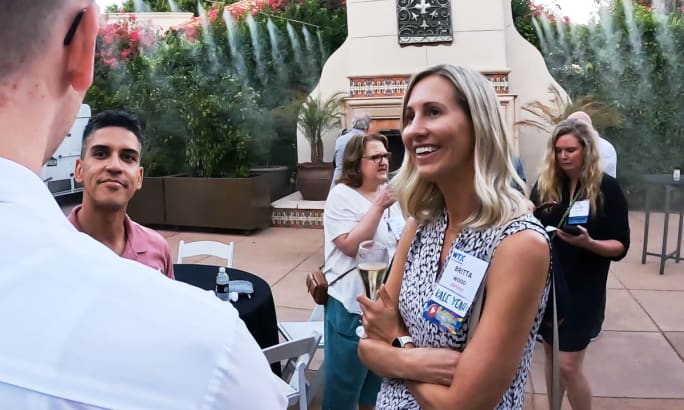
Networking at events like Work Truck Exchange are an important part of building reciprocal relationships in an industry.
Photo: Wayne Parham
Fletcher chimed in, agreeing with Rich-Spencer’s thought that reciprocal relationships need not be 50/50 if both parties benefit. She pointed out how organizations such as the Automotive Fleet Leasing Association, Women in Fleet Management, the Black Fleet Network, and other organizations help develop reciprocity among fleet participants.
“It's just really always amazed me to be on a show floor at any of our industry events and see the hugs and handshakes between what would be considered competitors who've known each other for years and have never had a problem helping each other out,” Fletcher said.
McCollum said she has seen many recent examples of reciprocity in her role at Comvoy and chose to share one that she said comes to mind.
“One that is up and coming will be Comvoy and Routeway 360 where we help Routeway remove barriers for entry points for independent distributors. They also need a marketplace,” McCollum said. “So, it's reaching out to those partners, proactively listening, learning and being creative on things, and thinking of ways where we can help each other.”
But reciprocity also can be between individuals. She shared how at Comvoy there is a new person on the team who is a search engine optimization (SEO) expert. He can help her understand the technical aspects of SEO, while she can help him learn about the commercial fleet space.
Rich-Spencer extended the conversation and returned to sharing more details about the partnership she experienced with the tech company.
“These partnerships between tech companies and traditional research companies were relatively new, and it was certainly new to the Escalent organization at the time, and the reason why it was truly unique is because both parties needed to learn from each other. We were both motivated to enter into this partnership because we saw benefits,” Rich-Spencer said. “We each had something that the other one needed, but it went beyond collaboration, because we had to, one, learn from each other and, two, we had to develop a sense of trust with one another.”
The key, she said, was communication, but it had to be with transparency. Two companies came together with very different cultures, so they also had to be respectful of each other.
“We were committed to offering both sets of customers or clients a best-in-class solution, and we did that by staying focused,” Rich-Spencer added.
Mentorship & Allyship in Reciprocal Relationships
Fletcher next guided the discussion to talk about how mentorship and allyship help build reciprocal relationships, especially for women in more male-dominated industries.
“Have you seen mentorship, either given or received, create that ripple effect that's benefited not just one person, but multiple people, or even a whole team?,” she asked the panel.
Rich-Spencer took the lead on the topic and said a few years ago she worked with three business students from Michigan State University on their capstone project.
“These students were sharp and bright and motivated and Escalent, at the time, was sitting on this database of connected vehicle data. We knew that there was insight in this huge lump of connected vehicle data, but we just didn't have the time or the resources to really put behind it,” Rich-Spencer explained.
The students’ capstone project was built around big data and data analysis, and how do you use those insights? Escalent wanted to understand driving behavior and how that aligns with self-reported driving behavior. Rich-Spencer said most of the time people don't intentionally lie, but human responses are not always accurate for a variety of reasons. The students were able to help Escalent perform that research.
“It was a true win-win. It was Escalent having an opportunity to give back to the community. I learned so much from these three students, and I remember thinking back and if I were only half as smart as these kids, I'd be doing so much better today,” Rich-Spencer added.
With that, Fletcher brought up the concept of reverse mentorship. That is when you can learn from someone you are mentoring, such as in the story shared by Rich-Spencer.
In thinking about mentorship, Combs took the panel back to a story from her early days of working in fleet. She said information was neither given nor received and when she was early in her career she felt like she was on an island.
“Flash forward to current state. I have both. Not only do I have both formally and informally in terms of having mentorship, but it's really made the transition and growth abilities a lot easier to navigate,” Combs said.
She pointed out how at Mitsubishi HC Capitol America there is a mentor program, and employees are welcomed to sign up either as a mentor or mentee.
“Because I had somebody step up and be a mentor for me, I wanted to pay it forward and do that for other people,” she said.
McCollum likewise said a mentorship program is important.
“I think there might not be as many women in the commercial industry space because maybe they didn't have that mentorship, there wasn't someone there,” McCollum said. “They didn't visually see someone already doing that. I think that helps in trying to define a career path.”
She said she is a true believer in mentorship, has experienced it for years, and shared a special memory from when she was a mentor.
“I mentored a youthful colleague, and she went on to lead a successful project, and that it actually impacted our entire team,” McCollum said. “Then her success later inspired for to me be a mentor to others. So that was the creating the ripple effect that built our entire team's capabilities.”
Fletcher shared a phrase related to the topic: “Be the example that you needed.”
“I think, whether you're a male or female, or in the any aspect of the industry, really look and see what was it that you needed when you first stepped in and have you been able to step into the shoes to maybe help be that person that you needed?” Fletcher said.
“It's not about being the woman in the room. You could be the only male in the room, you could be the youngest one in the room, you could be the newest one in the room,” McCollum said. “Just treat people how you want to be treated.”
“It's the everyday small gestures. It's being supportive and encouraging,” said Combs. “I think it's those little things that we can do every day to encourage and support. That's something we can give of ourselves, and we don't need anything in return.”
Reciprocity During Tougher Times
Reciprocity and helping each other out can be vitally important during difficult or challenging times.
McCollum recalled a time earlier in her career when her company was being restructured. There was uncertainty among her entire network, but they responded to support each other. They organized meetings in which people could share their concerns and ideas in a roundtable format.
“We would share all the experiences, we had strategies for navigating, because each one of us had a different life experience. Some were young. Some had children, some whatever. It was different. And during that, we were able to brainstorm and learn the desires of others,” she recalled.
She found her place among her peers, becoming the one to support creating resumes for people. Others helped their peers prep for interviews.
“Just looking back on it now makes me want to go reach out to some of those people, because it had such a big impact,” McCollum said.
She said that mentality should apply toward customers – sometimes you have to go out of your way to help them without expecting much in return.
“For us, we were entering into a partnership with a tech company because we needed their technology that was outside of our core competency. And likewise, they were entering into a partnership with Escalent because they needed research. They didn't have a desire to do research. They were a tech company, so there's a purpose to entering partnerships,” Rich-Spencer said, qualifying that to her every time can feel like a tough time but through those partnerships people achieve goals.
She continued, saying that for any partnership like that to work you need buy-in from executive leaders, but colleagues as well.
“My role was to convince senior leadership that we're going to enter into this partnership with this tech company that came out of nowhere, but they seemed to be pretty good. So, I needed to convince the president of the company, I needed to earn his trust that I wasn't going to screw it up. But I also had to earn the trust of my colleagues outside of the automotive team, because they were tasked to sell these things to their financial services, health care, consumer goods clients, and they needed to be convinced that I knew what I was talking about, but more importantly, I brought in the right partner,” Rich-Spencer said. “That was tough.”
Advice for Building Reciprocal Relationships
Next, Fletcher asked what advice would the panelists give to anyone entering the commercial vehicle industry on how to build mutually beneficial relationships that may lead to personal or business growth?
Rich-Spencer said it is about setting expectations in a complicated industry with a lot going on.
She said you must be realistic in your expectations of, “How fast can I learn?” and “What is the best path to becoming an expert?” You have to be open to relying on those who have more experience.
“Certainly, for women in this industry, they may have a steeper learning curve. So, you need to embrace that. You need to reach out for help and guidance and don't look at that as a sign of weakness. Look at that as a sign of strength, and this goes for if you're a man or a woman, inexperienced, or experienced,” said Rich-Spencer. “I really believe that you have to be committed to self-educating.”
For McCollum, it is about commitment – a commitment to learn and grow continually. She encourages people to find mentors, and to see networking as about giving and not just getting.
“When you're networking, just stay focused on giving, giving it your all, giving it your all to learn more, giving it all to be the best person you can be,” she said. Offer the skills that already to the network. “Be comfortable in being you.”
Combs said she encourages anyone emerging in the industry to join networking associations.
“Early on in my career, I had the opportunity to join the Women in Trucking Association. And up until then, as I mentioned earlier, I had been on an island,” Combs said. “So, to be in the presence of so many, women and peers across various industries in trucking and transportation, I was just kind of blown away. And from there, I had the opportunity to then give back.”
The battery-electric vehicle has forced the industry into learning more, and building relationships and partnerships as everyone learns about new technologies, explained McCollum. Industry times like that are when new relationships are built.
“I think that being women in the space, that it's more than just paving the way right. It's looking back on ways that we can help others,” McCollum said.
Rich-Spencer added to the thought, explaining that the disruptions and rapid changes in the industry and technology are driving new relationships and building current ones even stronger.
“The disruption is leading to a new way of doing business. And part of a new way of doing business is deepening of these existing relationships,” she said. “So, the key to success, as I said before, is identifying that partnership, that relationship that's right for the business, and you definitely want one plus one ideally equals three plus.”
“You hear about the women that went before us, right the trailblazers in the industry,” said Combs. “And what we're doing today is we're also continuing on that trail and leaving a path for people behind us to follow.”
More Operations
Family Ties Inside the Fleet Families Building Careers Across Generations
Three fleet families share what it really takes to work together, learn across generations, and keep business from following them home.
Read More →
Shades of Fleet Call for Voices: Fleet's Hidden Heroes
Fleet’s hidden heroes are often the ones keeping everything moving behind the scenes. September’s Shades of Fleet is looking for dispatchers, coordinators, parts specialists, and other support pros to share their stories.
Read More →
Truck Centers, Inc. Celebrates National Truck Driver Appreciation Week with $1,000 Fuel Card Giveaways
During National Truck Driver Appreciation Week, Truck Centers, Inc. is offering customers a chance to fuel up for free. Customers at all Truck Centers locations can enter to win one of four $1,000 fuel cards from Sept. 14 - 18.
Read More →
Fleet Guides, AI Time-Savers, Truck Tariffs & Fuel Strategy Lead the News
This week’s Truck Chat Cheat Sheet covers new fleet vehicle guides, practical AI use cases, U.S.-Canada truck production, mixed-energy strategy, and more.
Read More →
What Fleet Employers Are Missing When Hiring Veterans
What if some of the strongest candidates for fleet are already out there, but their experience is written in a language our industry does not always recognize?
Read More →
Automotive Fleet Opens 2026 Personal Use Survey for Commercial Fleet Managers
Less than two weeks left! Commercial and corporate fleet managers are invited to share how their organizations handle company vehicle personal-use policies, charges, and driver eligibility.
Read More →
What Resilient Fleets Do Differently When Conditions Change
Fleet resilience is about more than reacting to disruption. Lauren Fletcher talks with AP Fleet’s Alex Coveney about flexibility, planning, scaling, and what helps fleets adapt when business conditions shift.
Read More →
If We Want the Next Generation in Automotive, We Have to Give Them a Reason to Care
The automotive industry talks constantly about its workforce shortage. But before we can recruit the next generation, we may need to do a better job giving kids a reason to care about automotive in the first place.
Read More →
Ram ProMaster City Under $40K, Truck Tariffs, and AI Maintenance Lead the News
A sub-$40K commercial van, tariff questions, AI-powered maintenance, and a new EV production strategy headline this week’s Truck Chat Cheat Sheet.
Read More →
Bob Adamsky Shares the Fleet Lessons You Usually Learn the Hard Way
After more than 30 years in fleet, Arrow International’s Bob Adamsky has learned that the job is about far more than vehicles. He shares the lessons he wishes every fleet manager could learn a little earlier.
Read More →