




Navistar and VW Chiefs Talk Up Their Alliance Deal
Just two weeks after revealing they had forged a “wide-ranging strategic alliance,” the chief executives of Volkswagen Truck and Bus and Navistar International Corp. fielded questions from North American journalists covering the massive IAA truck show opening this week in Hannover, Germany.

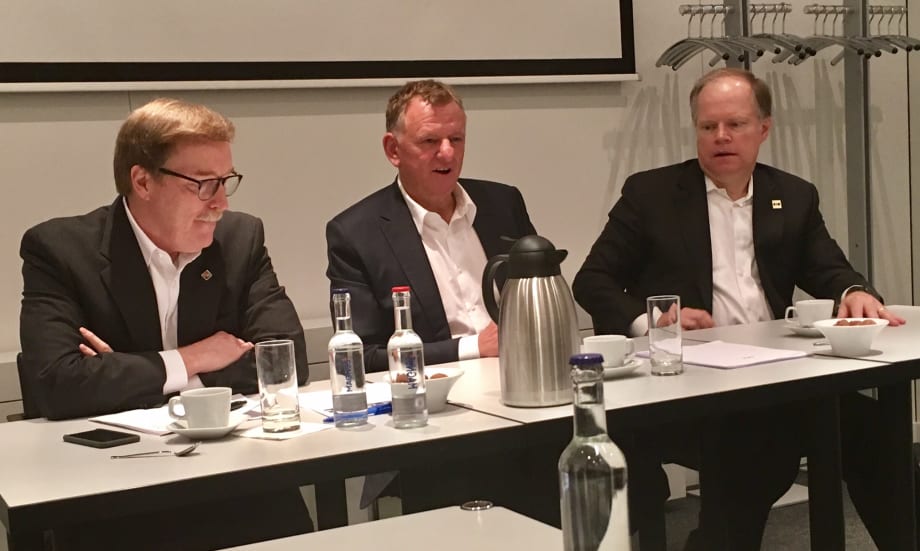
Navistar CEO Troy Clarke, VW Truck CEO Andreas Renschler, and Navistar CFO Walter Borst field queries from the press at IAA. Photo: David Cullen
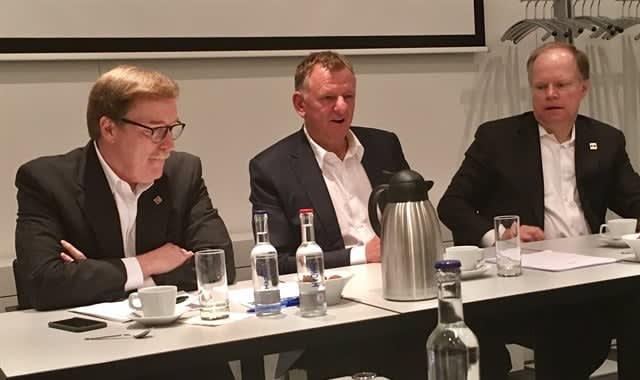
Navistar CEO Troy Clarke, VW Truck CEO Andreas Renschler, and Navistar CFO Walter Borst field queries from the press at IAA. Photo: David Cullen
HANNOVER, GERMANY. Just two weeks after revealing they had forged a “wide-ranging strategic alliance,” the chief executives of Volkswagen Truck and Bus and Navistar International Corp. fielded questions from North American journalists covering the massive IAA truck show opening here this week.
Their overall take on the deal was that it enables them to together develop advanced technology that will be needed by global truck markets for years to come.
On Sept. 7, VW announced it would acquire a 16.6% equity stake in Navistar and that the two OEMs would act as partners to share technological developments, especially regarding powertrains, and to pursue global sourcing opportunities to increase economy of scale.
Andreas Renschler, CEO of Volkswagen Truck & Bus, which also owns Europe-based global truck builders Scania and MAN, and Navistar CEO Troy Clarke said that discussions with an eye to seeking synergies that ultimately led to the deal began a year ago. Actual negotiations began only in March.
“We are looking forward to a successful alliance,” said Renschler, who is familiar with the North American trucking industry from when he headed up Daimler Trucks before moving onto VW two years ago. “Navistar needs what we can offer, including engines, transmissions and axles,” he said. He noted that thanks to the alliance, VW will be able to take into account Navistar’s requirements as it develops new products.
“We are excited to have found a partner that looks at the future the way we do and with whom we have a high degree of alignment,” said Clarke, CEO of Navistar. “We have a common vision of the industry and its issues. That we can do it better together makes it a perfect fit.”
Alluding to Navistar’s expensive recovery from having opted to pursue an EGR instead of the SCR solutions pursued by its competitors to meet EPA 2010 emissions standards, Clarke said the industry “turned left and we went right.” Nonetheless, he said that Navistar is well-positioned as a partner for VW as it is a strong “stand alone” in its own right.
“Our teams can work on next level [technologies,” said Clarke. “It’s not so much about ‘2020’ but where we will be in 10 years and so on. The [VW] deal does not solve all the problems, but it creates opportunities that did not exist six months ago.” He said that customer feedback on the partnership has been “very positive” and noted that Navistar is “well positioned and prepared for when business [in North America] picks up.”
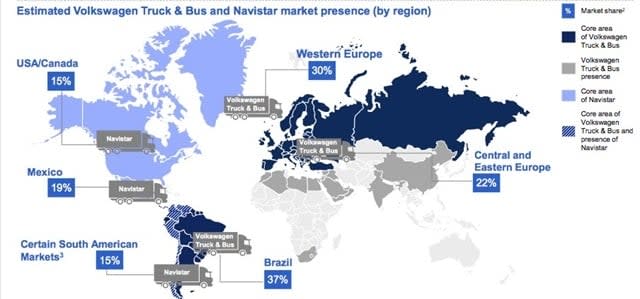
Graphic: VW Truck and Bus
Renschler remarked that there will always be difference in truck markets. “Some markets, like China, are 20 years away from our technology; India is 35 years away.” As for North America, he said that 2021 was a realistic timeframe for VW to develop an engine tailored for Navistar.
He also stressed that, in the partners’ view, technology-sharing isn’t about providing one-off solutions, but striving to enhance both brands through back-and-forth cooperation.
“We can use components from each other and go into markets,” Renschler said. “No one regional player alone can do.New drivetrain technology is one thing, but to enable our customers to be more profitable and more efficient, that is our goal.”
“It’s all about finding the right technology,” said Clarke, including integrating systems. "There’s a big shelf of technology to draw from at VW. But everything of onterest has to provide value to our customers.”
Originally posted on Automotive Fleet
More Operations
Family Ties Inside the Fleet Families Building Careers Across Generations
Three fleet families share what it really takes to work together, learn across generations, and keep business from following them home.
Read More →
Shades of Fleet Call for Voices: Fleet's Hidden Heroes
Fleet’s hidden heroes are often the ones keeping everything moving behind the scenes. September’s Shades of Fleet is looking for dispatchers, coordinators, parts specialists, and other support pros to share their stories.
Read More →
Truck Centers, Inc. Celebrates National Truck Driver Appreciation Week with $1,000 Fuel Card Giveaways
During National Truck Driver Appreciation Week, Truck Centers, Inc. is offering customers a chance to fuel up for free. Customers at all Truck Centers locations can enter to win one of four $1,000 fuel cards from Sept. 14 - 18.
Read More →
Fleet Guides, AI Time-Savers, Truck Tariffs & Fuel Strategy Lead the News
This week’s Truck Chat Cheat Sheet covers new fleet vehicle guides, practical AI use cases, U.S.-Canada truck production, mixed-energy strategy, and more.
Read More →
What Fleet Employers Are Missing When Hiring Veterans
What if some of the strongest candidates for fleet are already out there, but their experience is written in a language our industry does not always recognize?
Read More →
Automotive Fleet Opens 2026 Personal Use Survey for Commercial Fleet Managers
Less than two weeks left! Commercial and corporate fleet managers are invited to share how their organizations handle company vehicle personal-use policies, charges, and driver eligibility.
Read More →
What Resilient Fleets Do Differently When Conditions Change
Fleet resilience is about more than reacting to disruption. Lauren Fletcher talks with AP Fleet’s Alex Coveney about flexibility, planning, scaling, and what helps fleets adapt when business conditions shift.
Read More →
If We Want the Next Generation in Automotive, We Have to Give Them a Reason to Care
The automotive industry talks constantly about its workforce shortage. But before we can recruit the next generation, we may need to do a better job giving kids a reason to care about automotive in the first place.
Read More →
Ram ProMaster City Under $40K, Truck Tariffs, and AI Maintenance Lead the News
A sub-$40K commercial van, tariff questions, AI-powered maintenance, and a new EV production strategy headline this week’s Truck Chat Cheat Sheet.
Read More →
Bob Adamsky Shares the Fleet Lessons You Usually Learn the Hard Way
After more than 30 years in fleet, Arrow International’s Bob Adamsky has learned that the job is about far more than vehicles. He shares the lessons he wishes every fleet manager could learn a little earlier.
Read More →