




Fuso to Show All-Electric E-Cell Medium-Duty Truck
Mitsubishi Fuso Truck of America, Inc. (MFTA) will display its FUSO eCanter all-electric truck in its booth at GIE+Expo 2016, October 20-21 at the Kentucky Expo Center in Louisville.
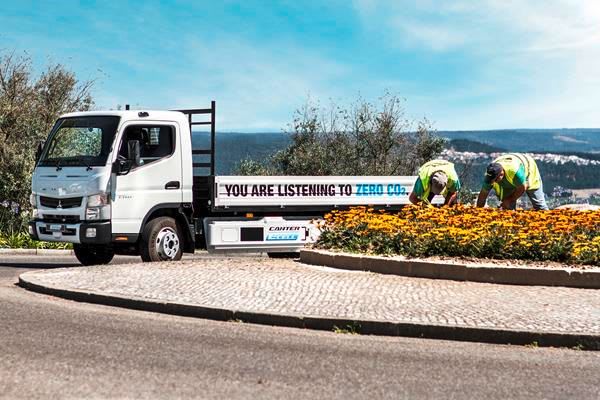
Photo courtesy of Mitsubishi Fuso Truck of America
Mitsubishi Fuso Truck of America, Inc. (MFTA) will display its FUSO eCanter all-electric truck in its booth at GIE+Expo 2016, October 20-21 at the Kentucky Expo Center in Louisville.
Its parent company, Daimler Trucks Asia/Mitsubishi Fuso Truck and Bus Corporation is well along in the development of an all-electric, battery-powered FUSO eCanter cabover work truck, and a year of in-use testing has demonstrated that FUSO eCanter all-electric trucks can generate a 64% savings in operating costs compared to an equivalent diesel-powered vehicle in the same service.
To help gauge the level of interest in an electric work truck in North America, MFTA is showing the FUSO eCanter truck at a number of trade shows, including GEI+EXPO 2016.
FUSO also recently announced during the IAA Commercial Vehicles Show in Hannover, Germany, that it will start a small production run of vehicles for several markets around the world, including the USA. The company expects the first all-electric trucks to reach the U.S. in 2017.
To prove the value of an all-electric work truck, MFTA’s parent company conducted a field trial using eight prototype vehicles, with varied flatbed/stakebody and dry van bodies installed. These trucks were operated by fleet customers in Europe, where the vehicles are assembled. The fleet managers were asked to put the E-Cell trucks to use in routine service while Mitsubishi Fuso engineers closely monitored the vehicles’ performance and use profiles for a full year.
An analysis of the data revealed that the FUSO eCanter work trucks required an average of 47.6 kwh/62 miles (47.6 kwh/100 km), compared to an equivalent diesel-powered Canter’s average fuel consumption of 3.72 gallons/62 miles (14.08 liters/100 km). Calculation of actual cost savings in any particular region would require the use of the specific cost of diesel fuel and electricity rates in that region. Based on diesel fuel pricing and electricity costs in the European locations where the trucks were operated, the E-Cell trucks produced a cost savings of 64% over the one-year testing period.
Not only did the eight test vehicles produce impressive operating cost savings, but they also produced zero CO2 or other tailpipe emissions, and even delivered a 37% reduction in CO2 emissions compared to diesel-powered trucks, after accounting for emissions generated by the power plants creating the electricity needed to recharge the batteries.
In addition to in-depth performance data, the company elicited customer evaluations of the vehicles’ practicality, suitability for their specific operating requirements and their ease of use. Results have been quite positive, with all customers reporting that, when used as intended, the trucks performed well. Types of service included express package delivery and freight forwarding in urban environments, municipal refuse and public works service, and forestry service equipment and debris hauling.
For more information about Mitsubishi Fuso and its Canter work trucks, visit www.mitfuso.com.
More Operations
Family Ties Inside the Fleet Families Building Careers Across Generations
Three fleet families share what it really takes to work together, learn across generations, and keep business from following them home.
Read More →
Shades of Fleet Call for Voices: Fleet's Hidden Heroes
Fleet’s hidden heroes are often the ones keeping everything moving behind the scenes. September’s Shades of Fleet is looking for dispatchers, coordinators, parts specialists, and other support pros to share their stories.
Read More →
Truck Centers, Inc. Celebrates National Truck Driver Appreciation Week with $1,000 Fuel Card Giveaways
During National Truck Driver Appreciation Week, Truck Centers, Inc. is offering customers a chance to fuel up for free. Customers at all Truck Centers locations can enter to win one of four $1,000 fuel cards from Sept. 14 - 18.
Read More →
Fleet Guides, AI Time-Savers, Truck Tariffs & Fuel Strategy Lead the News
This week’s Truck Chat Cheat Sheet covers new fleet vehicle guides, practical AI use cases, U.S.-Canada truck production, mixed-energy strategy, and more.
Read More →
What Fleet Employers Are Missing When Hiring Veterans
What if some of the strongest candidates for fleet are already out there, but their experience is written in a language our industry does not always recognize?
Read More →
Automotive Fleet Opens 2026 Personal Use Survey for Commercial Fleet Managers
Less than two weeks left! Commercial and corporate fleet managers are invited to share how their organizations handle company vehicle personal-use policies, charges, and driver eligibility.
Read More →
What Resilient Fleets Do Differently When Conditions Change
Fleet resilience is about more than reacting to disruption. Lauren Fletcher talks with AP Fleet’s Alex Coveney about flexibility, planning, scaling, and what helps fleets adapt when business conditions shift.
Read More →
If We Want the Next Generation in Automotive, We Have to Give Them a Reason to Care
The automotive industry talks constantly about its workforce shortage. But before we can recruit the next generation, we may need to do a better job giving kids a reason to care about automotive in the first place.
Read More →
Ram ProMaster City Under $40K, Truck Tariffs, and AI Maintenance Lead the News
A sub-$40K commercial van, tariff questions, AI-powered maintenance, and a new EV production strategy headline this week’s Truck Chat Cheat Sheet.
Read More →
Bob Adamsky Shares the Fleet Lessons You Usually Learn the Hard Way
After more than 30 years in fleet, Arrow International’s Bob Adamsky has learned that the job is about far more than vehicles. He shares the lessons he wishes every fleet manager could learn a little earlier.
Read More →