



Consumers Union (CU), the publisher of Consumer Reports, is dissatisfied with the new system for rating the rollover risks of motor vehicles unveiled today by the National Highway Traffic Safety Administration (NHTSA). After an initial review of the new ratings system, CU repeated its concerns that NHTSA has based its rollover rating system solely on the vehicle's so-called static stability factor (SSF), rather than basing it on driving tests and the dynamic performance of the vehicles. "While we believe that providing consumers some information is preferable to providing no information at all, Consumers Union has serious reservations about using a static measure such as SSF to determine for comparative purposes the stability of vehicles," said Dr. R. David Pittle, CU's senior vice president and technical director. Dr. Pittle noted that SSF utilizes only two aspects of the vehicle, both of which are static measurements -- the center of gravity height and the track width. (SSF is calculated as T/(2H), T being the track width and H being height above the ground of the vehicle's center of gravity with one or more occupants in place). Important vehicle-design elements such as the suspension, tire design, and steering response affect a vehicle's stability and differ from vehicle to vehicle -- but are not accounted for by SSF. "There is no real way to know how a vehicle will act in an emergency situation by simply measuring its shape at rest," Pittle said. "We must see how it performs when it is driven, when the whole vehicle is acting as a complete dynamic system. We are encouraged that under the recent TREAD Act, Congress has directed NHTSA to develop a dynamic test for vehicle stability." CU has been in the forefront of testing vehicles for routine handling and emergency handling, as well as braking, acceleration, fuel economy, comfort and convenience. The test results appear in Consumer Reports and other CU publications. In 1996 CU petitioned NHTSA to develop a consumer information program that provided consumers comparative data on the rollover risks of SUVs based on dynamic testing -- that is, a program based on actual driving tests. NHTSA granted CU's petition. However, CU was disappointed last May when it learned that NHTSA had abandoned its plans for dynamic testing in favor of a static formula such as SSF, which CU believes is too coarse a measure to compare vehicle stability within the same class of vehicles. Last year, Congress passed an auto safety law called the TREAD Act (Transportation Recall Enhancement, Accountability and Documentation Act). The law directs NHTSA to develop a dynamic test for rollover risks to be used as the basis for its consumer information program. "We applaud Congress for its efforts to uphold and improve the government ratings for rollover risks. When NHTSA develops a valid dynamic test, the results should provide a far more accurate measure of vehicle stability than what is being offered today," said Sally Greenberg, senior product safety counsel for CU. In comments filed with NHTSA last August, CU noted that, despite its reservations about SSF, the static measure does have some positive attributes. "The SSF metric shows the importance of vehicle load conditions. We note that on NHTSA's website, the SSF rating for a given vehicle, particularly SUVs and minivans, may vary depending on whether the vehicle is carrying a full load of passengers and cargo. When loaded, many of these vehicles drop one star in NHTSA's rating. SSF could also be a useful element of evaluating the propensity for tripped rollovers, but needs to be used in conjunction with a dynamic stability test," said David Champion, director of CU's Automotive Testing Division.
Consumers Union Dissatisfied with New Rollover Rating System
More Small Fleet
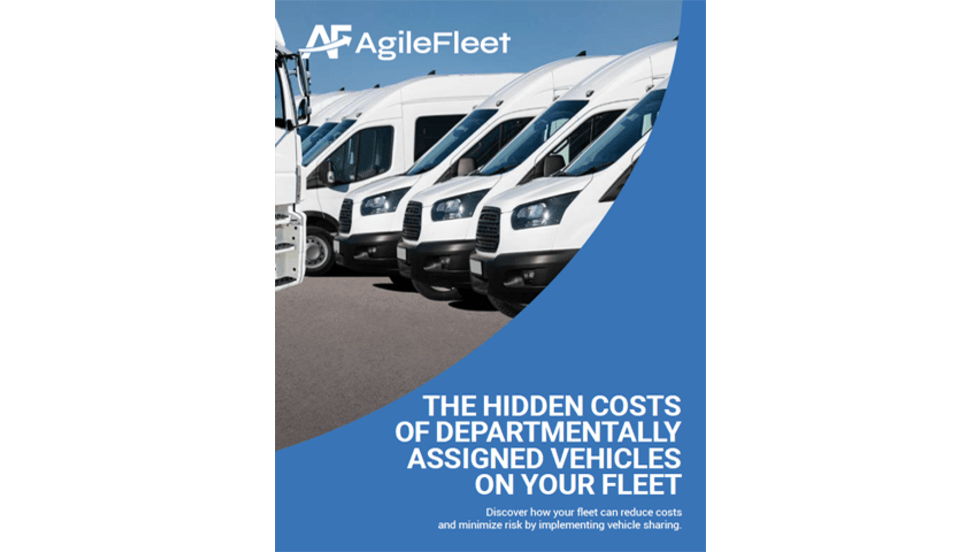
Why Fleet Managers Are Replacing Departmental Vehicles with Shared Motor Pools
Departmentally assigned vehicles often create hidden costs through underutilization, poor visibility, and increased administrative burden. This white paper explores how shared motor pool strategies help fleets reduce costs, improve accountability, and optimize vehicle utilization.
Read More →
Boosting Last-Mile Fleet Uptime, Safety, and Value with AI Vehicle Inspections
AI-powered inspections are transforming last-mile fleets by replacing manual checks with highly accurate automated scans that detect defects in seconds. By giving fleet operations visibility into the daily condition of their vehicles, you can identify trends over the vehicle’s lifecycle that enable improved procurement decisions, route management, driver training and accountability.
Read More →
Report: How AI Is Reshaping Fleet and Field Service Operations
AI is moving beyond the back office and into the driver’s seat of work truck and field service operations. New research shows fleets are using AI to improve predictive maintenance, optimize dispatch and routing, reduce downtime, and boost technician productivity, while also tackling challenges around workforce adoption and data readiness. Discover the trends, technologies, and real-world use cases shaping the future of connected work truck fleets.
Read More →
Five Ways Seat Belts Help Prevent Injuries
There are five ways seat belts protect occupants from injuries, according to the Tennessee Department of Safety and Homeland Security.
Read More →
It’s here: The 2026 Fleet Technology Trends Report
What does AI mean for fleets? Get the answer — and learn other top tech trends.
Read More →
Small Fleets, Big Impact: How Independent Drivers Power Wreaths Across America
Check out how small fleets and independent drivers power Wreaths Across America each December and why their impact matters more than ever.
Read More →
VMS Survey Finds 65% of Small Fleet Managers Run Operations Alone
A new VMS survey shows small fleet managers are stretched thin, with most handling operations solo and eager to adopt digital tools for relief.
Read More →
Tips for Driving Safely on Halloween Night
This video features a reminder from the Connecticut Department of Transportation (DOT) and the Connecticut Police Chiefs Association, urging drivers to prioritize safety this Halloween.
Read More →
AI, Access, and Uptime: VMS’s Next Chapter with David Prusinski
VMS’s new Co-CEO, David Prusinski, shares how an AI-first approach will give small fleets and repair shops the tools to compete like big players.
Read More →
Fleet Managers Share Winter Prep Tips: It's Never Too Early!
Three fleets share best practices to prep vehicles for winter and prevent downtime when the cold sets in.
Read More →