




Chevrolet Suburban: A 75-Year Legacy
DETROIT - Born from the marriage of passenger seats and a panel van, along with several windows from which to see out, the Suburban from Chevrolet celebrates a milestone that few other models can compare to; a 75-year legacy.
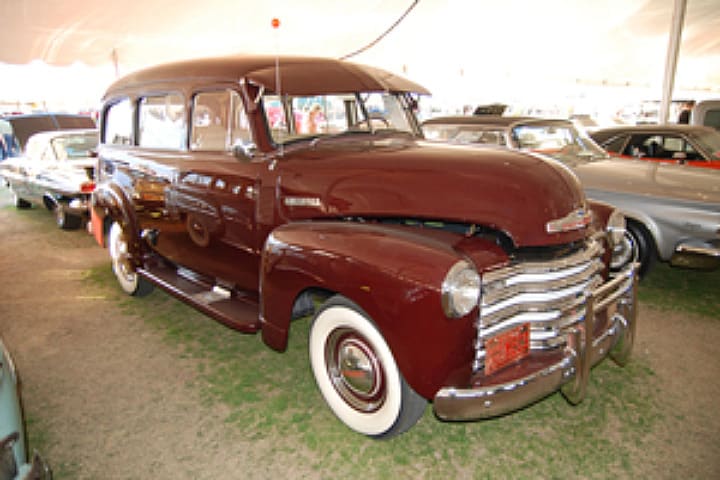
Considered one of the most important designs for a light-duty vehicle, the Advanced Design style applied to the early 1950s Chevrolet Carryalls made the vehicles look equally good on both a residential street or a remote job site
DETROIT - Born from the marriage of passenger seats and a panel van, along with several windows from which to see out, the Suburban from Chevrolet celebrates a milestone that few other models can compare to; a 75-year legacy. Who would have thought 75 years ago, just as America was starting to emerge from the Great Depression, that a utilitarian vehicle would grow-up to be one of the most prestigious vehicles to own, according to Kelley Blue Book.
It was a novel idea in 1935 when Chevrolet combined the heavy-duty ruggedness of a light-duty commercial vehicle with a purpose-built passenger vehicle. What started out as a bare-bones mode of transportation has grown into one of the most sought-after and popular modern day vehicles.
When first released in 1935, Chevrolet's Suburban Carryall was in a league of its own.
These vehicles were popular with construction companies when transporting work crews to remote locations, and for small rural school districts that needed transportation for fewer than 10 students. During World War II, the Suburban came into its own in a number of military applications, ranging from VIP transportation to moving troops to use as ambulances.
At the end of the war, the need for commercial vehicles was great and the Suburban was more popular than ever. Just as it does today, styling was shared with light-duty pickup trucks, and the versatility of this vehicle seemed limited only by the customers' imagination.
When the very popular "Advanced Design" trucks were introduced in the late 1940s, the Suburban gained an even bigger customer base, still limited to just two-passenger doors, but there were options for the rear opening with "side-by-side" or "clam-shell" lift and tail-gate combinations.
By the 1950s, some larger families were looking to the Suburban as a way to get the entire brood from home to school to the little-league practice, and on weekends to the country for camping or picnic duties. In 1960, one of the greatest innovations for the Suburban came when a third passenger door was introduced, allowing for easier access to the rear passenger seats. Also, Chevrolet realized that more and more civilian buyers were lining up to buy these ultra useful vehicles, so more creature comforts were added such as premium radios, heating and air conditioning systems, as well as conveniences such as automatic transmissions, power brakes and of course, power steering. Even four-wheel drive Suburbans could be ordered for those needing to explore the outback.
During the 1970s, when more restrictions were being placed on fuel economy for passenger cars, the once-mighty station wagon market started to shrink, especially with the innovation of the minivan in the early 1980s. However, there were still those looking for the comfort and safety of a full-size vehicle, and now more than ever, the Suburban fit the bill.
As more restrictive laws came into effect for passenger cars, light-duty commercial vehicles were taking a larger market share and the Chevrolet Suburban was a leader in the industry. By the late 1980s, any convenience item found in even the grandest of luxury cars (as well as a few that weren't) could be ordered from the factory for these massive family cruisers.
Despite some calls for the demise of these vehicles, their popularity has continued to grow, spawning luxury editions and even seeing names such as Cadillac, Lincoln, Lexus, BMW and even the sporty Porsche coming into the fold, all owing their heritage to the original Chevrolet Suburban, now popularly grouped into the sport utility vehicle classification.
In today's collector market, original editions of the Suburban have been treated to top-quality restorations usually reserved for such marques as Duesenberg or Rolls-Royce, and the prices they command have been just as impressive.
"It isn't unusual to see Suburbans from the early 1950s fetching as much if not more than the brand-new models," said Phil Skinner, collector car market editor for Kelley Blue Book. "While vintage pickup trucks have recently been gaining in value, the prices realized on many of these carryalls and similar vehicle have been strong for the past several years, and they are ahead of the curve for most other vintage vehicles."
As Chevrolet celebrates its 75 years of leadership with the Suburban, it is hard to believe that what originated as solely a commercial workhorse has now helped spawn a new vehicle category (SUV) and remains one of the safest family haulers around.
In fact, the expert editors of Kelley Blue Book's https://www.kbb.com/https://www.kbb.com/ just named the 2010 Chevrolet Suburban as one of the Top 10 Family Cars for 2010. To learn more about the 2010 Top 10 Family Cars, visit www.kbb.com/Top10FamilyCars.
Originally posted on Automotive Fleet
More Operations
Family Ties Inside the Fleet Families Building Careers Across Generations
Three fleet families share what it really takes to work together, learn across generations, and keep business from following them home.
Read More →
Shades of Fleet Call for Voices: Fleet's Hidden Heroes
Fleet’s hidden heroes are often the ones keeping everything moving behind the scenes. September’s Shades of Fleet is looking for dispatchers, coordinators, parts specialists, and other support pros to share their stories.
Read More →
Truck Centers, Inc. Celebrates National Truck Driver Appreciation Week with $1,000 Fuel Card Giveaways
During National Truck Driver Appreciation Week, Truck Centers, Inc. is offering customers a chance to fuel up for free. Customers at all Truck Centers locations can enter to win one of four $1,000 fuel cards from Sept. 14 - 18.
Read More →From Our Partners




Fleet Guides, AI Time-Savers, Truck Tariffs & Fuel Strategy Lead the News
This week’s Truck Chat Cheat Sheet covers new fleet vehicle guides, practical AI use cases, U.S.-Canada truck production, mixed-energy strategy, and more.
Read More →
What Fleet Employers Are Missing When Hiring Veterans
What if some of the strongest candidates for fleet are already out there, but their experience is written in a language our industry does not always recognize?
Read More →
Automotive Fleet Opens 2026 Personal Use Survey for Commercial Fleet Managers
Less than two weeks left! Commercial and corporate fleet managers are invited to share how their organizations handle company vehicle personal-use policies, charges, and driver eligibility.
Read More →
What Resilient Fleets Do Differently When Conditions Change
Fleet resilience is about more than reacting to disruption. Lauren Fletcher talks with AP Fleet’s Alex Coveney about flexibility, planning, scaling, and what helps fleets adapt when business conditions shift.
Read More →
If We Want the Next Generation in Automotive, We Have to Give Them a Reason to Care
The automotive industry talks constantly about its workforce shortage. But before we can recruit the next generation, we may need to do a better job giving kids a reason to care about automotive in the first place.
Read More →
Ram ProMaster City Under $40K, Truck Tariffs, and AI Maintenance Lead the News
A sub-$40K commercial van, tariff questions, AI-powered maintenance, and a new EV production strategy headline this week’s Truck Chat Cheat Sheet.
Read More →
Bob Adamsky Shares the Fleet Lessons You Usually Learn the Hard Way
After more than 30 years in fleet, Arrow International’s Bob Adamsky has learned that the job is about far more than vehicles. He shares the lessons he wishes every fleet manager could learn a little earlier.
Read More →