




Bureau of Labor Statistics Creates Price Indexes
Bureau of Labor Statistics (BLS) created four new producer price indexes (PPIs) for the truck equipment industry — two codes for vans, one for service bodies and one for upfits.
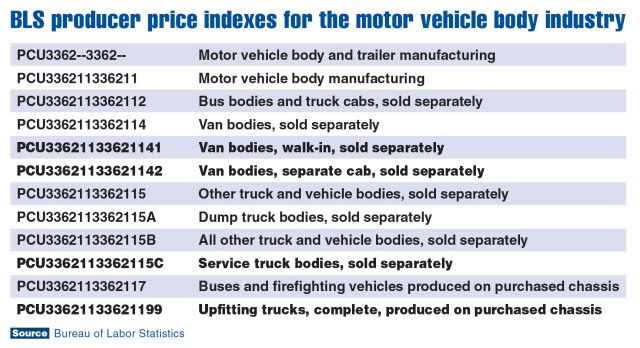
Chart courtesy of NTEA and the Bureau of Labor Statistics
Bureau of Labor Statistics (BLS) created four new producer price indexes (PPIs) for the truck equipment industry — two codes for vans, one for service bodies and one for upfits, according to a recent report from NTEA - The Association for the Work Truck Industry. They were all generated in 2016 and have a base time period of September 2015. These indexes have been published monthly since January 2016, and since there is now more than a year’s worth available, annual growth rates can be calculated.
PPIs are closely aligned with the North American Industrial Classification System (NAICS) that defines industries within the U.S. economy. Canada and Mexico use the same NAICS codes as the U.S., but PPIs and product codes (more detailed codes within industries) are different. In the U.S., many product codes within NAICS codes are grouped into product classes. Generally, BLS creates PPIs to match product classes, but in some cases, individual products have corresponding PPIs.
The chart above shows the complete list of PPIs published monthly by BLS for the motor vehicle body industry. There are numerous reasons to monitor how PPIs cycle over time — the most important of which is to use them as price escalators.
To do so, download data from bls.gov monthly. Like other government agencies, BLS uses terminology and acronyms that can be confusing, so the following may be helpful in attaining a greater understanding.
There are five alphabetic prefixes used to create unique PPI time series identifiers: WP, WD, PC, PD and ND. Each provides the user access to a different PPI database. Adding either a U (not seasonally adjusted) or S (seasonally adjusted) to the end of these prefixes further specifies the type of data needed. PC is used for final goods (truck bodies and equipment) and WP for commodities and intermediate goods (iron ore and steel sheet).
Current price indexes grouped by industry according to NAICS have series identifiers beginning with the prefix PCU. This is followed by 12 digits (the six-digit industry code is listed twice) and up to seven alphanumeric characters identifying product detail. Dashes are used as placeholders for higher-level industry group codes. All of the PPIs listed in the chart above have a PCU prefix, which means they are current (data is actively collected on a monthly basis) and not seasonally adjusted.
The new indexes for vans, service bodies and upfits measure the U.S. average change in price for those products. They allow for analysis of how prices change over time and for comparison with the rates of change for other products. For example, knowing the rate of change for walk-in van body prices is useful to many work truck industry companies, but knowing how that rate of change compares to chassis price changes could be even more valuable.
While not listed here, there are PPIs available for truck chassis, trailers and a few types of truck equipment other than bodies.
Visit www.ntea.com for more information.
More Operations

Family Ties Inside the Fleet Families Building Careers Across Generations
Three fleet families share what it really takes to work together, learn across generations, and keep business from following them home.
Read More →
Shades of Fleet Call for Voices: Fleet's Hidden Heroes
Fleet’s hidden heroes are often the ones keeping everything moving behind the scenes. September’s Shades of Fleet is looking for dispatchers, coordinators, parts specialists, and other support pros to share their stories.
Read More →
Truck Centers, Inc. Celebrates National Truck Driver Appreciation Week with $1,000 Fuel Card Giveaways
During National Truck Driver Appreciation Week, Truck Centers, Inc. is offering customers a chance to fuel up for free. Customers at all Truck Centers locations can enter to win one of four $1,000 fuel cards from Sept. 14 - 18.
Read More →
Fleet Guides, AI Time-Savers, Truck Tariffs & Fuel Strategy Lead the News
This week’s Truck Chat Cheat Sheet covers new fleet vehicle guides, practical AI use cases, U.S.-Canada truck production, mixed-energy strategy, and more.
Read More →
What Fleet Employers Are Missing When Hiring Veterans
What if some of the strongest candidates for fleet are already out there, but their experience is written in a language our industry does not always recognize?
Read More →
Automotive Fleet Opens 2026 Personal Use Survey for Commercial Fleet Managers
Less than two weeks left! Commercial and corporate fleet managers are invited to share how their organizations handle company vehicle personal-use policies, charges, and driver eligibility.
Read More →
What Resilient Fleets Do Differently When Conditions Change
Fleet resilience is about more than reacting to disruption. Lauren Fletcher talks with AP Fleet’s Alex Coveney about flexibility, planning, scaling, and what helps fleets adapt when business conditions shift.
Read More →
If We Want the Next Generation in Automotive, We Have to Give Them a Reason to Care
The automotive industry talks constantly about its workforce shortage. But before we can recruit the next generation, we may need to do a better job giving kids a reason to care about automotive in the first place.
Read More →
Ram ProMaster City Under $40K, Truck Tariffs, and AI Maintenance Lead the News
A sub-$40K commercial van, tariff questions, AI-powered maintenance, and a new EV production strategy headline this week’s Truck Chat Cheat Sheet.
Read More →
Bob Adamsky Shares the Fleet Lessons You Usually Learn the Hard Way
After more than 30 years in fleet, Arrow International’s Bob Adamsky has learned that the job is about far more than vehicles. He shares the lessons he wishes every fleet manager could learn a little earlier.
Read More →