



Which Alternative Fuel is Right for Your Fleet?
In this era of inexpensive gasoline, alternative fuels still work — though fleets must tailor the technology to the use case now more than ever before.

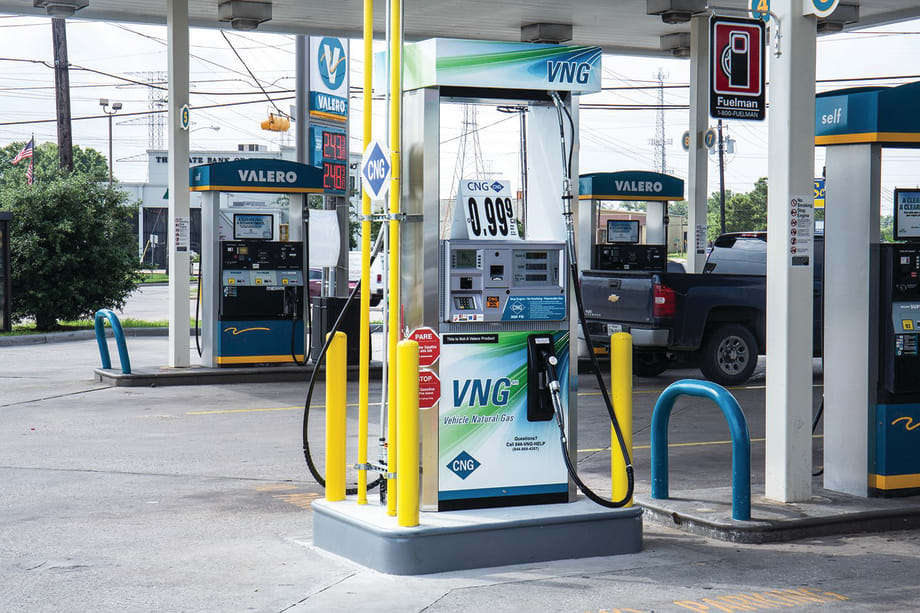
For small fleets, installing CNG fueling infrastructure onsite can be prohibitively expensive, leaving public fueling stations as the alternative. This CNG pump, provided by VNG.Co to a Valero station, is part of a multi-city public access fueling station development program in major U.S. markets. Photo courtesy of VNG.Co.
When retail fuel prices topped $4 a gallon, it was a lot easier to make the financial case for alt fuels and alt power — it was a great time to be a first adopter. Alternative fuels still work in this era of cheap gasoline, though the fleet scenarios in this article make clear that no single choice is a silver bullet.
Whether considering compressed natural gas (CNG), propane autogas, biodiesel, hybrid-electric or all-electric power, fleets need to define their duty cycles and tailor their technology accordingly.
Perform a Pilot
AmeriPride, a uniform and linen supply company, performs a myriad of delivery types across the country. As such, the AmeriPride fleet team modeled a pilot program for its step van fleet to match the alternative fuel with the route.
The pilot found that low-mileage routes were still best served with vehicles powered by gasoline, says Jimmy Crea, fleet compliance & programs coordinator, while propane and CNG work best for high-mileage routes of over 100 miles per day.
The company decided to go with CNG where public fueling is available, though coverage isn’t optimal in many locations. “In those cases, we’re going with propane,” Crea says.
The company has 15 dedicated CNG-powered step vans serving its Omaha, Neb., and Oklahoma City locations, fueled at publicly available pumps. At its Topeka, Kan., office, the company is running five propane-powered step vans fueled at an on-site pump that was subsidized by the propane supplier for close to no net cost.
In addition to substantial fuel savings, Crea cites reduced maintenance costs for both the CNG- and propane-powered vehicles. When those vehicles do need maintenance, AmeriPride outsources to qualified mechanics. “That’s been a struggle in certain places,” Crea says, however, “in only one place we couldn’t find someone to do the work.”
Crea says AmeriPride has experimented with hybrid-electric technology, in the form of electric, hydraulic and kinetics hybrids as well as all-electric trucks. However, most of the initiatives are highly dependent on grants. “The payback is hard to make it work, especially with all-electric,” he says. “With propane and CNG, we can usually make it work without incentive money.”
Crea says AmeriPride is seeing the quickest payback on CNG, dependent on retail fueling stations. “Even with low fuel prices right now, we’re still trying to move ahead on higher mileage routes with CNG,” Crea says.
AmeriPride is a family-owned company that is supportive of investing in new technology. “As one of the larger players in the industry with a lot of resources at our disposal, the family ownership feels it’s our responsibility to test and adopt new technologies,” Crea says. “That said, we’d like to break even or realize a cost savings as a result.”
The Electric Equation
Save for its transit buses, which fuel at one central location, the County of Sonoma, Calif., decided CNG wasn’t the right choice for the rest of its fleet. The county does not have a preponderance of public CNG fueling stations, and installing the fueling infrastructure would run in the millions of dollars.
To upgrade the county’s maintenance facilities to meet regulatory compliance, David Worthington, fleet manager for the county, estimates the costs alone to be $750,000 to $2.5 million.
“Because we are a decentralized fleet spread over a fairly large county, and the cost of the infrastructure is so high, the payback on the fuel savings does not pencil out,” he says. “For us, the cost-benefit ratio works better for hybrid-electric technology.”
The county runs a combination of light-duty all-electric, hybrid-electric and plug-in electric sedans, as well as two plug-in hybrid aerial bucket trucks and a 34,000-GVWR hybrid prisoner transport vehicle. Worthington says the county was able to secure grants that generally covered the cost to upgrade to electric technology.
In contrast to the lack of public CNG fueling stations, by the end of 2013, the county had more electric charging stations installed and operable than the entire California state government.
In addition to specific operational health benefits, the electric vehicles have returned substantial fuel savings and lowered maintenance costs, including saving two to three times on the brake life of the medium-duty hybrid trucks. “For brake jobs that cost $900 to $2,500 each in labor, parts and time, that’s significant savings,” Worthington says.
Worthington also counsels fleets to not overlook alt-fuel vehicles’ resale potential. Whether the vehicles are sold off to other fleets or retail buyers, the concentration of publicly available fueling stations should be a determining factor on technology choice.
For all-electric and hybrid vehicles, resale values generally have not kept pace with vehicles powered by internal combustion engines, according to Black Book data. However, Worthington says the county’s resale values on hybrids have held up, provided they’re sold with fewer than 90,000 miles. “Once you go above 90,000 on hybrids, the resale value drops significantly,” he says.
ROI in 4 Months
In 2006, Charles Feder, owner of Rossmoor Pastries in Signal Hill, Calif., bought a CNG-powered Dodge van with only 14,000 miles at a local auto auction for $4,500. Though he was unfamiliar with natural gas, for that price he quickly got acquainted with the technology.
In subsequent years, he bought more used CNG-powered vehicles until his entire fleet of 14 vans and three sedans was running solely on the alternative fuel. Feder realizes he won’t be able to buy CNG-powered vehicles as cheaply today, though he’s prepared to buy new gasoline-powered vans and convert them to CNG with aftermarket tanks for $12,000 to $14,000 per conversion.
To fuel, Feder bought a used slow-fill compressor. With a grant from the South Coast Air Quality Management District and a 30% tax write-off, he was right-side up in only four months.
The Rossmoor fleet uses about 125 CNG GGE (gas-gallons equivalent) per day, while its on-site compressors make 15 GGE per hour and can fill eight vehicles at once. If demand is greater than the compressor’s output, the vans fuel up at retail pumps about 15% to 20% of the time.
Even with today’s softened gasoline prices, the fleet still saves on fuel — paying less than $1 per GGE through his pipeline.
The vans leave the bakery with a full tank and drive about 130 to 160 miles a day, well under the range of his newer CNG tanks, which give a 225-mile range. Rossmoor’s drivers also use Clean Energy stations if needed. While his drivers have never gotten stranded, Feder himself has. “I forgot what I was doing one day and had to get towed, about a half mile from the bakery,” he says.
The Public Fueling Puzzle
Fastech is a fueling and service technology company with a recent focus on alternative fuel infrastructure. With this in mind, Dan McGill, president and founder, says his company needed to “walk the walk” in regards to using a clean burning fuel for the company’s fleet.
McGill says the first consideration was the fact that the fleet does not return to a central location each night, which ruled out on-site fueling for either propane or CNG.
Fastech decided to go with CNG. Earlier this year, McGill migrated the fleet to 50 CNG-powered (monofuel) Ram ProMaster vans and six Honda Civic GX models. Honda announced in June it would discontinue the Civic GX, the only factory-built natural gas-powered sedan. CNG aftermarket options for sedans are available now, though it will be a few years before Fastech has to worry about replacing the GX.
The conversion process was not without hiccups, as the aftermarket tank supplier had problems with approval by the California Air Resources Board (CARB) for the ProMaster tank installation. “It was a big nightmare with almost a year delay,” McGill says.
After the delay, McGill says the fleet will not receive its HOV stickers until October. They allow access to California’s carpool lanes, a tremendous timesaver when navigating one of the worst traffic congestion areas in the country.
While Southern California has one of the best networks of public CNG fueling stations in the country, Fastech has a wide daily coverage area — from San Diego to Santa Barbara — meaning drivers must always be aware of when and where to fuel.
Fastech signed a contract with Clean Energy to fill up at its public fueling stations, locking in a fuel price for three years. The drivers use a smartphone app to locate the nearest Clean Energy stations, though they have used other public stations in emergencies.
While no Fastech driver has yet run out of fuel, they have a safeguard: Each van is equipped with a valve at the fuel port that allows a hose to connect to another van. The attachment equalizes the pressure between the two vehicles, filling the empty tank with gas.
Prepare for Success
These fleets have greened the environment and done so cost effectively. But the human capital needed to understand the technologies — as well as having support from upper management — should not be underestimated.
“Unless somebody above you will allow you to take a chance with new technology, and accept that a certain percentage of those efforts will fail, you’ll never get anywhere,” says Worthington, adding that the county was left with a malfunctioning hybrid electric truck’s powertrain when the manufacturer went bankrupt.
“We have a lot of support of upper management,” says Crea. “They’ve let us take chances even if we’re not certain it’s going to work or not. For us, so far everything has been working pretty well.”
AmeriPride tried running hybrid electric cargo vans, yet found out that the application didn’t fit the duty cycle. “It’s not the technology’s fault; it’s how we use the vehicle,” Crea says.
“We’ll try a lot of things, and a majority of them will be successful,” Worthington says. “A couple will be flat-out failures and we’ll take a loss financially on them. But if you look at the big picture, it’s been a financial gain and an emissions reduction as well.”
More Small Fleet


Developing Budget-Friendly Driver Safety Programs
From driver training and safety meetings to one-on-one coaching and incentive programs, several small fleets share how they have developed a safety culture with their drivers using low- to no-cost resources.
Read More →
Boosting Last-Mile Fleet Uptime, Safety, and Value with AI Vehicle Inspections
AI-powered inspections are transforming last-mile fleets by replacing manual checks with highly accurate automated scans that detect defects in seconds. By giving fleet operations visibility into the daily condition of their vehicles, you can identify trends over the vehicle’s lifecycle that enable improved procurement decisions, route management, driver training and accountability.
Read More →
Five Ways Seat Belts Help Prevent Injuries
There are five ways seat belts protect occupants from injuries, according to the Tennessee Department of Safety and Homeland Security.
Read More →
It’s here: The 2026 Fleet Technology Trends Report
What does AI mean for fleets? Get the answer — and learn other top tech trends.
Read More →
Small Fleets, Big Impact: How Independent Drivers Power Wreaths Across America
Check out how small fleets and independent drivers power Wreaths Across America each December and why their impact matters more than ever.
Read More →
VMS Survey Finds 65% of Small Fleet Managers Run Operations Alone
A new VMS survey shows small fleet managers are stretched thin, with most handling operations solo and eager to adopt digital tools for relief.
Read More →
Tips for Driving Safely on Halloween Night
This video features a reminder from the Connecticut Department of Transportation (DOT) and the Connecticut Police Chiefs Association, urging drivers to prioritize safety this Halloween.
Read More →
AI, Access, and Uptime: VMS’s Next Chapter with David Prusinski
VMS’s new Co-CEO, David Prusinski, shares how an AI-first approach will give small fleets and repair shops the tools to compete like big players.
Read More →
Fleet Managers Share Winter Prep Tips: It's Never Too Early!
Three fleets share best practices to prep vehicles for winter and prevent downtime when the cold sets in.
Read More →