




Learn More: New Wireless Interface Control for Engine Drives from Miller
Top Challenges & Equipment Needs for a Lube Truck Mechanic
Hear from three lube truck mechanics about their biggest challenges and the importance of having reliable tools and equipment that help save them time.
by Cari Groppel, Miller Electric Mfg. LLC
June 28, 2021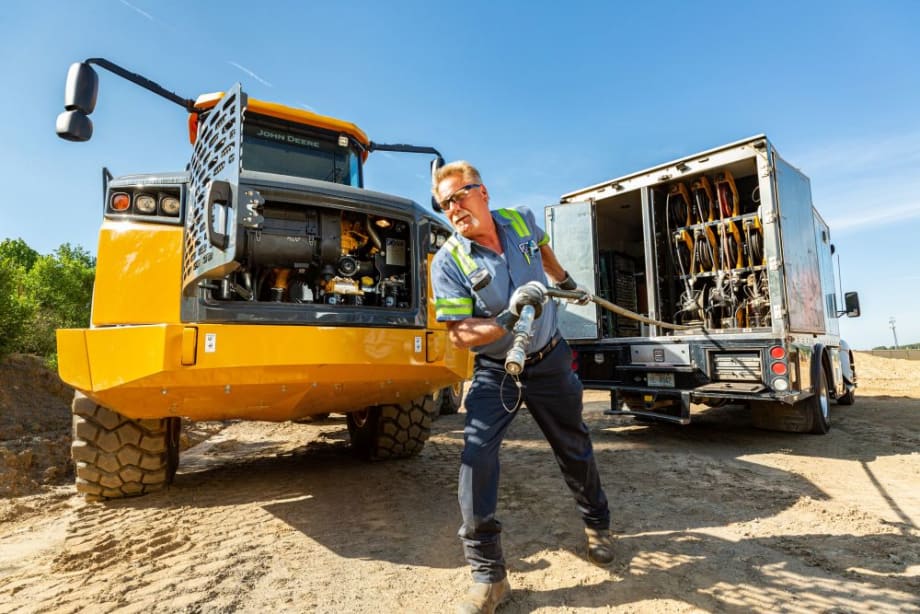
Lube truck mechanics may have hundreds of pieces of heavy machinery to service on a rotating schedule.
Photo: Miller
5 min to read
Lube truck mechanics may have hundreds of pieces of heavy machinery to service on a rotating schedule. Completing this preventive maintenance (PM) efficiently helps keep equipment performing optimally to prevent downtime. And because time is money, it’s critical for mechanics to finish PMs on schedule so they can move to the next job.
Hear from three lube truck mechanics — Vernon Patrick and John Ehlinger, both with Hoopaugh Grading Company in North Carolina, and Stewart Hanserd with Thompson Tractor in Alabama — about their biggest challenges and the importance of having reliable tools and equipment that help save them time.
Q: What is a typical day like for you with your mobile lube service truck?
Vernon: Our company owns about 500 pieces of equipment that need service. My boss usually sets me up with two services per day. We offer three types of service — a 500-hour, a 1,000-hour and a 2,000-hour. Some of these machines have up to 25 filters and depending on the service, we change all the filters. A 2,000-hour is a big service. We’ll drain all the differentials, all the hydraulic fluid, all the steering, all of the engine oil. And that can be up to 500 gallons.
John: Our boss usually sets us up with two PM services a day. We'll do one in the morning and one at lunch, and we'll spend the rest of our evenings filling the truck up with the oils and picking up filters for the next day. A 1,000-hour service would take about 90 minutes and the 2,000-hour service can take up to four hours.
Stewart: We do preventive maintenance work in the field, on machines in our company’s rental fleet and also on customer-owned machines. Some mornings, I'll start at 3:00 in the morning, some mornings I start at 5:00. And 14 or 17 hours later, I come back home. I must do about 50 services per month.
Q: Describe your truck setup.
Vernon: I have a 2019 Peterbilt box truck. I have an all-in-one system on the truck and a heater in the back that runs from the fuel tank. That keeps the back of the truck warm in the winter. The oil flows a lot better and faster when it’s warm. If the oil gets cold, it gets thick and runs really slow. Inside the box truck I’ve got shelves for all the filters. I carry about eight different types of oil because each piece of equipment requires different types. I have tanks that hold anywhere from 200 to 500 gallons each.
John: I have a box truck with a PTO system and an air compressor, and it carries everything you could think of to do an oil change on heavy machinery. I have pumps that pump the fluid out of the tanks with the oil guns and a suction hose that sucks up the waste oil into the waste tank. Pretty much from the time I leave the house to the time I get home, that truck’s running.
Stewart: I have a Class C Peterbilt. It has tanks and I have an all-in-one system in the back.

Because time is money, it’s critical for mechanics to finish PMs on schedule so they can move to the next job.
Photo: Miller
Q: What are the biggest challenges or issues for you on the jobsite?
Vernon: The weather is a big challenge. I've had to work in three inches of water running underneath the truck and you got to crawl under there and change the oil. I've had to sweep snow off the top of the machine to get to it. I like to keep my truck running because if I get cold or hot, I can hop in the truck and cool down or get warm. There are days where you can’t feel your fingers, so you have to get warm to keep working. The cab is like my home away from home. I spend so much time in there.
John: When it rains and makes everything muddy, that can be a challenge. The only other problem might be when bolts break or something like that.
Q: How has your job or the equipment/tools you’re using changed in the past 5 years?
Vernon: Switching from a PTO to the all-in-one system was a game changer, as far as I'm concerned. Since I’ve got the all-in-one, I can suck the oil out and I can fill it up at the same time. That has really helped us keep things moving a lot faster. Where before with my older PTO system, a 2,000-hour service might take me eight or nine hours, now I can do it in significantly less time. I’m saving time, I’m saving fuel and the operator gets to go back to work quicker.
Stewart: There's different equipment, different applications. I've got hydraulic reels or hydraulic pumps, where years ago all they had was air pumps. It's a whole lot faster. The equipment we service has gotten bigger and there’s more to do on them.
Q: What are the most important factors that keep you happy and efficient in your job?
Vernon: The newer the truck, the easier it is on the mechanic because I have to drive two to three hours sometimes just to get to one jobsite. And if you don’t have the right stuff, you can’t get the job done efficiently. That includes my all-in-one, my tanks being big enough, my heater, and having the right tools.
Stewart: I don’t want any wasted space because you always need places to put things. On lube trucks, you need all the storage you can get. Some of these air filters take up a lot of room. If you run out of supplies, you're going to have to go back, or you’ve got to find something to use to do your job.
Q: What is the biggest misconception about your job?
Vernon: That it’s just an oil change. It's a lot more complicated than just the engine oil. Because you’ve got hydraulics, transmission differentials, drop box, swing motor, final drives — and all of these take different types of oil.
Stewart: It's hard work. You endure the elements: the heat, the rain. It's just a fast pace. You’ve got to manage your time, manage the oil, manage your truck and get back home in a safe manner, too.
About the Author: This article was authored by Cari Groppel, market development manager for Miller Electric Mfg. LLC, and edited according to WT editorial standards and style to provide useful information to our readers. Opinions expressed may not reflect that of WT.
Subscribe to Our Newsletter
More Operations
Family Ties Inside the Fleet Families Building Careers Across Generations
Three fleet families share what it really takes to work together, learn across generations, and keep business from following them home.
Read More →
Shades of Fleet Call for Voices: Fleet's Hidden Heroes
Fleet’s hidden heroes are often the ones keeping everything moving behind the scenes. September’s Shades of Fleet is looking for dispatchers, coordinators, parts specialists, and other support pros to share their stories.
Read More →
Truck Centers, Inc. Celebrates National Truck Driver Appreciation Week with $1,000 Fuel Card Giveaways
During National Truck Driver Appreciation Week, Truck Centers, Inc. is offering customers a chance to fuel up for free. Customers at all Truck Centers locations can enter to win one of four $1,000 fuel cards from Sept. 14 - 18.
Read More →
Fleet Guides, AI Time-Savers, Truck Tariffs & Fuel Strategy Lead the News
This week’s Truck Chat Cheat Sheet covers new fleet vehicle guides, practical AI use cases, U.S.-Canada truck production, mixed-energy strategy, and more.
Read More →
What Fleet Employers Are Missing When Hiring Veterans
What if some of the strongest candidates for fleet are already out there, but their experience is written in a language our industry does not always recognize?
Read More →
Automotive Fleet Opens 2026 Personal Use Survey for Commercial Fleet Managers
Less than two weeks left! Commercial and corporate fleet managers are invited to share how their organizations handle company vehicle personal-use policies, charges, and driver eligibility.
Read More →
What Resilient Fleets Do Differently When Conditions Change
Fleet resilience is about more than reacting to disruption. Lauren Fletcher talks with AP Fleet’s Alex Coveney about flexibility, planning, scaling, and what helps fleets adapt when business conditions shift.
Read More →
If We Want the Next Generation in Automotive, We Have to Give Them a Reason to Care
The automotive industry talks constantly about its workforce shortage. But before we can recruit the next generation, we may need to do a better job giving kids a reason to care about automotive in the first place.
Read More →
Ram ProMaster City Under $40K, Truck Tariffs, and AI Maintenance Lead the News
A sub-$40K commercial van, tariff questions, AI-powered maintenance, and a new EV production strategy headline this week’s Truck Chat Cheat Sheet.
Read More →
Bob Adamsky Shares the Fleet Lessons You Usually Learn the Hard Way
After more than 30 years in fleet, Arrow International’s Bob Adamsky has learned that the job is about far more than vehicles. He shares the lessons he wishes every fleet manager could learn a little earlier.
Read More →