





Want more insights from Theresa Belding? Watch the full Fleet Legends video interview above to hear Theresa’s fleet journey in her own words, including her biggest challenges, career-defining pivots, and the advice she wishes someone had given her when she was starting out.
Theresa Belding on Learning, Leading, and Lasting in Fleet
From typewriters to telematics, from 250 vehicles to thousands, this story is a reminder that while vehicles may power the fleet industry, it's the people behind the wheel and behind the desk who steer the change.
September 4, 2025
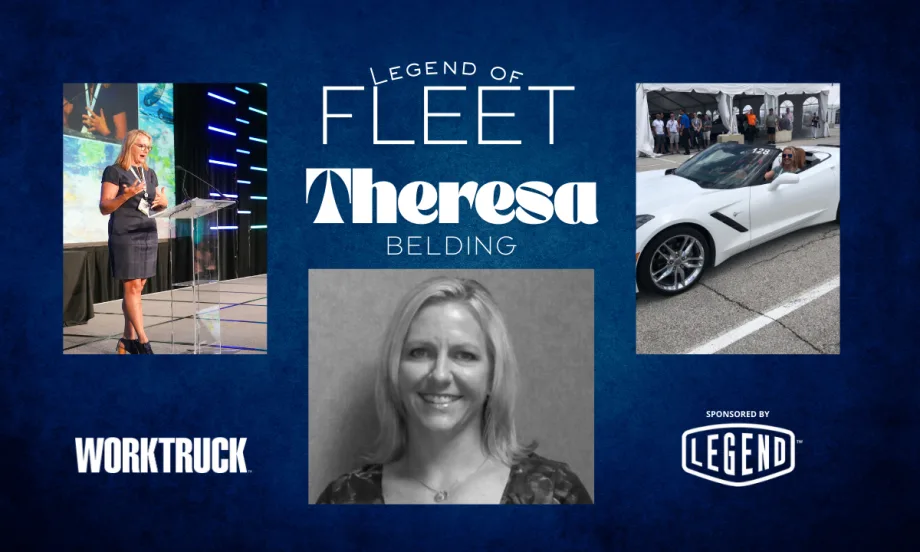
Theresa Belding's fleet journey began in 1991 with Forest Pharmaceuticals, working in data entry. Join the ride with us as we walk through her journey!
Photo: Theresa Belding | Work Truck
6 min to read
Some fleet legends are born. Others, like Theresa Belding, senior fleet consultant for Cavis, roll up their sleeves, start in data entry, and grow into their legendary status through experience, adaptability, and an unwavering willingness to learn.
In the latest Fleet Legends episode, sponsored by Legend Fleet, I had the privilege of sitting down with Belding to talk shop about her multi-decade journey in fleet management. From typewriters to telematics, from 250 vehicles to thousands, her story is a reminder that while vehicles may power the fleet industry, it's the people behind the wheel and behind the desk who steer the change.
From Bulletin Board to Big Picture
“I think like most people, I stumbled into fleet,” Belding said.
Her journey began in 1991 with Forest Pharmaceuticals, working in data entry. “About two years in, I saw a posting on the bulletin board for a fleet and benefits coordinator. And I thought, what's that? Let’s go find out,” she said.
After shadowing HR and deciding it sounded interesting, she jumped in. “We had a tiny fleet of about 250 vehicles at the time, and from there, things just went like wildfire,” Belding said. “There were mergers, acquisitions, organic growth, and my position morphed from HR generalist to fleet coordinator. I handled workers’ comp for a while, and eventually, fleet became the focus because we had thousands of vehicles.”
Technology Took Over
When asked about the biggest industry change over the years, Belding didn’t hesitate.
“Technology, 100%,” she said. “Technology with fleet management companies and in the vehicles themselves.”
She reflected on just how far things have come.
“I’m dating myself here, but my first vehicles came with manual roll-down windows and manual locks,” Belding said. “Today’s vehicles are very automated, and that technology keeps our employees safer. Technology has shaped the industry and how we do things.”
Lessons in the Pivot
One of Belding’s biggest challenges came from managing relationships and disruptions with OEMs.
“It’s our friends at the OEMs who have provided the most challenges,” she said. “Recently, with the allocation model, we had to expand our selector and make new contacts because we needed 400 orders and were only going to get 200 from our current OEMs.”
It wasn’t the first time. “About a decade ago, there were OEM strikes. If you were locked into one OEM, you weren’t going to get vehicles,” Belding said. “One time, we had a major concern with a Ford vehicle and had to pivot quickly. Thankfully, I had kept the lines of communication open with other manufacturers, so it was an easy transition.”
Her takeaway? “Remain open to all your options,” she said. “Don’t close doors. Keep relationships open because you don’t know what’s going to happen.”
Building Confidence Through Community
One of the most important lessons Belding learned wasn’t in a manual or a training session.
“Get involved,” she said. “AFLA, NAFA, your fleet management company forums—just get out there and meet your peers.”
Early in her career, she found her community in NAFA’s pharmaceutical group. “We did a survey every year and reported back at the expo. That’s where I got my first taste of knowledge sharing,” Belding said. “No one inside my company was a fleet expert, even leadership. So I leaned on the people who had done it before.”
Attending that first workshop was intimidating. “I didn’t know anyone. I hardly knew what I was doing,” she said. “But jumping in with both feet, meeting people, benchmarking, and keeping those lines of communication open is where you really learn.”
What She Wishes She Knew
“I wish I had known about the industry organizations sooner,” Belding said. “Thankfully, fleet management and OEM vendors introduced me to them.”
She credited her local NAFA chapter in St. Louis with giving her a strong start.
“Getting to my first I&E, then my first AFLA, helped me get integrated into this pool of experts. I wish I’d done it five years earlier,” she said.
Rookie Mistakes to Avoid
Belding has seen many new fleet managers walk in with the wrong assumption. “The biggest mistake is thinking your fleet management company is your one-stop shop,” she said.
She advises keeping an open mind when it comes to all vendors, even competitors. “Meet with remarketers, safety providers, anyone who handles even a small piece of fleet,” Belding said. “You don’t have to do business with them, but listen. Because sometimes you have to pivot.”
And when that time comes, it helps to have options. “If you haven’t nurtured those relationships, you don’t know where to go,” she said. “I’ve learned a lot from people I’ve never even done business with.”
Think Big Picture
Belding emphasized two key practices she always returns to: managing total cost of ownership (TCO) and educating stakeholders.
“There are so many fleet best practices,” she said. “Factory order where you can, of course. But more importantly, manage to a TCO instead of just looking at cap cost.”
She explained why it’s critical to bring others along for the ride.
“Make sure the people who sign off on your decisions understand why you’re choosing what you’re choosing,” Belding said. “We might pick a vehicle with a higher TCO because it has great resale. Or an EV because we’ll save on fuel. If you're only looking at the initial cost, you’re missing the whole picture.”
From Carbon Copies to Dashboards
Few fleet professionals have seen the digital leap firsthand quite like Belding.
“When I was placing orders with the fleet management company for the very first time, I was typing them on a typewriter,” she said. “Quadruple carbon copies. Mailing a copy. And another copy. And another…”
Now? “Drivers are ordering their own vehicles online,” Belding said. “The biggest takeaway is the speed at which you can deliver and receive information. What used to take an hour now takes 30 seconds.”
It’s All About the People
Fleet might sometimes feel like a solo sport, but the best success comes from a strong team. Belding is quick to credit communication as the key to building one.
“The biggest contributor to leading a successful team is making sure they understand why we’re doing what we’re doing,” she said. “It brings them into the decision-making, helps them understand the goal, and gives them a chance to offer new ideas.”
Veteran processes are great but not always perfect. “If an employee understands the goal, they can suggest a better way of doing something,” Belding said. “And sometimes I lose sight of that because I’ve been doing it a certain way for so long.”
Advice for the Next Generation
What would she tell new fleet professionals just entering the industry?
“Educate, educate, educate,” Belding said. “Grab all the information you can. NAFA has a great formal education. AFLA is developing new education. Attend conferences. Go to your fleet management forums. Stay open and keep learning.”
Even now, she’s still learning too. “We’ve got new technology, electric vehicles, and I got into a self-driving Uber last month,” she said. “These things are coming. If you want to stay relevant and at the top of your game, you’ve got to stay on top of it.”
The Final Word
“Fleet is fun,” Belding said. “There are a lot of fun things to do, such as OEM meetings, fleet management company forums, and your team needs to get in on the fun too.”
Her biggest piece of advice? “Network, network, network times 100,” she said. “Let your team make their own connections. That’s how they grow. That’s how you build a strong, independent team.”
Subscribe to Our Newsletter
More Operations
Family Ties Inside the Fleet Families Building Careers Across Generations
Three fleet families share what it really takes to work together, learn across generations, and keep business from following them home.
Read More →
Shades of Fleet Call for Voices: Fleet's Hidden Heroes
Fleet’s hidden heroes are often the ones keeping everything moving behind the scenes. September’s Shades of Fleet is looking for dispatchers, coordinators, parts specialists, and other support pros to share their stories.
Read More →
Truck Centers, Inc. Celebrates National Truck Driver Appreciation Week with $1,000 Fuel Card Giveaways
During National Truck Driver Appreciation Week, Truck Centers, Inc. is offering customers a chance to fuel up for free. Customers at all Truck Centers locations can enter to win one of four $1,000 fuel cards from Sept. 14 - 18.
Read More →
Fleet Guides, AI Time-Savers, Truck Tariffs & Fuel Strategy Lead the News
This week’s Truck Chat Cheat Sheet covers new fleet vehicle guides, practical AI use cases, U.S.-Canada truck production, mixed-energy strategy, and more.
Read More →
What Fleet Employers Are Missing When Hiring Veterans
What if some of the strongest candidates for fleet are already out there, but their experience is written in a language our industry does not always recognize?
Read More →
Automotive Fleet Opens 2026 Personal Use Survey for Commercial Fleet Managers
Less than two weeks left! Commercial and corporate fleet managers are invited to share how their organizations handle company vehicle personal-use policies, charges, and driver eligibility.
Read More →
What Resilient Fleets Do Differently When Conditions Change
Fleet resilience is about more than reacting to disruption. Lauren Fletcher talks with AP Fleet’s Alex Coveney about flexibility, planning, scaling, and what helps fleets adapt when business conditions shift.
Read More →
If We Want the Next Generation in Automotive, We Have to Give Them a Reason to Care
The automotive industry talks constantly about its workforce shortage. But before we can recruit the next generation, we may need to do a better job giving kids a reason to care about automotive in the first place.
Read More →
Ram ProMaster City Under $40K, Truck Tariffs, and AI Maintenance Lead the News
A sub-$40K commercial van, tariff questions, AI-powered maintenance, and a new EV production strategy headline this week’s Truck Chat Cheat Sheet.
Read More →
Bob Adamsky Shares the Fleet Lessons You Usually Learn the Hard Way
After more than 30 years in fleet, Arrow International’s Bob Adamsky has learned that the job is about far more than vehicles. He shares the lessons he wishes every fleet manager could learn a little earlier.
Read More →