





Related: How the Evolution of Parking Will Affect Fleets
Should Delivery Fleets Pay to Park in Loading Zones?
The humble city curb is now coveted real estate, and it’s making mobility increasingly difficult. Cities are turning to curb management concepts that allow fleets to dynamically guarantee parking for a fee.
October 13, 2020
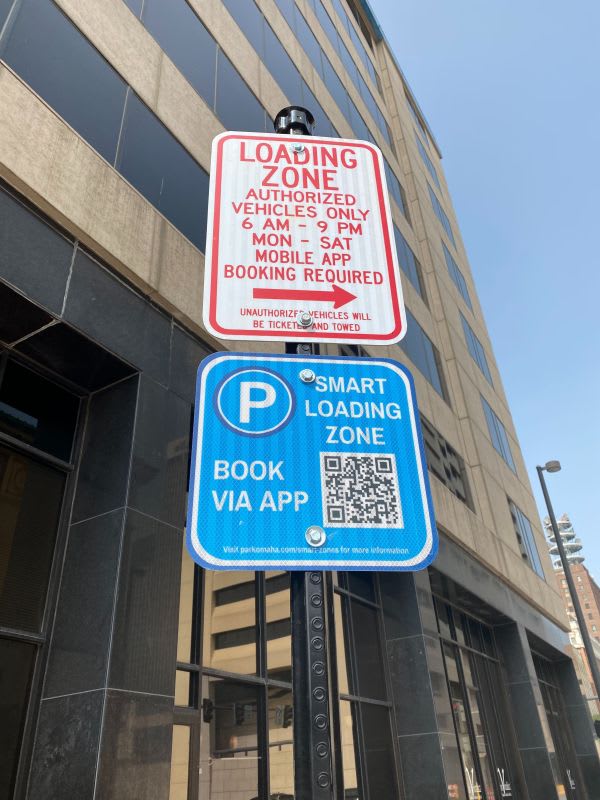
Instead of a jumble of street signs, fleet drivers in Omaha scan a QR code on a placard to access rules and information for that space. They can place a hold on that space, pay for, and extend their time through a downloaded app.
Photo by Doneliza Joaquin/Coord.
5 min to read
“It’s bad enough that parking rates have almost doubled in some cities in the last few years. And now you expect me to pay to park in a loading zone that was traditionally free? Please.”
Fleets across the U.S. are seeing rising operational costs, from insurance and driver salaries to tires, maintenance, and repairs. Add parking to the list, as cities such as Seattle and San Francisco charge commercial vehicles to park in loading zones. More will follow suit.
It’s easy for fleets to throw up their hands at rising costs, but what if these fees came with a system to make commercial parking “smart” and promise to ease the congestion, double parking, and chaotic loading experiences that are the norm in most cities?
Smart Zone programs being developed by Coord, a “curb management company,” are intended to do just that. “We provide technology to cities and fleets to both manage and use that space more effectively on a real-time, dynamic basis,” says Stephen Smyth, Coord CEO and cofounder.
The need for smarter parking has been growing for a decade, Smyth says, which has been recently exacerbated during the pandemic. What started with parcel delivery vans, personal cars, and carsharing vehicles grew into ride-hail services and then fleets of scooters, e-bikes, and cargo tricycles — all jockeying for a limited number of curb space.
Now add pandemic responses to the mix such as curbside food pickup and entire street closures in some cities for outside restaurant dining. Smyth cites the statistic that a quarter of all retail sales in the third quarter of 2020 came via e-commerce. This trend appears to be a societal shift with no sign of slowing down.
Yes, the humble city curb is now coveted real estate, and it’s making mobility increasingly difficult for everyone. The explosion of demand for street space is causing city planners, businesses, transit authorities, and commercial fleets to rethink curb management and policies.
A Guaranteed Spot
Spun out of Alphabet’s Sidewalk Labs, Coord is developing curb management pilot programs in Omaha, Aspen, Nashville, and West Palm Beach. The goal is to create tailored “Smart Zones,” in which loading space is dedicated for use by participating drivers using a mobile app to view Smart Zone locations, availability, and rules for each loading space. Drivers use the app to place a hold on the space, pay for, and extend their time.
By having a guaranteed spot waiting for them, fleets can reduce the wasted time spent circling for parking, which accounts for 25% to 30% of a typical last-mile delivery. “That extra time really adds up for even 10 trips a day,” Smyth says. “If cities can do a better job with parking, they can do a better job of managing traffic flow in general.”
The system is also designed to ease the impetus to park illegally, which comes with the associated burden of fines. UPS pays $25 to $30 million to New York City each year in parking tickets. “Those fines can’t be written off as a business expense, but parking fees can,” Smyth adds.
As making deliveries is dynamic and sometimes haphazard, drivers are only enabled to hold the space when they’re reached the last half mile. If they pull up and the space is taken, enforcement officers are notified to take appropriate action.
As the system is entirely digital, rules and prices can be adjusted in response to policy changes, special events, or emergencies without having to modify signage on the street.
For cities, the Coord platform provides information about when, where, and for how long drivers are loading. Cities can calibrate the system to create more loading space where and when it’s most needed and manage demand for loading spaces through pricing and time limits.
The fleet is billed on a per-minute basis. Charging per minute allows better demand management for loading and promotes better availability for drivers who need to use a loading zone. Peak and off-peak pricing can spread demand over a larger window of the day and across different zones, Smyth says.
Omaha’s Program
In September, the city of Omaha, Neb. launched its Smart Zone pilot with Coord. The five Smart Zones are located in Omaha’s downtown and Old Market districts.
Ken Smith, Omaha’s parking & mobility manager, witnessed the growing parking problem firsthand. “We saw it coming on the horizon with deliveries and ride hailing and other services that all needed access to the curb, and we started to figure out how we were going to manage it all,” he says.
Omaha applied to participate in and was chosen for Coord’s inaugural Digital Curb Challenge to implement its curb management program. The other chosen cities are Aspen, Nashville, and West Palm Beach, Fla.
“The curb has become much more valuable to the city,” Smith says, adding that traditional metered parking spaces have been overwhelmed by package deliveries and gig economy services. “It's having a big impact on city infrastructure. And I think it's wise for cities to start thinking about how to manage that dynamic movement of goods and services from the curb space to the property.”
Smith says the rollout has gone well, even as the city and fleets are still on a learning curve to disseminate information. Fleets have been receptive to the concept, with one distinct advantage to date — they don’t pay to use the Smart Zones.
Smith is non-committal on whether or when the city eventually will charge, but he says data collection will inform the decision. Overall, he’s aware of the promise of dynamic charging to create change.
“We're all going to have to eventually make these economic choices, because that's how we're going to manage curbs,” he says. “And the best way to do that is to charge something for it.”
Originally posted on Automotive Fleet
Subscribe to Our Newsletter
More Operations
Family Ties Inside the Fleet Families Building Careers Across Generations
Three fleet families share what it really takes to work together, learn across generations, and keep business from following them home.
Read More →
Shades of Fleet Call for Voices: Fleet's Hidden Heroes
Fleet’s hidden heroes are often the ones keeping everything moving behind the scenes. September’s Shades of Fleet is looking for dispatchers, coordinators, parts specialists, and other support pros to share their stories.
Read More →
Truck Centers, Inc. Celebrates National Truck Driver Appreciation Week with $1,000 Fuel Card Giveaways
During National Truck Driver Appreciation Week, Truck Centers, Inc. is offering customers a chance to fuel up for free. Customers at all Truck Centers locations can enter to win one of four $1,000 fuel cards from Sept. 14 - 18.
Read More →
Fleet Guides, AI Time-Savers, Truck Tariffs & Fuel Strategy Lead the News
This week’s Truck Chat Cheat Sheet covers new fleet vehicle guides, practical AI use cases, U.S.-Canada truck production, mixed-energy strategy, and more.
Read More →
What Fleet Employers Are Missing When Hiring Veterans
What if some of the strongest candidates for fleet are already out there, but their experience is written in a language our industry does not always recognize?
Read More →
Automotive Fleet Opens 2026 Personal Use Survey for Commercial Fleet Managers
Less than two weeks left! Commercial and corporate fleet managers are invited to share how their organizations handle company vehicle personal-use policies, charges, and driver eligibility.
Read More →
What Resilient Fleets Do Differently When Conditions Change
Fleet resilience is about more than reacting to disruption. Lauren Fletcher talks with AP Fleet’s Alex Coveney about flexibility, planning, scaling, and what helps fleets adapt when business conditions shift.
Read More →
If We Want the Next Generation in Automotive, We Have to Give Them a Reason to Care
The automotive industry talks constantly about its workforce shortage. But before we can recruit the next generation, we may need to do a better job giving kids a reason to care about automotive in the first place.
Read More →
Ram ProMaster City Under $40K, Truck Tariffs, and AI Maintenance Lead the News
A sub-$40K commercial van, tariff questions, AI-powered maintenance, and a new EV production strategy headline this week’s Truck Chat Cheat Sheet.
Read More →
Bob Adamsky Shares the Fleet Lessons You Usually Learn the Hard Way
After more than 30 years in fleet, Arrow International’s Bob Adamsky has learned that the job is about far more than vehicles. He shares the lessons he wishes every fleet manager could learn a little earlier.
Read More →