





Dive Deeper: Gas vs. Diesel: The Bad Investment Only Fleet Managers Know About
One Year Later: The Impact of ULSD on Diesel Engines
It’s been a year since stricter EPA regulations aimed at reducing sulfur content in diesel fuel became effective. Most fleets surveyed report no problems, although cold weather and vehicle age may present issues.
November 1, 2007
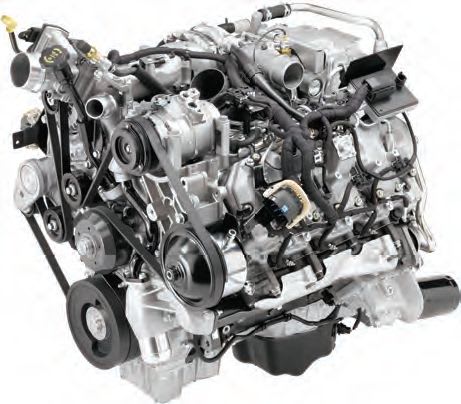
Chevy’s 2008 Duramax Diesel 6.6L V8 Turbo
Photo: Chevrolet
6 min to read
Except for some older trucks, the switch by fleets to using ultra low sulfur diesel (ULSD) fuel has been relatively painless.
New Environmental Protection Agency (EPA) regulations regarding ULSD for on-highway vehicle use went into effect in 49 states in fall 2006. In California, fuel refining and distribution requirements apply to both on- and off-highway vehicles.
ULSD, now required to account for at least 80% of the volume of diesel fuel produced and imported, reduces sulfur content from a previous 30 parts per million (ppm) to 15 ppm.
By 2010, all highway diesel fuel must be ULSD.
Florida Fleets Experience Zero Issues
Like most fleets, “We haven’t noticed any difference whatsoever” in using ULSD, said John Crull, CAFM, fleet manager for the city of Daytona Beach, Fla. He manages approximately 1,700 vehicles.
“Everybody mentions it (ULSD), but nobody seems to be having any issues with it,” he said.
Doug Weichman, CAFM, director, Palm Beach County Fleet Management in Florida also noted, “We’ve had no problems whatsoever related to ULSD.”
The Palm Beach County fleet numbers nearly 5,000 vehicles. It includes about 2,000 diesel engine vehicles of varying size and configuration, which consume about 3.5 million gallons of fuel annually.
Weichman said it took “quite a few times of processing” or “through-putting” of ULSD at the county’s own fueling sites and storage tanks to eliminate the older, higher sulfur content fuel and achieve 15 ppm.
However, the Palm Beach County agency began the process early enough so that when its 2007 vehicles began arriving, “We knew we’d be at the proper ppm level so as not to clog the particulate traps,”Weichman explained.
Marvin Fletcher, CAFM, director of fleet services for Hanover County, Virginia, also reported having had “no impact from a performance or breakdown standpoint with the use of ULSD.”
“We haven’t had any drivability issues or complaints at all. It’s one of the things I’m glad to say we’ve had no problems with,” Fletcher concluded.
His fleet numbers about 1,200 vehicles and includes some models dating back to the 1980s.
New Hampshire Fleet Adds Lubricity in Winter
With some older trucks, the transition to ULSD hasn’t been totally smooth.
Larry Forkum, fleet manager for the city of Portsmouth, N.H., said, with USLD, “some of the (1998 and older model) trucks were stumbling, almost like the (fuel) pumps were trying to bind. We chased down everything — didn’t get a good answer on all the checks we knew — and came to the point where we decided it must be a lubricity problem.”
The problem primarily surfaced in the winter — a particularly inopportune time because of crucial road salting and snowplowing operations Forkum’s municipality must deal with.
“The fuel (ULSD) is dry. But when it’s cold, it seems to get drier,” he said.
His maintenance people solved the problem by adding a half-quart of antigel with a lubricity package to every tank of fuel in wintertime.
“You can buy anti-gels as an additive, and now you can buy anti-gel with lubricity. It’s just another product,” Forkum said.
Lubricity is a measure of the fuel’s ability to lubricate and protect the various parts of the engine’s fuel injection system from wear.
According to the EPA, the processing required to reduce sulfur to 15 ppm does remove naturally occurring lubricity agents in the diesel fuel.
However, the American Society for Testing and Materials adopted a new lubricity specification standard for all diesel fuels to manage the change, effective January 1, 2005, EPA officials point out.
Biodiesel mixed with ULSD also adds lubricity, as various fleet managers note.
Steve Russell, fleet superintendent for the city of Keene, N.H., for example, uses a ULSD biodiesel blend exclusively in the city’s fleet and said he hasn’t had any fuel-related issues with his trucks.
Palm Beach County’s Weichman, who attended a seminar on the subject, also noted the lubricity benefits of biodiesel mixed with ULSD and is considering its use in his fleet.
Los Angeles Adopts ULSD
The County of Los Angeles, Public Works has, perhaps, the most extensive experience with ULSD, having used the fuel since early 2002, when it began retrofitting its trucks with particulate filters and diesel oxidation catalysts.
The California Air Resources Board (CARB) requires all diesel-powered, 2006-model and older public fleet and utility trucks to be retrofitted with particulate filters and oxidation catalysts by the end of 2010.
“We got in really early as one of the first ones,” said Richard Teebay, an official with the County of Los Angeles Public Works.
In early 2002, Public Works began using only ULSD for all the fleet’s diesel-powered equipment. That year, it had 550 diesel-powered trucks and another 200 diesel construction, portable, and stationary units.
At that time, it did not experience any issues with the engines, that were linked to changing to ULSD, said Teebay.
But, in the mid-1990s, the agency encountered issues when California modified its diesel fuel standard from the Federal (500 ppm) to CARB low sulfur (150 ppm).
“We saw some hose failures and some accelerated fuel filter replacement. But most of these were limited to the older (early 1980s) engines,” Teebay said.
Subsequently, on 60 trucks the agency retrofitted with passive diesel particulate filters, which logged almost 63,000 hours of service, four “problems” occurred; but they were with the retrofit devices — not the fuel, Teebay noted.
Perhaps most instructive was a truck whose injector(s) became fouled. It required cleaning out the diesel particulate filter and injectors.
“The diesel particulate filter will magnify any kind of fuel problem,” Teebay said. “If the engine misses, for example, because you lost an injector, it will magnify that.”
Another incident involved a vehicle whose engine simply “didn’t work hard enough” to cause the particulate filter to burn off the soot accumulated during the regeneration/cleaning process.
This situation can occur in low-speed applications, where the truck sits and idles a great deal. It can affect utility vehicles, for example, depending on where they work and how long they idle.
L.A. County’s Public Works department solved the problem by cleaning particulate filter more regularly — every 40-50 weeks.
Refuse trucks actually do pretty well with retrofits, according to Teebay, because when they are full of cargo and go to landfill, the engines work hard — hard enough and long enough to cause the passive particulate filters to regenerate.
A third incident simply involved an off-road operator knocking the wire off a backpressure sensor at a work site. “That was a pretty easy fix,” Teebay recalled.
Fleets used to operating with extended drain intervals, such as major over-the-road fleets with long intervals between oil changes, with ULSD may need to shorten the intervals, Teebay added.
“Most governmental fleets don’t do that. And it hasn’t been an issue with us,” he says.
Affected fleets should test oil samples to find the optimal point (for an oil change), and then set the drain interval accordingly, Teebay concluded.
Subscribe to Our Newsletter
More Operations

Family Ties Inside the Fleet Families Building Careers Across Generations
Three fleet families share what it really takes to work together, learn across generations, and keep business from following them home.
Read More →
Shades of Fleet Call for Voices: Fleet's Hidden Heroes
Fleet’s hidden heroes are often the ones keeping everything moving behind the scenes. September’s Shades of Fleet is looking for dispatchers, coordinators, parts specialists, and other support pros to share their stories.
Read More →
Truck Centers, Inc. Celebrates National Truck Driver Appreciation Week with $1,000 Fuel Card Giveaways
During National Truck Driver Appreciation Week, Truck Centers, Inc. is offering customers a chance to fuel up for free. Customers at all Truck Centers locations can enter to win one of four $1,000 fuel cards from Sept. 14 - 18.
Read More →
Fleet Guides, AI Time-Savers, Truck Tariffs & Fuel Strategy Lead the News
This week’s Truck Chat Cheat Sheet covers new fleet vehicle guides, practical AI use cases, U.S.-Canada truck production, mixed-energy strategy, and more.
Read More →
What Fleet Employers Are Missing When Hiring Veterans
What if some of the strongest candidates for fleet are already out there, but their experience is written in a language our industry does not always recognize?
Read More →
Automotive Fleet Opens 2026 Personal Use Survey for Commercial Fleet Managers
Less than two weeks left! Commercial and corporate fleet managers are invited to share how their organizations handle company vehicle personal-use policies, charges, and driver eligibility.
Read More →
What Resilient Fleets Do Differently When Conditions Change
Fleet resilience is about more than reacting to disruption. Lauren Fletcher talks with AP Fleet’s Alex Coveney about flexibility, planning, scaling, and what helps fleets adapt when business conditions shift.
Read More →
If We Want the Next Generation in Automotive, We Have to Give Them a Reason to Care
The automotive industry talks constantly about its workforce shortage. But before we can recruit the next generation, we may need to do a better job giving kids a reason to care about automotive in the first place.
Read More →
Ram ProMaster City Under $40K, Truck Tariffs, and AI Maintenance Lead the News
A sub-$40K commercial van, tariff questions, AI-powered maintenance, and a new EV production strategy headline this week’s Truck Chat Cheat Sheet.
Read More →
Bob Adamsky Shares the Fleet Lessons You Usually Learn the Hard Way
After more than 30 years in fleet, Arrow International’s Bob Adamsky has learned that the job is about far more than vehicles. He shares the lessons he wishes every fleet manager could learn a little earlier.
Read More →