




Navistar & Mahindra Launch Joint Truck Venture
A new line of trucks manufactured by Mahindra-Navistar for commercial customers in India may impact how vehicles will be designed for similar customers elsewhere around the world.

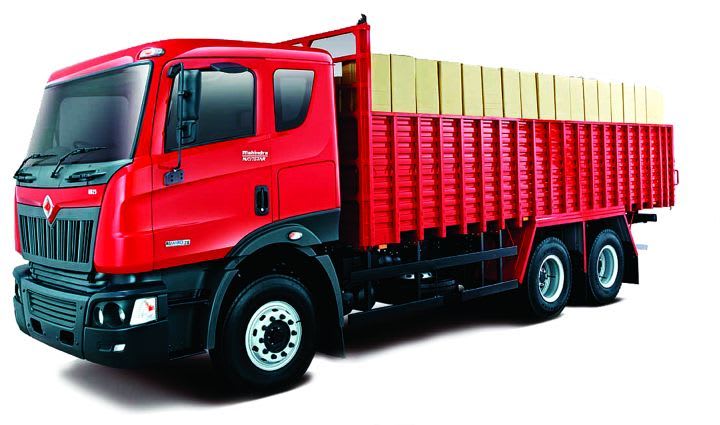
Mahindra-Navistar’s new line of trucks include conventional aero-nose trucks for sale in the North American market.
Photo: Navistar
Formed in 2005, Mahindra-Navistar is a joint venture between Mahindra Mahindra, a utility vehicle, tractor, and information technology company; and Navistar Inc., a manufacturer and marketer of medium- and heavy-duty trucks and mid-range diesel engines.
A new line of Mahindra-Navistar trucks built through its MNAL (Mahindra-Navistar Automotives, Ltd.) joint venture was designed, developed, and tested for Indian roads and conditions. The trucks are made for and in India, and leverage Navistar's expertise in designing and manufacturing medium- and heavy-duty commercial trucks.
All Mahindra-Navistar trucks built for India are cab-over engine vehicles, while vehicles built for the North American market are conventional aero-nose trucks.
Also, current U.S. emissions regulations are far more stringent than those in India, which allow for additional "power" components added to vehicles made for India.
Built with India in Mind
Designed from the ground up in India, Mahindra-Navistar trucks are built to outperform even in the most extreme conditions in that country, said Stephen Schrier, manager, truck group communications for Navistar-Mahindra.
Such conditions generally include intense heat, rough terrain, and wind. The company understands the Indian market well, due to Mahindra's 60 years of experience.
Vehicle power was made to withstand and thrive in the country's weather conditions. In addition, Navistar's technological expertise adds additional vehicle power, allowing for what Mahindra-Navistar believes is an application-friendly and highly customizable truck ready for the most difficult terrains.
The trucks were also designed to handle unique load conditions. According to Schrier, there is an operational side to challenges as well. There are business requirements and challenges in India, such as governmental and trade regulations, that differ from other global markets.
However, there are different challenges for virtually all countries around the globe with various economic and environmental laws, different taxes and trade barriers, cultural ramifications, etc.
"While there are certainly opportunities to apply what we've learned designing and developing the Mahindra-Navistar trucks for India and other global markets, there's not much overlap between these trucks and vehicles built for North America," explained Schrier.
Emissions Regulations Impact Engine Choices
With the introduction of the U.S. Environmental Protection Agency's (EPA) 2010 emissions regulations, "essentially all engines designed for Mahindra-Navistar's trucks could be considered enhancements to our existing product portfolio," Schrier said.
Navistar and International-brand trucks will be built with the company's MaxxForce Advanced EGR (exhaust gas recirculation) engines. The Advanced EGR technology is an evolution of technology used to meet EPA 2004 and EPA 2007 emissions regulations.
"[EGR] does not require drivers to find or fill liquid urea. Unlike the truck/engine manufacturers utilizing liquid urea SCR (selective catalyst reduction) technology, with our advanced EGR technology, as the OEM, we are responsible for emissions compliance - not the driver or owner of the vehicle," Schrier said.
Economic Growth Increases
India is generally regarded by global automotive industry experts as having one of the fastest-growing economies among the emerging countries in the world. The economic growth led to the creation of a large middle class with rising disposable incomes. As incomes rise, so do growth opportunities for public and private entities that require medium- and heavy-duty commercial trucks.
Commercial trucking needs are only expected to increase in India. The country has a working population growth rate of 2.2 percent (defined by automotive forecasting and consulting firm CSM Worldwide as 25-54 years compared to less than 1 percent for China.)
Vehicle production for India increased from 204,000 in 2002 to 549,000 in 2007, according to the Society for Industrial and Applied Mathematics (SIAM). While the number fell to less than 420,000 in 2008 due to the weakening of the global economy, it is expected to rise again significantly in the coming years.
A low average workforce that still works comparatively inexpensively compared to other fully-developed industrialized nations means a strong potential for further commercial trucking growth in India.
Two of the big stories for this year's global commercial truck market include the introduction of the International ProStar+ (Plus) Class 8 truck.
"The Mahindra-Navistar truck builds upon what was the top-selling Class 8 truck in the industry," Schrier said, which is one reason the company hopes it will enjoy profitable sales from the vehicle in India.
The original ProStar is considered one of the more aerodynamic and fuel-efficient Class 8 trucks on the road, and the new ProStar+ takes that leadership position to the next step with reduced weight, further enhanced aerodynamics, and the fuel-efficient performance of Mahindra-Navistar's MaxxForce 13 engine.
Truck Features Include Comfort Options
Several unique features are available with Mahindra-Navistar trucks. A spacious driver cabin was included in the truck's design, enhancing driver comfort during long-distance journeys, according to the manufacturer.
The trucks also offer extra occupant protection in case of an accident, Schrier said. The vehicles are furnished with bunk beds that include ample storage space.
For added comfort, the trucks also have an adjustable driving seat with tiltable and telescoping steering. This combination ensures comfort for drivers over 6-feet tall to below-average height and build. A wide windshield offers adjustable seat positions for improved forward and side visibility.
Other features include additional space for staff, wide and long sleeper berths for resting after long hours of driving, and abundant storage space throughout the vehicle. Highlights also include:
Strong and rugged chassis aggregates. C-section ladder-type chassis frame.
Unique front axle: Strong front axle with wider cross-section and larger bearing sizes for longer life. Wider track for more stability.
Strong rear axle. Heavy-duty rear axle for a better life at higher torques.
Strong and durable suspension. Wider leaves for enhanced safety by avoiding spring eye failures. Wider track for more stability.
Indian components: Specially developed parts to achieve vehicle commonality.
Wide range of cabins: Customizable tippers, haulage, and trailers in various sizes to suit varied businesses.
Extensive road testing. Tested more than 13,000 passes on torture tracks.
Over the next several years, India and other fast-growing Asian countries, most notably China, and including Vietnam and Pakistan, are on a path for tightened and more stringent emissions levels, comparable to what is currently required in the U.S. It is difficult to say if the environmental laws in these countries may eventually be tougher, but there is more likely to be a degree of similarity among countries around the globe.
As of press time, Mahindra-Navistar trucks are not commercially available in North America.
More Operations

Family Ties Inside the Fleet Families Building Careers Across Generations
Three fleet families share what it really takes to work together, learn across generations, and keep business from following them home.
Read More →
Shades of Fleet Call for Voices: Fleet's Hidden Heroes
Fleet’s hidden heroes are often the ones keeping everything moving behind the scenes. September’s Shades of Fleet is looking for dispatchers, coordinators, parts specialists, and other support pros to share their stories.
Read More →
Truck Centers, Inc. Celebrates National Truck Driver Appreciation Week with $1,000 Fuel Card Giveaways
During National Truck Driver Appreciation Week, Truck Centers, Inc. is offering customers a chance to fuel up for free. Customers at all Truck Centers locations can enter to win one of four $1,000 fuel cards from Sept. 14 - 18.
Read More →
Fleet Guides, AI Time-Savers, Truck Tariffs & Fuel Strategy Lead the News
This week’s Truck Chat Cheat Sheet covers new fleet vehicle guides, practical AI use cases, U.S.-Canada truck production, mixed-energy strategy, and more.
Read More →
What Fleet Employers Are Missing When Hiring Veterans
What if some of the strongest candidates for fleet are already out there, but their experience is written in a language our industry does not always recognize?
Read More →
Automotive Fleet Opens 2026 Personal Use Survey for Commercial Fleet Managers
Less than two weeks left! Commercial and corporate fleet managers are invited to share how their organizations handle company vehicle personal-use policies, charges, and driver eligibility.
Read More →
What Resilient Fleets Do Differently When Conditions Change
Fleet resilience is about more than reacting to disruption. Lauren Fletcher talks with AP Fleet’s Alex Coveney about flexibility, planning, scaling, and what helps fleets adapt when business conditions shift.
Read More →
If We Want the Next Generation in Automotive, We Have to Give Them a Reason to Care
The automotive industry talks constantly about its workforce shortage. But before we can recruit the next generation, we may need to do a better job giving kids a reason to care about automotive in the first place.
Read More →
Ram ProMaster City Under $40K, Truck Tariffs, and AI Maintenance Lead the News
A sub-$40K commercial van, tariff questions, AI-powered maintenance, and a new EV production strategy headline this week’s Truck Chat Cheat Sheet.
Read More →
Bob Adamsky Shares the Fleet Lessons You Usually Learn the Hard Way
After more than 30 years in fleet, Arrow International’s Bob Adamsky has learned that the job is about far more than vehicles. He shares the lessons he wishes every fleet manager could learn a little earlier.
Read More →