





Keep Learning: Sliding Sideways Into Fleet Success: Carl Nelson's Journey | Legends of Fleet
Debi McClendon on Change, Confidence, and Earning Your Seat in Fleet
Debi McClendon shares hard-earned fleet lessons on change, leadership, buy-in, and why great fleet management is always about people first.
April 2, 2026
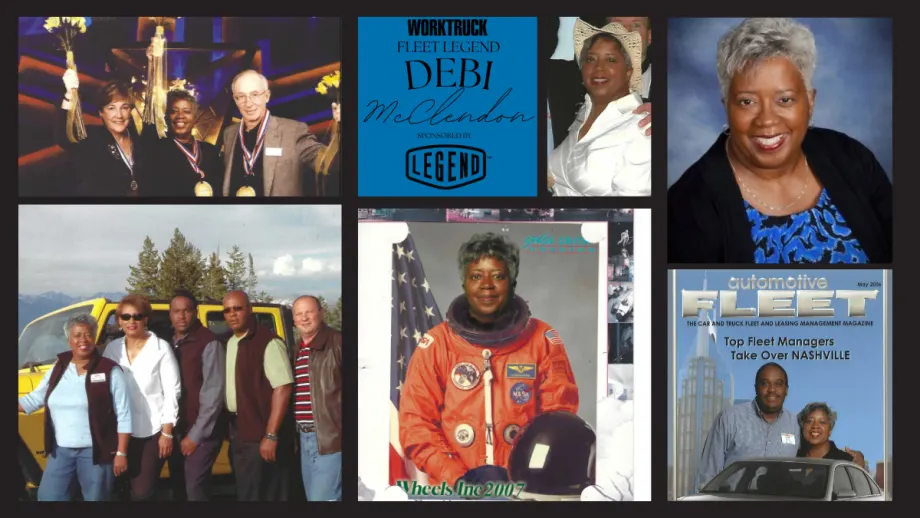
From industry events to career milestones, Debi McClendon’s journey in fleet spans decades of leadership, innovation, and lasting impact on the people and practices that drive the industry forward.
Credit: Debi McClendon | Work Truck
8 min to read
Fleet may run on vehicles, policy, and process, but as Debi McClendon reminds us, the real engine has always been people.
In the latest episode of Fleet Legends, sponsored by LEGEND, I sat down with McClendon, a longtime fleet professional whose career wasn’t just about managing vehicles. It was about guiding organizations through change, often when things felt anything but steady. Even though she retired in 2014, her perspective still hits, especially for fleet leaders navigating transformation, new tech, and the constant pressure to do more with less.
Some things evolve, sure, but a lot of the core challenges still feel very much the same. And if there was one thing she made clear, it’s this: fleet leadership is about a lot more than knowing cars.
Thrown into Fleet and Tasked with Changing It
Like a lot of people in fleet, McClendon didn’t map out this career path. She landed in it.
“As a lot of corporate fleet managers experienced, especially back when I started, you’re pushed into an area that you have no knowledge about,” she said.
When she stepped into fleet in 2000, she was replacing someone who knew vehicles inside and out. Meanwhile, she’s the first to admit where she started.
“I knew nothing about cars other than to put gas in and get the oil changed,” she explained. “So intimidation was there.”
No pressure, right? What she walked into was a highly manual operation built around one person’s way of doing things, even as her company was going through mergers and broader cultural shifts. So while she was learning fleet from scratch, she was also expected to modernize it.
“Imagine a newborn baby now in a college atmosphere. That’s kind of the way it felt,” McClendon shared.
And honestly, that might be one of the most accurate descriptions of starting in fleet I’ve heard.
From a Perk to a Business Tool
One of the biggest shifts she led was redefining what a fleet vehicle actually meant. At the time, vehicles were often treated as a perk, something flashy to help recruit or reward employees. McClendon helped reframe that entirely.
“We changed the paradigm from thinking a fleet vehicle was a bonus or an incentive to hire people, but instead it became a tool necessary to do their jobs,” she said.
That sounds simple, but if you’ve ever tried to change how an organization thinks about anything, you know it’s not. It meant building a fleet policy from scratch and aligning teams that had been operating completely independently.
“We had probably about seven different divisions at that time, and I had to learn to merge their different practices into one fleet,” she said. “So you can imagine that was a bit of a challenge.”
Seven different ways of doing things and shooting for one unified strategy is no small task, and no, it didn’t happen overnight.
“It did take me about six to nine months to come up with something that the higher-ups approved of… not everybody was happy with that, but it was something that was needed.”
It took months to build, years to land fully, and a whole lot of conversations along the way. Some are easier than others. But in the end, it worked. It created consistency, reduced costs, and set the fleet up to operate more strategically.
Why Networking Became One of Her Biggest Advantages
When I asked about the biggest lessons from her career, she didn’t go straight to policy or process. She went straight to the people.
“Building a strong network, to me, is one of the best lessons learned during my fleet career,” McClendon shared.
And the more she talked, the more that made sense. As her team structure changed and resources got leaner, those external connections became even more important.
“I got to meet other fleet managers who also were having their own struggles and were willing to share those struggles, really willing to give me advice on what they did or what they think is coming through.”
Other fleet managers, industry peers, and even competitors became part of her extended team in a way. She described sitting in conversations where she realized just how much she could learn just by listening.
“I wanted to have a notepad at lunch… just to take notes,” she said. “Because I wanted to be able to say, hey, this competitor is doing this, and we’re not there.”
That openness to learning from others helped her stay sharp and bring better ideas back to her organization. It also helped her realize she wasn’t the only one figuring things out as she went.
Communication Matters at Every Level
If networking were one pillar, communication was right there with it, and not just polished, boardroom-ready communication. Real, adaptable, human communication.
“You could go from the boardroom to the fields… and be able to talk to anybody on any level and make them feel like they are important too, because they are,” she said.
That’s not just a nice-to-have. That’s how you get things done in fleet. Because the reality is, you’re constantly moving between audiences: leadership, drivers, operations, safety, and procurement. And if even one of those groups feels left out or unheard, things start to break down.
“This is where we are. This is where we need to be… I would prefer that you would help to make us get there instead of fighting trying to get there,” she explained. “What are your ideas to make that happen?”
There’s clarity in that, ownership in that, and an open door for collaboration. Which, let’s be honest, is usually where the best solutions come from anyway.
Change Is Constant, So Fleet Leaders Need to Stay Open
At this point, it probably won’t surprise you that change came up more than once. Actually, more than once is an understatement.
“There’s always going to be one constant as you live this life… and that’s change,” McClendon noted.
And she’s not wrong. From technology to safety expectations to how companies structure their fleets, things are always moving. The challenge isn’t avoiding change. It’s figuring out how to move with it.
“Being stuck in doing it the way you used to do it is not going to work,” she said. “Always being open to change, adapting to change… that’s what’s needed.”
That applies across the board, but especially when it comes to technology. And while there’s always something new getting attention, McClendon made it clear that not everything is a fit.
“You have to decide what is going to work best for your fleet,” she said.
She pointed to early telematics as an example. It was gaining traction, but for her sales fleet, it just didn’t make sense at the time.
“It just depends on your fleet… if you’ve got a fleet of utility drivers, it might make sense, but for a sales team it didn’t.”
Which feels like one of those simple statements that carries a lot of weight, because there really isn’t a universal playbook here. There’s your fleet, your people, and your needs.
The Lesson She Wishes She Knew Sooner
One of the most real moments in the conversation came when she talked about what she wished she had known earlier.
“No one person can do it themselves. It’s okay to ask for help… it’s okay to be vulnerable in some situations,” she said.
Coming into the role, she thought she needed to be that one person, the one who knew everything, handled everything, and figured it all out.
“But the person that I replaced was a one-man island, and when I went into the job, I thought that’s what I had to be too.”
That mindset doesn’t hold up, especially in fleet. Over time, she learned that asking for help isn’t a weakness, it’s part of the job.
She also got honest about her confidence, which a lot of people don’t always talk about.
“I thought that I was… not a person that can influence change,” she shared. “But I was a person who made significant changes for the company.”
That shift, from questioning your impact to owning it, is a big one, and it doesn’t happen overnight.
Her Advice for the Next Generation of Fleet Managers
So what does all of this mean for the people coming into fleet today? Her advice is actually pretty straightforward.
“Keep learning, stay relevant, and fight for a seat at the table,” she said.
Fleet is not an industry where you can get comfortable and stay there. Things change too fast, and expectations shift too often. And if you’re doing the work, you should be part of the conversation.
“Because you should be sitting in the boardroom as well as in the field… and you want to make sure people understand what you’re doing, how you’re doing it, and how it affects them.”
That one hits because it’s easy to assume the work speaks for itself, but in reality, visibility matters.
“It’s okay to let people know what you’re doing,” McClendon added. “That was one of my pitfalls… I didn’t let them know enough.”
And if you’re early in your career or feeling like you’re on the outside looking in, she had one more reminder.
“Never think that you’re not important… even if you’re sitting in a cubicle in a corner, you are important. You are needed. Fleet will never go away.”
People and goods still have to move, and however that looks in the future, fleet is going to be part of it.
A Legacy Built on People
What stuck with me most wasn’t just what McClendon accomplished. It was how she talked about the people around her.
“We were more than just colleagues… we had become friends,” she noted.
And that’s something you hear a lot in this industry. Fleet has a way of turning working relationships into real connections. Maybe it’s the shared challenges. Maybe it’s the constant problem-solving. Probably a mix of both. But it’s real. Because at the end of the day, fleet isn’t just vehicles, policies, or even technology. It’s people showing up, figuring it out together, and helping each other along the way.
And by that measure, McClendon’s legacy is exactly what Fleet Legends is all about.
Subscribe to Our Newsletter
More Operations
Family Ties Inside the Fleet Families Building Careers Across Generations
Three fleet families share what it really takes to work together, learn across generations, and keep business from following them home.
Read More →
Shades of Fleet Call for Voices: Fleet's Hidden Heroes
Fleet’s hidden heroes are often the ones keeping everything moving behind the scenes. September’s Shades of Fleet is looking for dispatchers, coordinators, parts specialists, and other support pros to share their stories.
Read More →
Truck Centers, Inc. Celebrates National Truck Driver Appreciation Week with $1,000 Fuel Card Giveaways
During National Truck Driver Appreciation Week, Truck Centers, Inc. is offering customers a chance to fuel up for free. Customers at all Truck Centers locations can enter to win one of four $1,000 fuel cards from Sept. 14 - 18.
Read More →
Fleet Guides, AI Time-Savers, Truck Tariffs & Fuel Strategy Lead the News
This week’s Truck Chat Cheat Sheet covers new fleet vehicle guides, practical AI use cases, U.S.-Canada truck production, mixed-energy strategy, and more.
Read More →
What Fleet Employers Are Missing When Hiring Veterans
What if some of the strongest candidates for fleet are already out there, but their experience is written in a language our industry does not always recognize?
Read More →
Automotive Fleet Opens 2026 Personal Use Survey for Commercial Fleet Managers
Less than two weeks left! Commercial and corporate fleet managers are invited to share how their organizations handle company vehicle personal-use policies, charges, and driver eligibility.
Read More →
What Resilient Fleets Do Differently When Conditions Change
Fleet resilience is about more than reacting to disruption. Lauren Fletcher talks with AP Fleet’s Alex Coveney about flexibility, planning, scaling, and what helps fleets adapt when business conditions shift.
Read More →
If We Want the Next Generation in Automotive, We Have to Give Them a Reason to Care
The automotive industry talks constantly about its workforce shortage. But before we can recruit the next generation, we may need to do a better job giving kids a reason to care about automotive in the first place.
Read More →
Ram ProMaster City Under $40K, Truck Tariffs, and AI Maintenance Lead the News
A sub-$40K commercial van, tariff questions, AI-powered maintenance, and a new EV production strategy headline this week’s Truck Chat Cheat Sheet.
Read More →
Bob Adamsky Shares the Fleet Lessons You Usually Learn the Hard Way
After more than 30 years in fleet, Arrow International’s Bob Adamsky has learned that the job is about far more than vehicles. He shares the lessons he wishes every fleet manager could learn a little earlier.
Read More →