



Related: How E-Commerce Surge Is Changing Delivery Vehicle Design and Deployment
A Day in the Life of an Amazon Delivery Agent
Delivering up to 330 packages a day while meeting performance metrics around truck load time, deliveries per hour, and driving behaviors can be rewarding — but isn’t for the faint of heart.
by Denise Rondini
April 15, 2021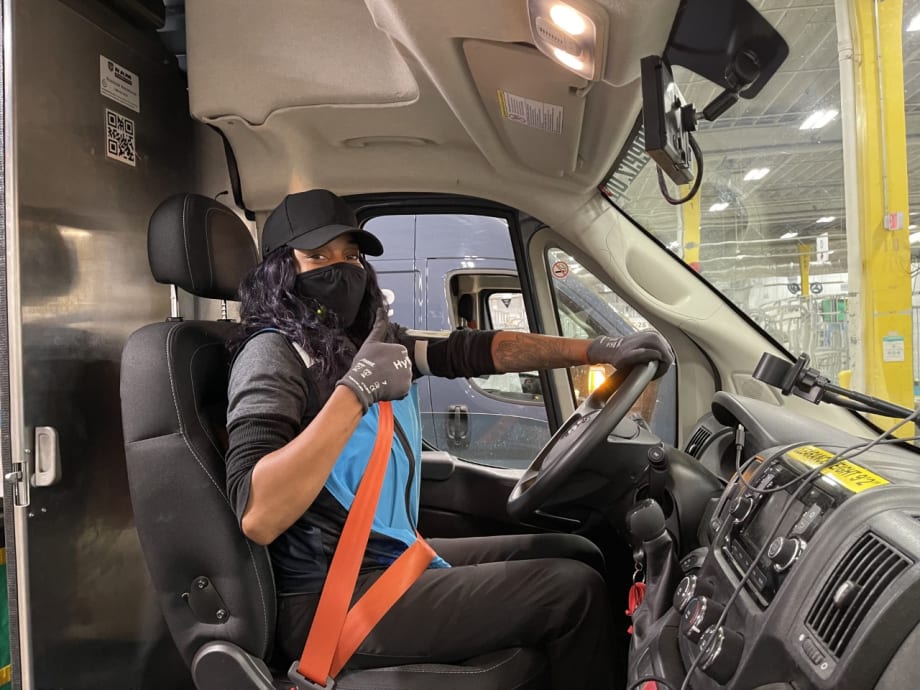
Amazon delivery associates such as Shameka Brown must mind their ABCDS: acceleration, braking, cornering, distraction, and speeding. If a driver violates any of the Amazon-set thresholds it will result in a deduction of points.
Photo courtesy of Jeb Lopez.
6 min to read
The Covid-19 pandemic changed the way consumers and businesses purchase products. U.S. e-commerce grew more than 40% in 2020, and it will come as no surprise that one of the biggest beneficiaries of that growth was Amazon, which saw both sales and profits increase significantly.
Of course, the increase in orders meant there was a need for more drivers to deliver those packages to our doorsteps. Jeb Lopez saw an opportunity. The founder and president of Wheelz Up, who already had a delivery firm that among other things delivers auto parts for dealerships and automotive shops, applied to become an Amazon Delivery Service Partner (DSP).
Once he was accepted — a process that included nine interviews — Wheelz Up was awarded a DSP contract. Lopez started with five routes initially, with additional routes added over a two-month period until a total of 25 routes were being served.
Becoming a DSP meant Lopez needed to find drivers — or in Amazon terms, Amazon delivery associates (DAs). Shameka Brown began driving for Wheelz Up as a DA in September 2020. We caught up with Brown on her day off to talk about what it’s like to deliver for the e-commerce giant.
Metrics of Everything
Brown’s day starts with a 15-minute virtual drivers’ meeting, during which drivers learn how many packages they will deliver and in what radius. “During these meetings we tell drivers what happened the day before in terms of us meeting our goals and we go over things that we have to improve upon,” Lopez says.
Brown then gets her van assignment and code for where to park at the warehouse, where she will be picking up her packages. She drives either a Ram ProMaster or Ford Transit van. A pouch in the van contains her routing information for the day.
She then has 20 minutes to scan and load the 300+ packages into her van in the proper order that corresponds with her delivery route. Time to load packages is one of the metrics Amazon uses in its driver scorecard. According to Brown, getting the van loaded in only 20 minutes is the hardest part of her job.
DAs interact with various apps that help them be more productive. One is the Flex app which is where they enter information from the mandatory pre- and post-trip inspections. “Based on what the DA enters into the app, Amazon may automatically ground a van,” Lopez says. Things like bad tires and non-operating lights are among the items that will take a van out of service.
Once Brown has completed the pre-trip inspection, she also logs into her Amazon Mentor app before heading to her first delivery. The Mentor app monitors driving behavior while the DAs are on their routes. “The app tells you your score from the week prior and tells us if we are lagging in some area,” Brown says. It also provides tips on how to improve on weak areas.
“We have to adhere to certain policies on how our drivers do their ABCDS,” says Lopez. “That stands for acceleration, braking, cornering, distraction, and speeding.” If a driver violates any of the Amazon-set thresholds it will result in a deduction of points. “A good score is 800,” Lopez says. The Mentor app tracks incidents of speeding and hard braking, and based on the Mentor app report, Lopez can coach drivers on ways to improve.
The scorecard also measures how many packages the driver delivered in an hour and how accurate those deliveries were. The app also indicates if there were any customer complaints. Once a driver has made a delivery, Amazon sends an email to the recipient with thumbs up and thumbs down icons that allow customers to give feedback.
Package Protocols
One of the things that attracted Brown to driving for Amazon during the pandemic is the fact that she works alone. “It is safe because you are pretty much working by yourself. On top of that, I am not the type of person who wants to sit behind a desk. I like being active and this job keeps me very active. I am always on the go.”
She also likes the fact that she gets to see different areas of Virginia as well as being able to interact with different types of people. This is, of course, within Amazon’s covid safety protocols, including wearing masks and maintaining six feet of social distancing when interacting with customers. Brown says she has had to remind customers that for health and safety reasons she can't directly hand them their packages but rather will leave them at the location they have chosen.
In a typical day, Brown will deliver 300 to 330 packages, but that may equate to 180 drop-off sites. “Packages can be small and medium or even oversized,” Brown explains, adding, “we deliver them all.” DAs get paid in 10-hour blocks and if they complete their deliveries in under 10 hours, they still get paid for 10 hours.
When making a delivery, Brown must scan the package and take a photo of it in the location she left it. Her app tells her where the customer has indicated the package should be left, but sometimes there are problems. For example, the customer may have said to deliver inside a door, but then forgot to leave the door open. The Flex app can help the driver by allowing them to interact with Amazon who might tell them to text the customer for an alternate delivery location.
Both Brown and Lopez say that Amazon is always tweaking things to improve the delivery experience for customers and drivers, which includes in-cabin cameras. While the cameras don’t record continually, they will record when triggered by certain events like rolling stops and speeding.
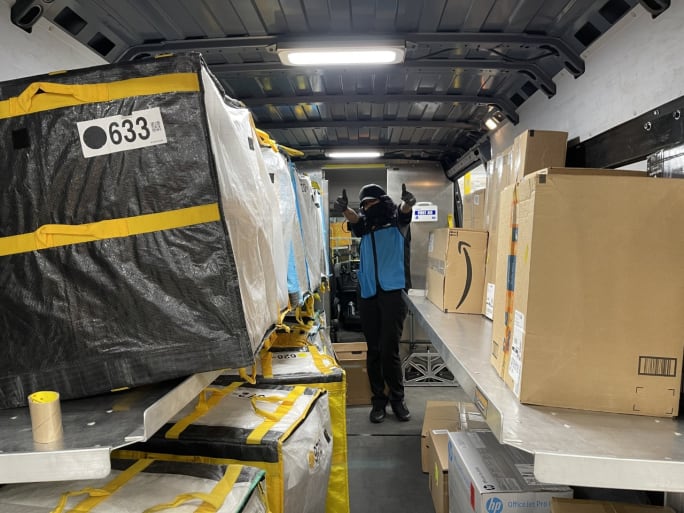
At the beginning of her day, Brown only has 20 minutes to scan and load the 300+ packages into her van in the proper order that corresponds with her delivery route.
Photo courtesy of Jeb Lopez.
Moving with Purpose
Brown says being an Amazon DA is not for the faint of heart because you are constantly on the move, but that is one of the things she likes about the job. “It is about moving with a purpose and developing a stride that gets you into a rhythm that becomes second nature,” she says.
Unlike gig economy delivery jobs that require drivers to use their own vehicles, Amazon provides its DAs with both vehicles and cell phones for use during their workdays. “All I have to do is delivery my packages within the 10-hour time slot,” Brown says,
While her days are hectic, Brown likes that she has learned a lot about time management since becoming a DA. “And I have learned how to be my own boss because I am the only one out there in my van.”
A typical week for Brown consists of four 10-hour days, but she can request to work a fifth day. However, Amazon does not allow its DAs to drive more than five days in any given week. Brown sometimes will add that fifth day, but she says the secret is to make sure she has the day off before both before and after.
“It is all about taking care of yourself both physically and mentally,” Brown says. “I think it is possible to do this job long term if you take care of yourself. My advice to other DAs is if they ever feel overwhelmed to try meditating. I meditate and it really helps me.”
Originally posted on Automotive Fleet
Subscribe to Our Newsletter
More Operations

Work Truck Seeks Fleet and Industry Insights on 2026 Trends and 2027 Forecasts
Work Truck is seeking insights from fleet leaders and industry partners on the trends that shaped 2026 and what commercial fleets should prepare for in 2027. Participate today!
Read More →
30 Years in Fleet and Still Learning: Lessons Beyond Trucks
After more than three decades in fleet, Bob Adamsky has learned that knowing trucks is only part of the job. The bigger lessons come down to communication, understanding, and never assuming you know it all.
Read More →
What Every New Fleet Manager Should Know
Carolyn Edwards shares lessons on finding mentors, showing fleet’s value, and leading teams in this episode of Legends of Fleet.
Read More →From Our Partners
Basic Tracking vs Next Generation Fleet Technology
Sponsored by AT&T Business

5 Facts Every Fleet Manager Should Know About Embedded Telematics
Sponsored by Stellantis/Mobilisights
How AI Video Telematics Boosts Driver Safety and Helps to Avoid Unnecessary Costs
Sponsored by Verizon Connect
Charting the 8 Bottom-Line Benefits of Workforce Optimization
Sponsored by Verizon Connect


Les Schwab Tires Launches Foundation With $100,000 for Community Recovery
Les Schwab Tires launches a foundation with $100,000 to support recovery for Silver Rail Elementary and the Bend community following a school shooting.
Read More →
Bring Some Fleet to Your Halloween with Our Pumpkin Carving Templates
Download Work Truck’s truck-themed pumpkin patterns, explore more automotive designs, and give your shop or front porch a seasonal upgrade.
Read More →
How Cardless Fuel Payments Benefit Commercial Fleets
Is it time for fleets to move beyond plastic fuel cards? David Abraham of WEX explains how cardless fuel payments can help reduce fraud, simplify driver transactions, and improve efficiency by allowing drivers to pay for fuel using their smartphones.
Read More →
Good Fleet Leadership Starts With the People You Already Have
From developing future leaders to listening to employees, discover how better leadership can help work truck fleets retain talent and build stronger teams.
Read More →
ATRI Names Next President and CEO
Page Siplon, a longtime transportation and logistics industry executive, has been chosen as the next president and CEO of the American Transportation Research Institute (ATRI).
Read More →
Coltrain Onsite Fleet Care Sponsors 2026 Cure Bowl to Support Cancer Research
The mobile fleet maintenance provider is supporting the annual college football bowl game, which has helped raise $6.83 million for cancer research since 2015.
Read More →
Racing Lessons, Electric Fleet Growth, and Ghostbusters Lead This Week's Work Truck News
Racing lessons for fleets, Republic Services' electric truck expansion, 40 years of fleet wisdom, truck trivia, autonomous yard trucks, and more headline this week's Truck Chat Cheat Sheet.
Read More →