




Related: Trends From the 2015 L.A. Auto Show
2016 L.A. Auto Show: SUVs, Electrification, Mobility
The mobility revolution is happening through greater connectivity, manufacturers' suites of transportation services, electrification, and the introduction of autonomous vehicles themselves. At the same time, manufacturers are placing the car at the center in this new world.
by Staff
November 22, 2016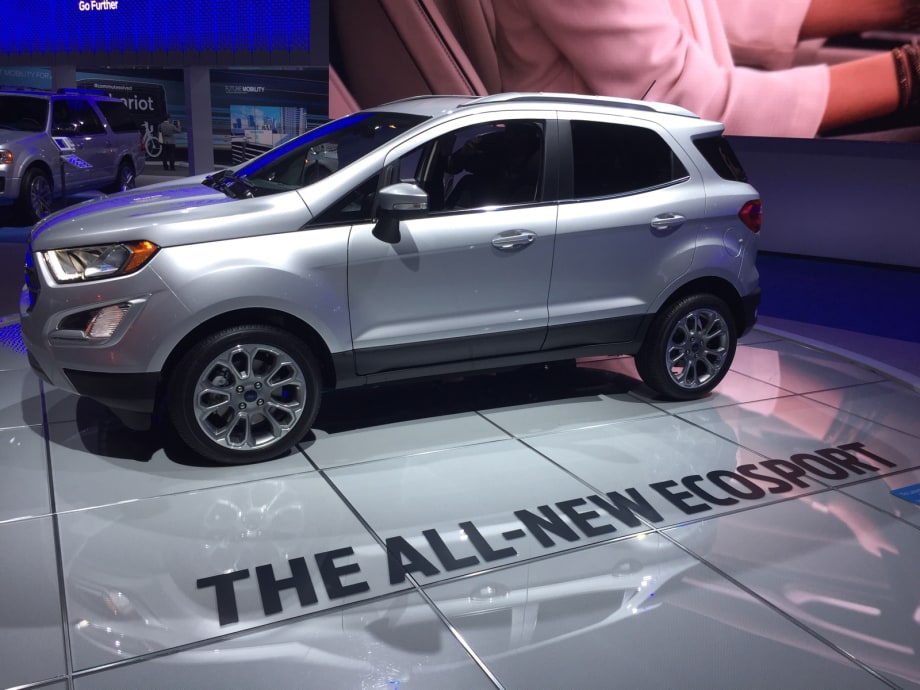
Photo of 2019 Ford EcoSport by Paul Clinton.
4 min to read
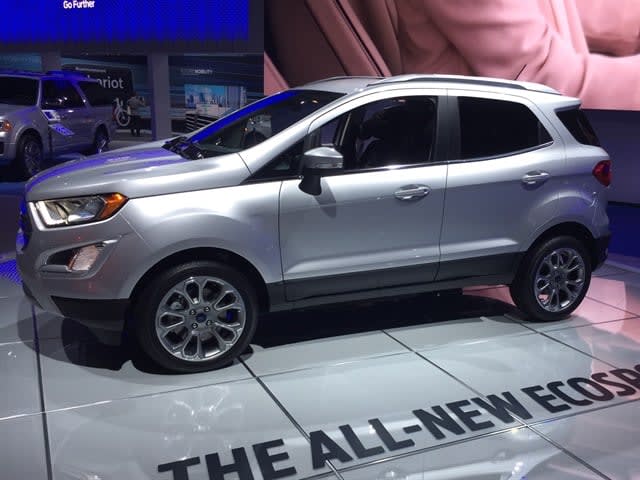
Photo of 2019 Ford EcoSport by Paul Clinton.
The 2016 Los Angeles Auto Show is riding the auto industry’s wave toward mobility, having rebranded itself as AutoMobility LA. Mobility encompasses more than a car; it’s a transportation eco-system, and this year auto manufacturers were eager to show how they are laying the groundwork for this radical, and seemingly rapid, evolution.
The mobility revolution is happening through greater connectivity, manufacturers' suites of transportation services, electrification, and the introduction of autonomous vehicles themselves. At the same time, manufacturers are placing the car at the center in this new world. This year's show reflected an increasing appetite in the marketplace for SUVs and a proliferation of high-end pickup trucks.
Cars are now connected to their environment through third-party tech providers such as Amazon’s Alexa, Apple's CarPlay, and Google's Android Auto. Hyundai introduced its Blue Link system, which gathers car diagnostics, telematics information, and remote start-stop functionality in an app. Other automakers have similar systems.
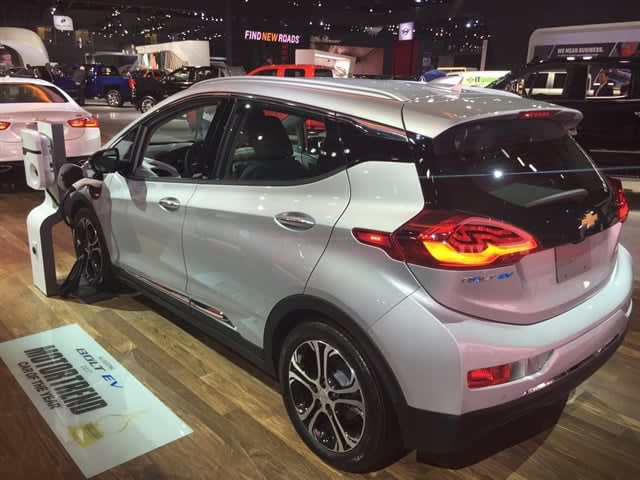
Photo of 2017 Chevrolet Bolt EV by Paul Clinton.
BMW announced the expansion of its ReachNow service, which encompasses peer-to-peer carsharing of late-model Minis, a ride-hailing service similar to Uber and Lyft, delivery of a rental vehicle, and sharing of BMWs for residences and businesses. Ford's CEO Mark Field’s keynote addressed how Ford is taking the company into new transportation partnerships as well.
GM’s Maven carsharing service is now offering Uber ride-sharing drivers the option to lease vehicles by the week or longer at discounted rates, and Hyundai has teamed up with electric carsharing service WaiveCar to give users the opportunity to drive the new Hyundai Ioniq electric vehicles for two hours at no charge. The vehicle is wrapped in advertising and includes a roof-mounted digital display that generates advertising revenue.
Volvo introduced Volvo On Call, a mobile concierge service that allows Volvo owners to get their vehicle refueled, washed, and serviced at their convenience. Volvo owners can send requests for refueling, maintenance, and other services to their nearest Volvo dealer. The app also suggests when maintenance is needed. Volvo is launching a pilot of the concierge service among owners of the new Volvo XC90 SUV and S90 luxury sedan in San Francisco that's set to begin in November.
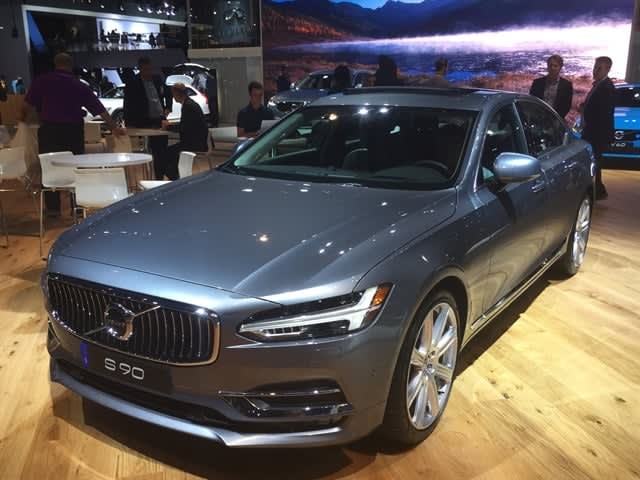
Photo of 2017 Volvo S90 by Paul Clinton.
The 2016 Los Angeles Auto Show served as a platform for the introduction of plenty of new SUVs, including Ford's subcompact 2019 EcoSport, FCA's compact 2017 Jeep Compass, Mazda's diesel-powered compact 2018 CX-5, Toyota's subcompact 2018 C-HR, and Volkswagen's mid-size 2018 Atlas.
The Atlas, which is expected to replace the Touareg luxury SUV, will help Volkswagen expand its lineup in the wake of its exit from clean diesel.
"We want to grow in the U.S. market and be a relevant player," said Hinrich Woebcken, head of North American operations.
Subaru also unveiled its VISIV-7 three-row, seven-seat SUV concept it plans to offer in 2018 as the largest SUV the automaker has ever produced. The automaker said the mid-size SUV is intended to grow its vehicle sales 30% by 2020.
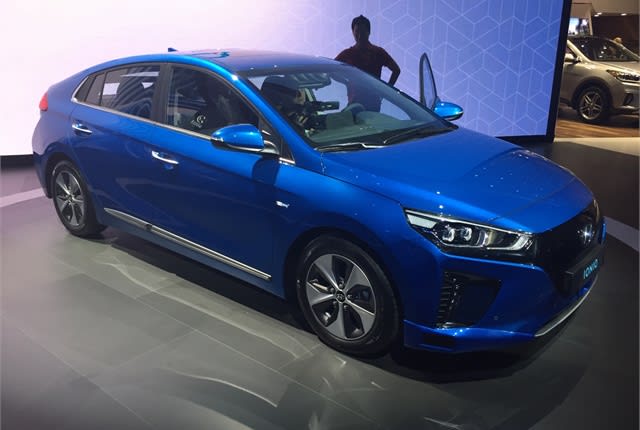
Photo of 2017 Hyundai Ioniq Electric by Paul Clinton.
A cornucopia of luxury SUVs dotted the show floor, including the 2018 Alfa Romeo Stelvio performance-oriented crossover, three-row 2017 Land Rover Discovery, and Jaguar's compact I-Pace that's expected to go on sale in early 2018 as a battery-electric model. MINI brought its next-generation 2017 MINI Countryman, which will now include a plug-in hybrid variant.
Low fuel prices may have dampened the economic case for alternative-fuel vehicles right now, but automakers are pushing forward with new all-electric and plug-in electric models. MINI, Porsche, Jaguar, and Mitsubishi unveiled new all-electric models. Hyundai unveiled three versions — hybrid, electric, and plug-in electric — of its all-new compact Ionic. General Motors displayed its plug-in electric Cadillac CT6 and the all-electric Chevrolet Bolt. FCA brought its 2017 Chrysler Pacifica Hybrid minivan that's expected to provide 530 miles of driving range.
The 2017-MY Mitsubishi iMiev was on the show floor, and smart introduced its newest Fortwo Electric Drive, which has an increased range of 80 miles. Volkswagen boosted the range of its battery-electric 2017 e-Golf to 124 miles.
While it could be argued that the electrification push is mostly to satisfy new federal regulations that require a higher corporate average fuel economy, automakers say there is a still-growing market of eco-conscious consumers, and the autonomous driving future doesn’t ultimately include fossil fuels.
One presentation on electrified vehicles was optimistic about the technology, with one presenter citing a decline in the number of gasoline fueling stations since 2006.
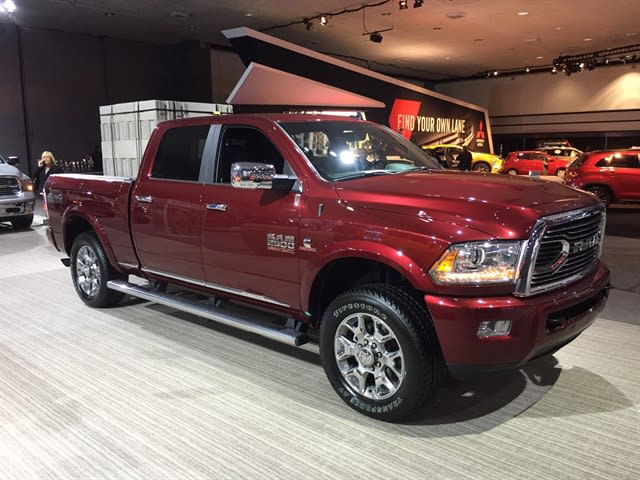
Photo of 2017 Ram 2500 Limited crew cab by Paul Clinton.
While it's not electrified, Elio Motors brought its highly efficient E1c two-person personal transportation vehicle it hopes may find a place among food service and pest control fleets. The vehicle, which is classified as a motorcycle, is expected to have a base price of $7,300 and get 84 mpg. It should arrive in late 2017.
Finally, the concept car went autonomous at this year’s show, with reveals of driverless concepts from Hyundai and Kia.
A start-up manufacturer, Local Motors, revealed the most future-reaching vehicle of all with Olli, a self-driving, electric, partially 3D printed minibus. No longer a concept, Olli is open source and "micro-manufactured," and it has already been sold to several municipalities.
One presentation on autonomous vehicles focused on the benefits of a future with autonomous vehicles — including improved parking space efficiency, reduced traffic fatalities, and easier transit by using autonomous vehicles as first/last mile modes of transit.
Editor's note: Chris Brown, Paul Clinton, Thi Dao, Amy Hercher-Winter, Andy Lundin, Roselynne Reyes, and Chris Wolski contributed to this article.
Originally posted on Automotive Fleet
Subscribe to Our Newsletter
More Operations
Family Ties Inside the Fleet Families Building Careers Across Generations
Three fleet families share what it really takes to work together, learn across generations, and keep business from following them home.
Read More →
Shades of Fleet Call for Voices: Fleet's Hidden Heroes
Fleet’s hidden heroes are often the ones keeping everything moving behind the scenes. September’s Shades of Fleet is looking for dispatchers, coordinators, parts specialists, and other support pros to share their stories.
Read More →
Truck Centers, Inc. Celebrates National Truck Driver Appreciation Week with $1,000 Fuel Card Giveaways
During National Truck Driver Appreciation Week, Truck Centers, Inc. is offering customers a chance to fuel up for free. Customers at all Truck Centers locations can enter to win one of four $1,000 fuel cards from Sept. 14 - 18.
Read More →
Fleet Guides, AI Time-Savers, Truck Tariffs & Fuel Strategy Lead the News
This week’s Truck Chat Cheat Sheet covers new fleet vehicle guides, practical AI use cases, U.S.-Canada truck production, mixed-energy strategy, and more.
Read More →
What Fleet Employers Are Missing When Hiring Veterans
What if some of the strongest candidates for fleet are already out there, but their experience is written in a language our industry does not always recognize?
Read More →
Automotive Fleet Opens 2026 Personal Use Survey for Commercial Fleet Managers
Less than two weeks left! Commercial and corporate fleet managers are invited to share how their organizations handle company vehicle personal-use policies, charges, and driver eligibility.
Read More →
What Resilient Fleets Do Differently When Conditions Change
Fleet resilience is about more than reacting to disruption. Lauren Fletcher talks with AP Fleet’s Alex Coveney about flexibility, planning, scaling, and what helps fleets adapt when business conditions shift.
Read More →
If We Want the Next Generation in Automotive, We Have to Give Them a Reason to Care
The automotive industry talks constantly about its workforce shortage. But before we can recruit the next generation, we may need to do a better job giving kids a reason to care about automotive in the first place.
Read More →
Ram ProMaster City Under $40K, Truck Tariffs, and AI Maintenance Lead the News
A sub-$40K commercial van, tariff questions, AI-powered maintenance, and a new EV production strategy headline this week’s Truck Chat Cheat Sheet.
Read More →
Bob Adamsky Shares the Fleet Lessons You Usually Learn the Hard Way
After more than 30 years in fleet, Arrow International’s Bob Adamsky has learned that the job is about far more than vehicles. He shares the lessons he wishes every fleet manager could learn a little earlier.
Read More →