




Portable Toilet Company Makes Best Use of GPS Tracking
Mobile Thrones, a portable toilet company in northern Texas, spends $10,000 a month on diesel fuel, making route management an integral part of keeping costs down for this small business.
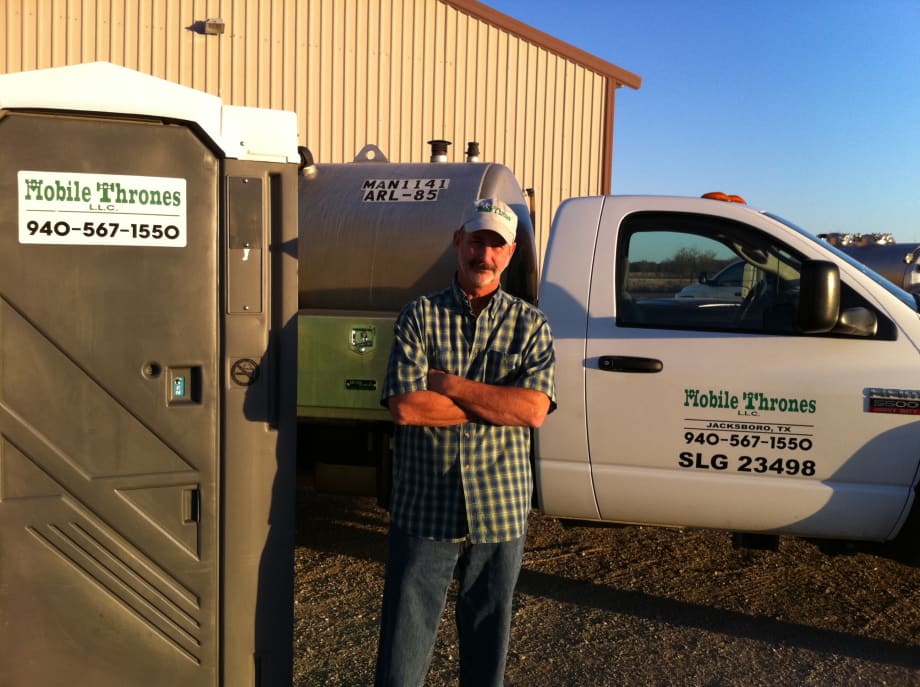
Gary Oliver, CEO of Mobile Thrones, by one of his Ram 5500 service trucks.
- By Joanne M. Tucker
In five years Mobile Thrones went from zero portable toilets to about 475 and from zero vehicles in its fleet to six, with one ordered and on the way, according to Mobile Thrones CEO Gary Oliver. And while the largest part of its growth happened in more recent years, Mobile Thrones was an early adopter of a global positioning system (GPS) for its vehicles.
In 2007, the Texas-based portable toilet company deployed TomTom, a GPS program that allows companies to create map routes, compare jobsite locations, and track vehicle mileage and speed, among other features.
Spending an average of $10,000 a month on diesel fuel for its majority Dodge Ram 5500 fleet makes route management an important aspect of Oliver’s now sprawling business, which serves the northern region of the state out of Jacksboro, Texas. “We’re maximizing our time,” he says. “We’re not just zigzagging around.”
Oliver adds that TomTom increased his company’s bidding power because he is able to quickly estimate fuel costs in relation to other worksites. In revenue, “there’s no telling how much it’s saved me,” he says.
Mobile Thrones mostly services oil companies and other jobsites located on country roads. TomTom allows Oliver to mark specific gates and off-street areas, which are typically visually inaccessible from map services such as Google Maps.
As well, the programming helps Mobile Thrones stave off abuse from any of its clients. For example, if a company requests and pays for weekly servicing to its portable toilets and claims Mobile Thrones didn’t comply with a service, Oliver can show the client records of his trucks traveling to that site, the amount of time spent there, and which employees finished the task.
When Oliver first deployed the TomTom software, he had only one employee. “He wasn’t too crazy about it because he thought I was going to use it as a policing device — and I certainly can do that and I do use it as that,” Oliver says. “But he’s a country boy, and he was scared to death to drive through the city, but with that TomTom on there, it took a lot of the edge off.” Oliver added that employees are forced to be honest if they make a personal trip on the job. “It will mark their trails pretty well,” he says.
Gary Oliver, CEO of Mobile Thrones, by one of his Ram 5500 service trucks.
Portable toilets and related sanitation services started as a side project for Oliver, who first got his license in septic pumping and sanitation when he bought three car washes that he still owns. He had to pay $700 to have the sand traps — the car washes drainage systems — cleaned for each station. “I figured I could get an apparatus and do it myself,” he says, and so he obtained his license, which is the same used in the portable toilet industry.
Oliver says he received some inquiries from people asking if he offered portable toilet services. “So I went out and bought about seven of them,” he says.
Mobile Thrones quickly became Oliver’s larger money-maker over the car washes, even after two fleet vehicles were totaled — in two separate accidents — and replaced. “I always encourage the guys to be very safe,” Oliver says. “There are times when we try to get stuff done in a very timely fashion as quick as we can, but then always safety is of the utmost. Nobody’s life or health is worth a toilet.”
To read more small fleet profiles, click here to see a full list.
More Small Fleet
Why Fleet Managers Are Replacing Departmental Vehicles with Shared Motor Pools
Departmentally assigned vehicles often create hidden costs through underutilization, poor visibility, and increased administrative burden. This white paper explores how shared motor pool strategies help fleets reduce costs, improve accountability, and optimize vehicle utilization.
Read More →
Boosting Last-Mile Fleet Uptime, Safety, and Value with AI Vehicle Inspections
AI-powered inspections are transforming last-mile fleets by replacing manual checks with highly accurate automated scans that detect defects in seconds. By giving fleet operations visibility into the daily condition of their vehicles, you can identify trends over the vehicle’s lifecycle that enable improved procurement decisions, route management, driver training and accountability.
Read More →
Five Ways Seat Belts Help Prevent Injuries
There are five ways seat belts protect occupants from injuries, according to the Tennessee Department of Safety and Homeland Security.
Read More →
It’s here: The 2026 Fleet Technology Trends Report
What does AI mean for fleets? Get the answer — and learn other top tech trends.
Read More →
Small Fleets, Big Impact: How Independent Drivers Power Wreaths Across America
Check out how small fleets and independent drivers power Wreaths Across America each December and why their impact matters more than ever.
Read More →
VMS Survey Finds 65% of Small Fleet Managers Run Operations Alone
A new VMS survey shows small fleet managers are stretched thin, with most handling operations solo and eager to adopt digital tools for relief.
Read More →
Tips for Driving Safely on Halloween Night
This video features a reminder from the Connecticut Department of Transportation (DOT) and the Connecticut Police Chiefs Association, urging drivers to prioritize safety this Halloween.
Read More →
AI, Access, and Uptime: VMS’s Next Chapter with David Prusinski
VMS’s new Co-CEO, David Prusinski, shares how an AI-first approach will give small fleets and repair shops the tools to compete like big players.
Read More →
Fleet Managers Share Winter Prep Tips: It's Never Too Early!
Three fleets share best practices to prep vehicles for winter and prevent downtime when the cold sets in.
Read More →
Hot Weather Driving Tips for Fleet Drivers
As we head into another potentially extreme summer season, the risks for fleet drivers remain high, from engine strain and tire blowouts to unpredictable traffic patterns. An expert shares advice on how fleet drivers can boost their safety during the steamy summer months.
Read More →