




Last-Mile Delivery Beyond the Chassis [Photos]
If you operate a delivery fleet or operate in the last-mile sector, your operations are booming, and technology is advancing. While bigger trucks are great for getting bulk items across long distances, the more compact urban neighborhood was not meant for even the smallest medium-duty delivery trucks.
While we have talked about “mixed fleets” for years, that often just covers a mix of cars, trucks, and some larger equipment. The mixed delivery fleet of the future goes way beyond what’s on a chassis.
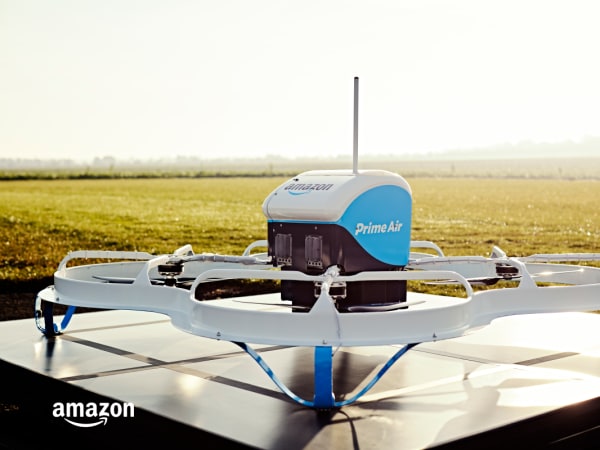
In December 2016, Amazon completed its first fully autonomous Prime Air Delivery. There was no human pilot and the process took just 13 minutes from order click to delivery. In August 2020, Amazon received a Part 135 Air Carrier Certificate from the United States Federal Aviation Administration.
Amazon Prime Air is a service that will deliver packages up to five pounds in 30 minutes or less using small drones.
Amazon is testing many different vehicle designs and delivery mechanisms to discover how best to deliver packages in a variety of operating environments.
Photo: Amazon Prime
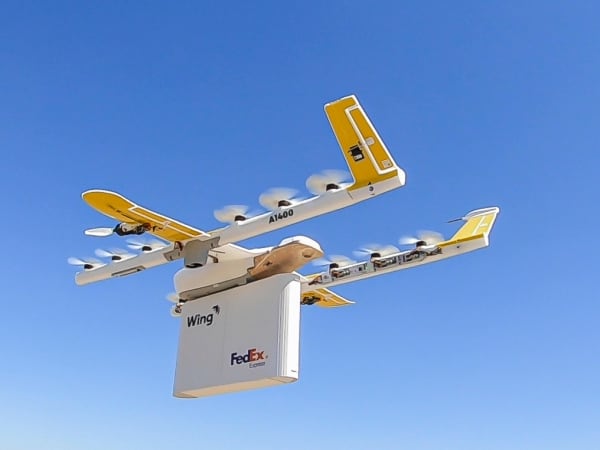
In October 2019, FedEx completed a commercial residential delivery to a home in Christianburg, Virginia, with a drone. The drone delivery was conducted by Wing Aviation, in collaboration with FedEx Express, as part of the U.S. Department of Transportation’s Unmanned Aircraft Systems Integration Pilot Program (IPP).
Since the first delivery, the drones have continued testing, with the most recent news in late 2021 when FedEx Express completed the first drone delivery as part of a monthlong test in Ireland.
Photo: FedEx
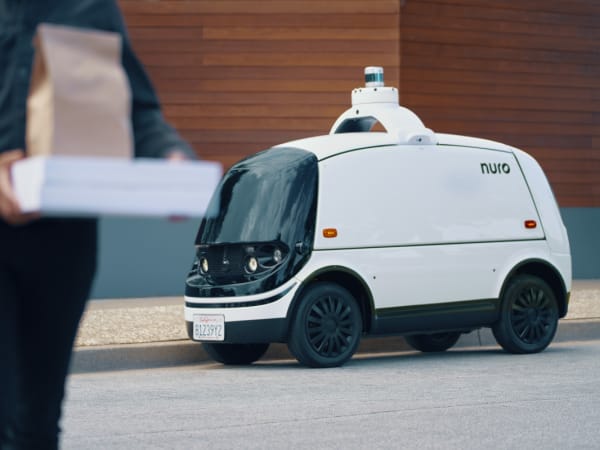
Nuro has created custom autonomous delivery vehicles designed to drive in neighborhoods. These items only carry goods, which, according to Nuro, means they prioritize the safety of others.
Their units are small and feature 360-degree cameras as well as Lidar, short- and long-range radar, and ultrasonic sensors. Nuro adds advanced hardware with an autonomy stack that includes mapping, localization, perception, and prediction.
The R2 from Nuro is on roads today. In January 2022, BYD announced a partnership with Nuro to begin producing the company’s third-gen electric autonomous delivery vehicle.
Photo: Nuro
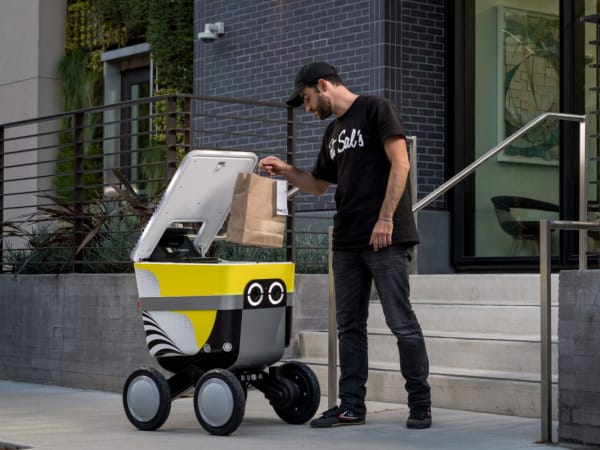
Whether you are grabbing a late-night burrito or on your morning run, Serve was designed from the wheels up to join you in your neighborhood.
Unveiled in 2018 by Postmates, using Lidar and advanced sensors, Serve creates a virtual picture of the world in real-time.
Serve features an interactive touchscreen for communication purposes. The all-electric robot has a 50-lb. capacity and can keep food warm and our air clean. Postmates asks, “why deliver a 2-lb. burrito in a 2-ton truck?”
The goal of Serve is to help businesses large and small expand their last-mile reach.
In December 2020, Uber acquired Postmates, including Serve. The development was spun out from Uber-owned Postmates in March 2021 as Serve Robotics. Its robots have now completed tens of thousands of contactless deliveries from more than 100 merchants in Los Angeles and San Francisco.
Photo: Serve Robotics
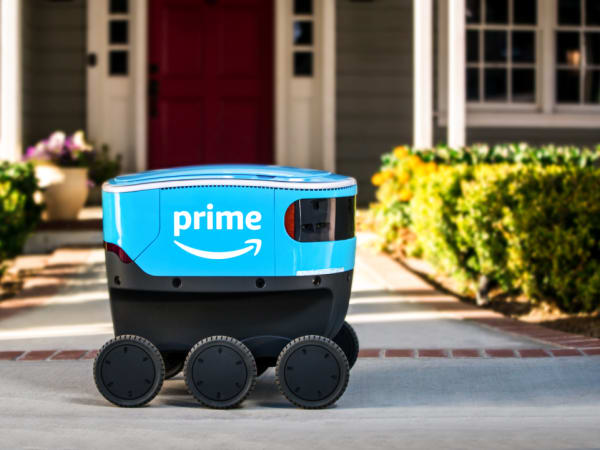
Amazon developed the Amazon Scout to help get packages to customers using autonomous delivery services. In January of 2019, the delivery devices started testing in a neighborhood in Snohomish County, Washington.
Amazon customers order products as normal, and packages are delivered by a trusted partner or Amazon Scout. Since the initial pilot, Scout now delivers to four locations in the U.S.
In July 2021, Amazon announced the launch of a new development center in Helsinki, Finland, to help develop autonomous technology. The new team will consist of over two dozen engineers in Helsinki to start and will be dedicated to research and development for Amazon Scout, Amazon’s fully electric autonomous delivery service that currently operates in the U.S.
Photo: Amazon Prime
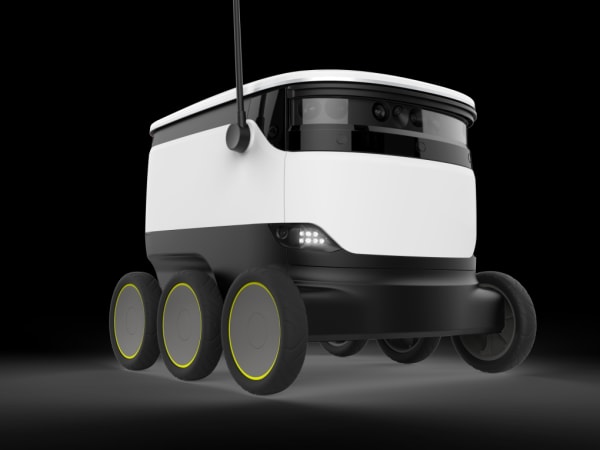
Starship robots are advanced devices that can carry items within a 4-mile radius. Parcels, groceries, and food are directly delivered from stores, when the customer requests via a mobile app. Once ordered the robots’ entire journey and location can be monitored on a smartphone.
Starship’s robots move at pedestrian speed and weigh no more than 100 pounds. For security, the cargo bay is mechanically locked throughout the journey and can be opened only by the recipient with their smartphone app. The location of the robots is tracked, so you know exactly the location of your order and receive a notification at the time of arrival.
In October 2021, the company hit 2-million autonomous deliveries, traveling more than 2.7-million miles in neighborhoods and university campuses. In January 2022, Starship received funding from the European Investment Bank to boost R&D.
Photo: Starship
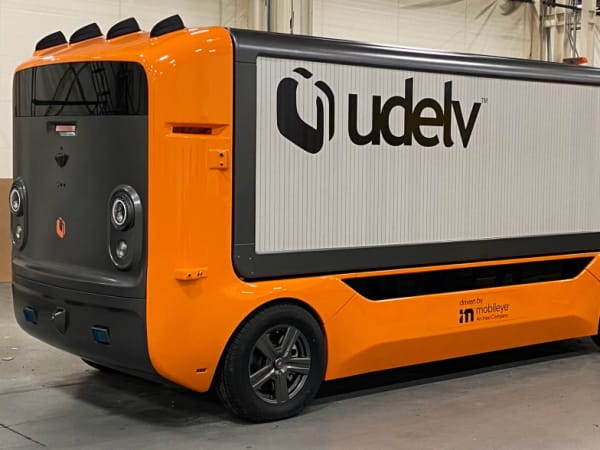
Since completing the world’s first autonomous delivery on public roads in January 2018, Udelv has been in the business of bringing clean, safe, and cost-effective autonomous delivery to retailers and shippers.
In January 2022, Udelv unveiled the first cab-less autonomous electric delivery vehicle for multi-stop delivery, the Transporter, driven by Mobileye.
The multi-stop electric delivery vehicle features a proprietary, self-contained, hot-swappable modular cargo pod called the uPod. It can carry up to 2,000 pounds of goods, make up to 80 stops per cycle at highway speeds, cover ranges between 160 and 300 miles per run depending on the battery pack option, and be operated by Udelv’s mobile apps to seamlessly schedule, deliver, track, and retrieve packages.
Photo: Udelv
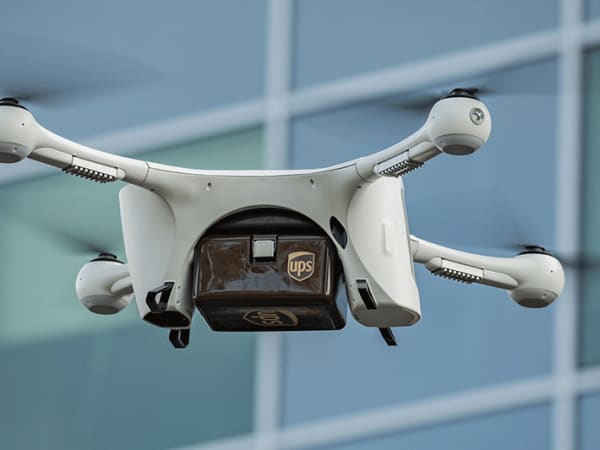
n March 2019, UPS partnered with drone startup company Matternet to deliver medical samples to a hospital in Raleigh, North Carolina. In July 2019, UPS announced the wholly-owned subsidiary UPS Flight Forward that would focus on parcel delivery by drone. In 2020, Verizon, UPS Flight Forward, and Skyward started testing 4G LTE in delivery drones to demonstrate cellular reliability and performance at altitude.
As of early 2021, UPS had operated more than 3,800 successful drone delivery flights since the creation of UPS Flight Forward.
UPS Flight Forward is now making COVID-19 vaccine deliveries via drone for Atrium Health Wake Forest Baptist in Winston-Salem, North Carolina, using new cold chain packaging developed specifically for drones.
Photo: UPS