





Women in Commercial Fleet: Pioneering Change in the Fleet Industry
The 2023 WIT Index Sheds Light on Gender Diversity in Transportation
The Women In Trucking Association (WIT) surveyed gender diversity in the transportation industry from January through April 2023.
July 25, 2023
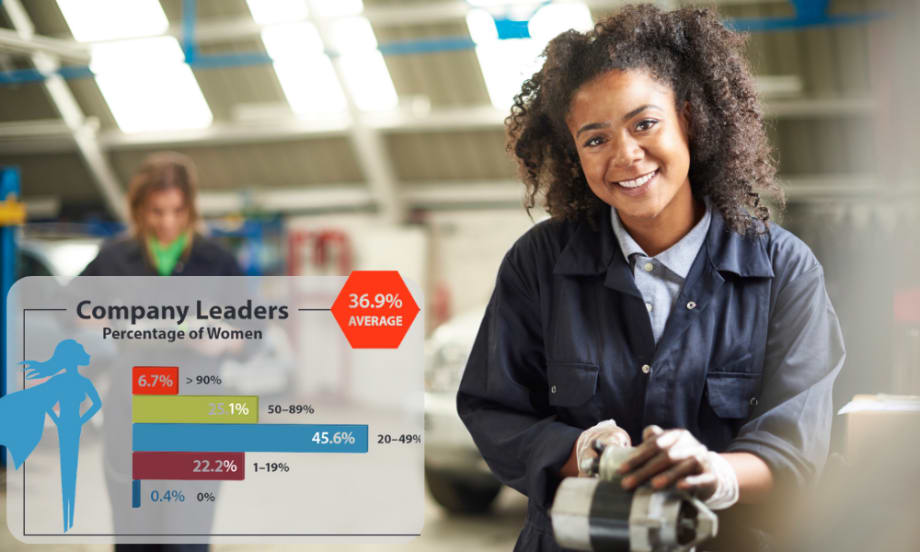
Women make up 36.9% of company leaders in fleet.
Photo: WIT/Work Truck
4 min to read
The Women In Trucking Association (WIT) surveyed gender diversity in the transportation industry from January through April 2023.
Respondents were surveyed on demographics, status, C-Suite executive, and more.
The most notable question was “What’s the percentage of women in key roles in the transportation industry?”
The percentages revealed are nationwide averages:
C-Suite Executives: 31.6%.
Company Leaders: 36.9%.
Females Serving on Boards of Directors: 28.4%.
Women in HR/Talent Management: 74.6%.
Women in Technician Roles: 7.5%.
Women in Professional Driver Roles: 12.1%.
Women in Dispatcher Roles: 43.5%.
Women in Safety Roles: 41.6%.
What 350 Respondents Reveal About Gender Diversity in Transportation
In the 2023 WIT Index survey, 350 respondents were authorized to provide their organizations' gender diversity statistics.
Most of these respondents (51.8%) were associated with organizations with for-hire or private fleets as part of their operations.
Among those representing organizations with fleet assets, 41.0% reported on behalf of various motor carriers, including full truckload, less-than-truckload, refrigerated, flatbed, expedited, and liquid carriers.
Additionally, 10.8% were reporting for manufacturers, retailers, distributors, and other company types with private fleets. Another 14.2% represented intermediary companies, which included third-party logistics companies, truck brokers, and intermodal marketing companies.
Furthermore, 6.5% of respondents were from companies providing professional services in the transportation industry, while another 6.5% represented technology companies offering transportation management systems, warehousing management systems, and/or enterprise-wide technology solutions.
A notable 21% of respondents belonged to other company types falling into the "Other" category.
The survey also saw a significant presence of major transportation companies with over 10,000 employees, accounting for 14.2% of the respondents.
Large companies with 1,000 to 4,999 employees comprised 13.4% of the respondents.
However, the 2023 WIT Index also had substantial representation from small and medium-sized companies, with 23.1% having less than 50 employees and another 33.8% with 50 to 499 employees.
Advancing Gender Diversity in Transportation Leadership
The demand for more female leaders in the transportation industry has reached a critical juncture, supported by a plethora of compelling data.
Companies with a higher representation of women on their boards have been observed to outperform their counterparts lacking gender diversity. Research has further demonstrated that organizations with greater gender diversity exhibit significantly higher profitability, particularly in senior leadership positions.
Moreover, the transportation sector is also experiencing a notable increase in gender diversity within its leadership ranks.
According to data from the 2023 WIT Index, participating companies reveal that, on average, 31.6% of executives in the C-suite are women.
Among the respondents, 39.2% report having 20% to 49% of female executives in their C-Suite, while another 22% indicate that 1% to 19% of their executives are women.
On the other end of the spectrum, 7.8% report having more than 90% of their C-suite comprised of women, but conversely, 13.1% disclose having no women in their C-suite positions.
The index also examines the representation of women in supervisory roles across the transportation industry. Referred to as "company leaders," these individuals hold supervisory responsibilities and can include executives within the C-Suite.
The survey reveals that 36.9% of company leaders with supervisory roles are women. Specifically, around 45.6% of respondents indicate that 20% to 49% of their company leaders are female, while 25.1% report that 50% to 89% are women.
Approximately 22.2% mention having 1% to 19% of company leaders represented by women.
Gender Diversity Improvements in Truck Maintenance Technicians
The trucking industry has long grappled with a well-documented shortage of professional truck drivers, crucial for efficiently transporting the nation's freight.
However, an equally critical aspect is often overlooked — the need for skilled truck maintenance technicians.
As per the U.S. Bureau of Labor Statistics, diesel technicians are highly sought-after throughout the country, with around 242,200 currently employed.
A severe shortage of technicians exists, leaving the industry with a significant shortfall. The American Trucking Association projects a requirement of approximately 200,000 technicians in the next decade to meet the current demands for truck maintenance.
Technical schools in the U.S. are producing only about 3,500 new diesel technicians annually.
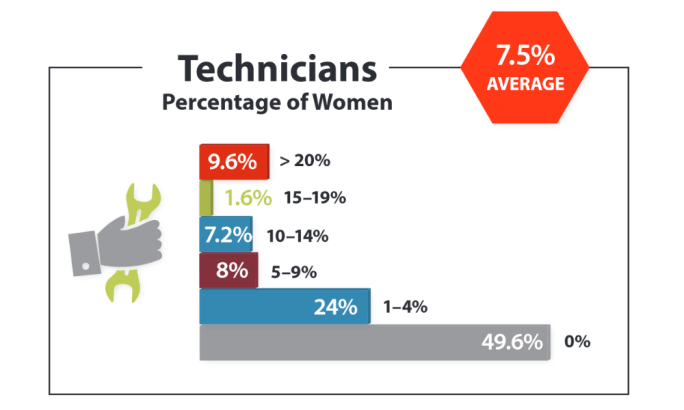
Of the surveyed, only 7.5% of technicians are female.
Photo: WIT
A notable gender disparity exists in this field, as highlighted by the 2023 WIT Index.
Participating organizations in the index reveal that only 7.5% of their overall technicians are female, with around 49.6% of respondents reporting no women in technician roles.
Merely 24% of respondents indicate that women comprise 1% to 4% of their technician workforce. However, there are signs of progress, as compared to past WIT Indexes, showing an average of approximately 3.7% of women in technician roles in 2022 - a notable increase of 3.8%.
Efforts to bridge the gender gap in truck maintenance technicians are underway, aiming to attract and train more women for these critical roles in the industry.
Topics:Operations
More Operations
Family Ties Inside the Fleet Families Building Careers Across Generations
Three fleet families share what it really takes to work together, learn across generations, and keep business from following them home.
Read More →
Shades of Fleet Call for Voices: Fleet's Hidden Heroes
Fleet’s hidden heroes are often the ones keeping everything moving behind the scenes. September’s Shades of Fleet is looking for dispatchers, coordinators, parts specialists, and other support pros to share their stories.
Read More →
Truck Centers, Inc. Celebrates National Truck Driver Appreciation Week with $1,000 Fuel Card Giveaways
During National Truck Driver Appreciation Week, Truck Centers, Inc. is offering customers a chance to fuel up for free. Customers at all Truck Centers locations can enter to win one of four $1,000 fuel cards from Sept. 14 - 18.
Read More →
Fleet Guides, AI Time-Savers, Truck Tariffs & Fuel Strategy Lead the News
This week’s Truck Chat Cheat Sheet covers new fleet vehicle guides, practical AI use cases, U.S.-Canada truck production, mixed-energy strategy, and more.
Read More →
What Fleet Employers Are Missing When Hiring Veterans
What if some of the strongest candidates for fleet are already out there, but their experience is written in a language our industry does not always recognize?
Read More →
Automotive Fleet Opens 2026 Personal Use Survey for Commercial Fleet Managers
Less than two weeks left! Commercial and corporate fleet managers are invited to share how their organizations handle company vehicle personal-use policies, charges, and driver eligibility.
Read More →
What Resilient Fleets Do Differently When Conditions Change
Fleet resilience is about more than reacting to disruption. Lauren Fletcher talks with AP Fleet’s Alex Coveney about flexibility, planning, scaling, and what helps fleets adapt when business conditions shift.
Read More →
If We Want the Next Generation in Automotive, We Have to Give Them a Reason to Care
The automotive industry talks constantly about its workforce shortage. But before we can recruit the next generation, we may need to do a better job giving kids a reason to care about automotive in the first place.
Read More →
Ram ProMaster City Under $40K, Truck Tariffs, and AI Maintenance Lead the News
A sub-$40K commercial van, tariff questions, AI-powered maintenance, and a new EV production strategy headline this week’s Truck Chat Cheat Sheet.
Read More →
Bob Adamsky Shares the Fleet Lessons You Usually Learn the Hard Way
After more than 30 years in fleet, Arrow International’s Bob Adamsky has learned that the job is about far more than vehicles. He shares the lessons he wishes every fleet manager could learn a little earlier.
Read More →