




Ford Debuts E-Transit Pilot Vehicles
Penske Truck Leasing and National Grid have added preproduction E-Transit vans to their fleets. Both will evaluate E-Transit’s capabilities, driving experience, and charging for their applications.

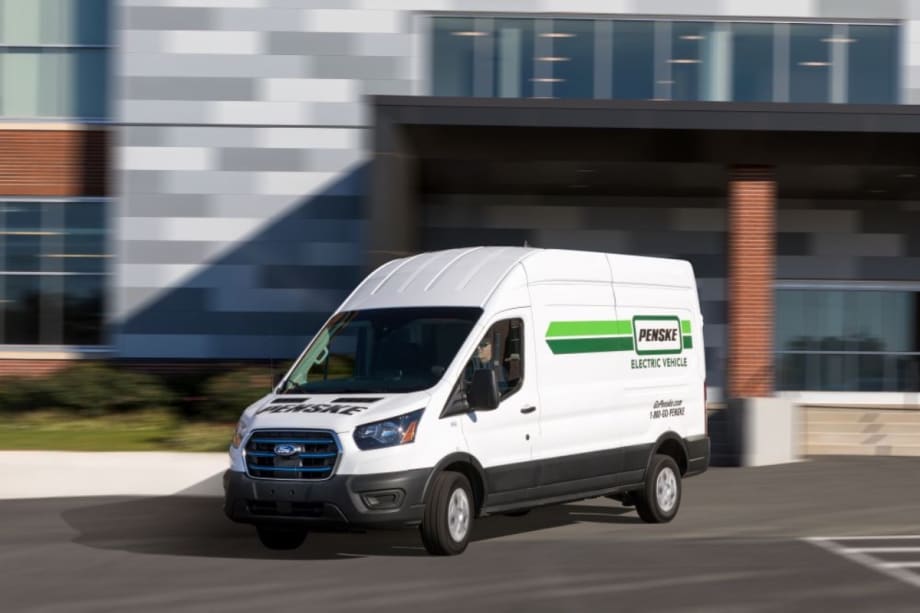
Ford Pro will use feedback and data from the pilot program to validate real-world vehicle performance across a range of use cases, upfits, temperatures, and driving environments.
Photo: Ford Pro
Penske Truck Leasing and National Grid are among the first companies adding preproduction E-Transit vans to their fleets. The early learnings from those pilots will help deployment of the E-Transit into their operations when the vehicle arrives to market early next year, Ford Pro said in a statement.
Penske Truck Leasing and National Grid, an energy company operating in the U.K. and U.S., have taken delivery of preproduction units of the Ford E-Transit van.
Penske plans to evaluate and validate E-Transit van capabilities, driving experience, and charging strategies for specific applications, including rentals to small- and medium-sized commercial businesses.
As part of the pilot program, Penske has deployed an E-Transit van in the Reading, Pennsylvania area. Penske’s long-term electric vehicle plans include adding electric vans throughout its wider network, including Southern California.
“We’re excited to collaborate with Ford Pro on the introduction and real-world testing of these new electric vehicles as the first truck rental and leasing company to do so,” said Art Vallely, president, Penske Truck Leasing. “We expect to see strong utilization and interest from customers making final-mile deliveries, regional deliveries, and eventually consumer use for smaller household moves.”
National Grid, a global energy management company and operator of several utility conglomerates, recently took delivery of a preproduction low-roof E-Transit cargo van that it will test on regular home meter-reading routes. The company will validate performance compared to its gas-powered vehicles.
“We are proud to be the first energy company in the Northeast to test out Ford’s electric van and collaborate with Ford Pro,” said Badar Khan, president of National Grid, U.S. “Over the next decade, National Grid will be moving to a 100% electric fleet for our light-duty vehicles and working to replace medium- and heavy-duty vehicles with sustainable options. Last year, we began testing electric backhoes and this year, e-vans could bring us closer to our goal of net zero emissions by 2050.”
Participating companies in the pilot will deploy vehicles in specific applications to evaluate performance, identify the best route types, and explore charging solutions while connected to the Ford Pro ecosystem.
The E-Transit pilot vans will operate in in fleets that span industries such as rental, delivery, service, maintenance, telecom, and utilities.
The pilots will couple E-Transit with Ford Pro Intelligence and Ford Pro Charging solutions to monitor and help manage energy usage. Ford Pro will use feedback and data from the pilot program to validate real-world vehicle performance across a range of use cases, upfits, temperatures, and driving environments to continue to refine products and develop additional training tools.
The E-Transit, assembled alongside Transit at Ford’s Kansas City Assembly Plant, will come in eight configurations, including a cargo van with three roof heights and three lengths, plus chassis cab and cutaway versions.
The Ford E-Transit will begin arriving at dealerships in early 2022.
Ford Pro Solutions
Ford Pro is a commercial products, services, and distribution business within Ford that will supply products and services for commercial and government customers that include Ford Pro vehicles, Ford Pro Charging, Ford Pro Intelligence, Ford Pro Elite, and Ford Pro FinSimple.
“Our customers are telling us that they have ambitious sustainability goals to reduce their fleets’ carbon emissions through the integration of all-electric vehicles,” said Ford Pro CEO Ted Cannis. “E-Transit commercial vans and the supporting Ford Pro ecosystem, especially end-to-end charging, play a critical role in helping achieve those goals and transforming their business operations without disruption.”
Cannis pointed out that electrifying fleets requires an ecosystem of products and services to expand penetration.
“Beyond supplying all-electric vehicles to customers, Ford Pro is helping businesses determine better solutions for energy management and fleet efficiency,” said Cannis. “Our services link to the vehicle and into the entire operational environment of the business, which is the only way EVs will stick. Anything else is just disruptive to their business bottom line.”
Ford Pro Intelligence delivers technology solutions that connect to the vehicle, such as Ford Pro E-Telematics software tools. The technology connects wirelessly, helping businesses manage fleets with real-time vehicle insights such as charge event monitoring, vehicle tracking, state of charge, range, charge history and logs, charging/battery settings and alerts, and departure preconditioning.
Ford Pro Charging provides tools to enable home, public, and depot charging for fleets. Employee home charging will include available hardware and software solutions to manage overnight charging along with access to energy reports to aid in driver reimbursement.
When public charging is needed, customers can access the BlueOval Charge Network, Ford’s public charging network that currently offers more than 19,500 charge stations and 63,000 charging plugs nationwide.
Depot charging solutions include hardware and software that monitor optimal charging times for fleets to help avoid costs associated with peak charging hours.
Originally posted on Automotive Fleet
More Green Fleet

Fleet Forward Conference Introduces One-Day Passes for 2026
New one-day registration gives fleet professionals the flexibility to attend Tuesday, Wednesday, or Thursday, with passes available for $199 through Sept. 18.
Read More →
CALSTART Rebrands as Catalyst Mobility, Will Combine with Forth in 2027
CALSTART has rebranded as Catalyst Mobility and will combine with Forth at the start of 2027. The new organization said it is poised to become one of the world's largest, strongest, and most impactful clean transportation nonprofits.
Read More →
Electric Truck and Charging Programs to Boost Sustainability at NY & NJ Ports
Together, the Port Authority of New York and New Jersey and CALSTART will electrify drayage and terminal operations serving the East Coast’s busiest container port. A pair of incentive programs totaling $45 million has launched to accelerate adoption of zero-emission drayage trucks and terminal tractors.
Read More →
Xos Hub Surpasses One Gigawatt-Hour of Energy Delivered in the Field
A single Xos Hub has surpassed one gigawatt-hour of energy across more than 33,600 charging sessions in the field, demonstrating performance that supports Xos' expansion across new products and markets.
Read More →
Carrier Transicold Launches All-Electric Vector 8200 TRU for Diesel-Free On-Site Cold Storage
Carrier Transicold’s first engineless multi-temperature TRU helps fresh- and frozen-food fleets add supplemental cold storage capacity during seasonal peaks.
Read More →
Narro Trucks Introduces Electric Utility Vehicle
Narro Trucks officially launched its operations on Aug. 20 and hosted a ride and drive to showcase its electric truck, which will be produced in Virginia.
Read More →
Samsung SDI Takes Full Control of GM Battery JV as Indiana Plant Pivots to Energy Storage
Samsung SDI is taking full control of its Indiana battery plant with GM, marking a major shift from the EV-focused joint venture Charged Fleet first covered in 2023.
Read More →
NWSA Taps CALSTART to Administer Zero-Emission Drayage Assistance Program
CALSTART will provide free technical assistance services to drayage fleets serving the Ports of Seattle and Tacoma and looking to transition to cleaner technologies and help decarbonize freight hubs.
Read More →
EV Fleet Reality Check: What Operators Wish They Knew Before Electrifying Their Work Vans
Electric work truck upfits bring new compatibility questions. Learn how parts availability, OEM guidance, power demands, and route planning can affect fleet performance.
Read More →
Peterbilt Expands Sourcewell Partnership with Electric Vehicle Lineup
Peterbilt Motors Company’s cooperative purchasing agreement with Sourcewell and its Canadian partner, Canoe Procurement Group, now includes including Peterbilt's battery-electric vehicle lineup.
Read More →