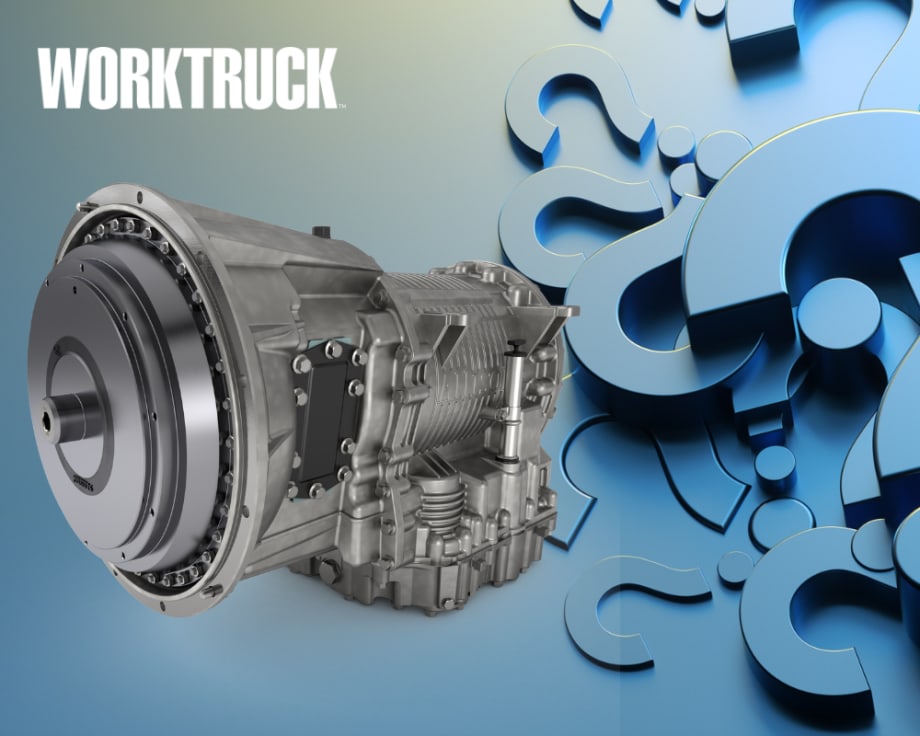
With more than 25 different transmissions and more than 15 different engine options available, how can you select the right combination for your medium-duty trucks? Here are some guidelines to help.
With more than 15 different engine options available, how do you ensure you spec the right transmission in your medium-duty vehicles?
Photo: Work Truck/Allison Transmission
8 min to read
When you’re writing specs on a 3/4-ton long-bed diesel pickup, the transmission selection process centers on one key question: manual or automatic? And usually, you have only one manual transmission and one automatic compatible with the one available diesel engine.
Medium-duty commercial vehicles are a different story. In a typical medium-duty truck, one of more than 25 different transmissions must be married to the right diesel engine with the right horsepower and torque ratings.
Ad Loading...
With more than 15 different engine options available, how do you ensure you spec the right transmission in your medium-duty vehicles?
Whether you’re developing specs from scratch or evaluating existing transmission specs, here are eight questions to guide you in developing selection criteria:
1. How Are Medium-Duty Commercial Vehicles Used?
This is the starting point:
Will it be used for pickup and delivery with a lot of starting and stopping? Or more on-highway straight-line driving?
Will the truck be used for off-road construction, where parking speeds are most important? Or will on-highway cruising speed be most important?
For example, are you running a pest control spray application, where you’ll want to engage the power take-off (PTO) while the truck is in motion at slow speeds? Or will you operate the PTO while the truck is stationary, such as a towing and recovery rollback application?
When clear about the truck’s purpose, you can narrow the number of options of the transmissions that fit those functions.
Ad Loading...
2. What are the Truck Trailering Requirements?
The key indicator for medium-duty trailer capacity is Gross Combined Weight Rating (GCWR).
GCWR is the maximum allowable weight of the truck and its payload, combined with the weight of the trailer and its payload.
Therefore, the question becomes: Will this truck be pulling a trailer? If so, how much weight will the trailer need to haul?
Suppose you are assembling specs on a Chevrolet Kodiak/GMC Topkick C-7500 with a gross vehicle weight rating (GVWR) of 25,950 pounds. You’re looking to marry a Caterpillar engine with a 660-lb.-ft. torque rating to the right Allison automatic transmission.
While the 6-speed automatic Allison 2500 transmission and Allison 3000 6-speed are compatible with that spec engine, each yields a completely different GCWR, directly impacting trailer capacity:
Ad Loading...
The Allison 2500 series offers 33,000-lb. GCWR.
The Allison 3000 series bumps it up to 60,000-lb. GCWR.
Which transmission should be selected if you need to pull a trailer that hauls a minimum of 25,000 pounds? The 3000 series.
With such a wide variance, even among automatics, make sure you spec a transmission that does the job you require.
Suppose you’re running a 250-horsepower Caterpillar with 800-lb.-ft. torque and prefer a 6-speed manual transmission.
An Eaton-Fuller FS5406A 6-speed manual won’t work because its torque rating is only 560 lb.-ft. Instead, you’ll need to spec an Eaton-Fuller FS08406 6-speed manual with a more compatible torque rating of 860-lb.-ft.
Ad Loading...
When your torque requirements are identified, you can focus on evaluating a shorter list of compatible transmissions.
4. What Transmission Spec Does the Body Company Require?
Mike Cain with E.D. Etnyre and Co., an Oregon, Ill.- based company that builds asphalt distributor trucks, says his equipment requires a close look at transmission specs.
“For the chip seal contractor, who sprays down a heavy load of liquid asphalt and then follows behind it with a chip spreader, putting stone in the asphalt, we really concern ourselves with the transmission and rear axle combination. This is to ensure the truck can still operate efficiently and at a slow enough speed to spray asphalt,” says Cain.
How do you tell if the transmission will allow the truck to operate at sufficiently slow speeds?
“Look at the first gear ratio,” explains Cain. “A typical 5-speed manual transmission has a first gear ratio of 7:1. The typical 6-speed manual has a 9:1. The higher the ratio, the slower the speeds we can get.”
Ad Loading...
Would any available automatic transmissions work for this application?
“The automatic transmissions really throw us for a loop,” says Cain. “The best one out there is the Allison 3000 series with a ratio of 4.59:1, which means it’s quite fast. And that presents a problem.”
Consult your upfitter at the beginning of the selection process. Determine if specific needs must be considered in the transmission specs. This way, you’ll save yourself the hassle and downtime cost that come with purchasing the wrong spec.
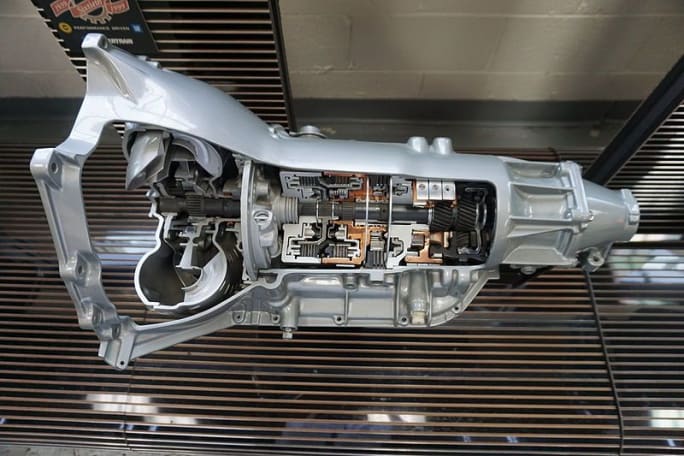
A cutaway of a Hydra-Matic 3L80 transmission.
Photo courtesy of Ypsilanti Automotive Heritage Museum
“Do you have drivers with a good set of brains who can handle a clutch pedal and shifter in their hands?” asks Miguel Soetaert, manager of Mercedes Benz Transmissions with Freightliner. “Or do you need a transmission that does all the work—no clutch pedal, no shifter, no need for the driver to think?”
Ad Loading...
In other words, is your pool of drivers skilled in driving manual transmissions? Or do you need a truck that just about any of your employees would be able to drive?
Remember, an inexperienced driver can also drive up maintenance costs on manual transmissions.
“If the driver shifts really fast all the time and put really high forces on the synchronizers, you’ll wear them out much faster. That kind of repair is normally not covered by warranty because it’s not the transmission — it’s a driver issue. And that repair can cost a lot of money,” explains Soetaert.
6. Manual Transmission or Automatic Transmission for Medium-Duty Vehicles?
Your answer to question five usually will guide your answer here. If you have skilled drivers, the manual transmission might be a good fit. But if driver availability is an issue, the automatic may be the best option.
Here is a basic overview of the key advantages of each transmission type to consider in your decision:
Ad Loading...
Manual Transmissions
More fuel efficient. “The torque converter in the automatic transmission dissipates more energy than a friction clutch (in the manual transmission). So, with the manual, you can get be more fuel efficient, but you need a good driver,” says Soetaert.
Lower initial cost. The manual transmission for medium-duty vehicles range anywhere between $2,500-$4,000 less than the corresponding automatic transmission, depending on the truck’s make, model, and GVWR.
More shift control. This can be an advantage for the asphalt-paving example discussed earlier, off-road applications, driving on hills, and driving on bends. “You don’t want your transmission to shift while you’re driving around a bend. You want as much control over the shifting as possible,” Soetaert advises.
Automatic Transmissions
Safety. Drivers can keep their eyes on the road and hands on the steering wheel. You don’t have to worry about the driver inadvertently allowing the truck to roll backwards when at a stoplight on a hill. As discussed earlier, this also opens up your driver pool to more employees because it doesn’t require as skilled a driver. The more skill the truck requires to operate efficiently, the higher the cost to find qualified drivers.
Smoother shifts. “Each time you have passengers standing in a truck while it’s in motion — such as city buses, emergency vehicles, and garbage trucks — I recommend going with the automatic,” Soetaert advises.
Driver comfort. The driver doesn’t need to constantly push in with one foot and shift gears with a hand. The automatic transmission does the work.
Once you’ve decided between manual or automatic, choose the specific transmission that meets the parameters set from the questions above.
7. Need for PTO to Operate Efficiently
The National Truck Equipment Association (NTEA) defines PTO as a mechanical device used to transmit engine power to auxillary equipment. PTOs can be mounted on either a main or auxiliary transmission.
Essentially, PTOs are spec’d with the transmission to run equipment such as dump bodies, wheel lifts for tow trucks, or spray bodies designed for pest control companies. If you operate flat beds or box trucks, for example, that don’t require engine power to run equipment, then a PTO is not required.
Ad Loading...
However, even if a PTO is not required initially, you may want it for resale purposes.
“The PTO may not be meaningful for the first life of the truck, but it’s the second life — when you trade it in or sell it — that the lack of PTO becomes an issue,” explains Ed Rogers with sales engineering at General Motors Isuzu Commercial Truck. “Without the PTO, you can’t easily convert the truck into a dump application or something that operates equipment. And it’s expensive to correct after the fact, requiring about a $2,000 conversion to put a gear in it.”
If you decide to include a PTO in the transmission specs, Soetaert recommends asking the following questions:
Where should the PTO be placed? On the left side, right side or rear?
What kind of ratio is needed between PTO RPM in comparison to engine RPM, e.g. 1.5, 2.0?
What kind of performance is required? How much horsepower is needed to generate that performance?
How will the PTO be used? Only in a stationary mode when the vehicle is in park (e.g. crane/mechanic’s truck application)? Or in a mobile mode (e.g. street sweeper)?
If you’re unclear on an answer to these questions, Soetaert advises consulting your body company or the truck manufacturer for clarification.
Ad Loading...
8. What's Best: A Wide or Close Ratio Transmission?
If you select an automatic transmission, do you need a wide-ratio or a close ratio? What’s the difference?
“A close-ratio transmission is best suited for applications that operate most of the time on paved roads and do not require a deeper reduction for offroad operation,” explains Lou Gilbert, with GM Allison North American Market Development. “On-highway operation does not require the greater low-end reduction that a wide-ratio transmission provides.”
What are common applications for wide-ratio automatic transmissions? Gilbert offers these examples:
Refuse vehicles operating in landfill environments.
Dump trucks running both on and off-highway.
Pickup and delivery with numerous starts and stops.
Consult your upfitter at the beginning of the selection process. Determine if specific needs must be considered in the transmission specs.
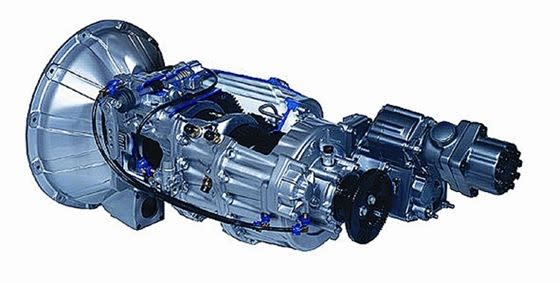
Photo: Allison Transmission
The Bottom Line
One size does not fit all when it comes to medium-duty commercial vehicles and transmissions.
Ad Loading...
However, with a clear understanding of how the truck will be used and the skill set of your drivers, the answers to the other six questions seem to fall into place — and make the transmission selection process much easier.
Yokohama Tire Manufacturing Mississippi’s Maintenance Apprenticeship Program, in partnership with East Mississippi Community College, combines classroom instruction with on-site experience as employees pursue an associate degree.
Bobit Business Media surveyed 190 fleet professionals and found that while most fleets are tracking costs, fragmented systems and data gaps are keeping true TCO visibility out of reach. With rising pressure to control spend in an increasingly volatile environment, the gap between what fleets think they know and what the data actually shows is wider than you might expect. See how your peers are managing costs today and where the industry still has room to improve.
Technicians tackle varied tasks every day, but as problem-solvers, they need good illumination during inspections, repairs, and maintenance. So, what makes a good technician inspection light?
Kenworth Truck Company has selected leading Kenworth service professionals for its 2026 Kenworth Service Council, which will promote service and product enhancements. See who was selected and which Kenworth dealers they represent.
In the past year, General Motors has invested nearly $200 million to grow skilled trade careers across the U.S. The goal for GM is to support its current workforce with the skills and development they need while building clear, compelling career paths for the next generation.
Patrick Etheridge has been promoted to director of OEM/truck stop sales for CMA/Double Coin, and Jose Pfirrmann has been promoted to director of sales for Region 1 for CMA.
Installer’s Advantage, by DRiV, brings together more than 5,000 exclusive parts engineered to address common challenges technicians face every day in the service bay.
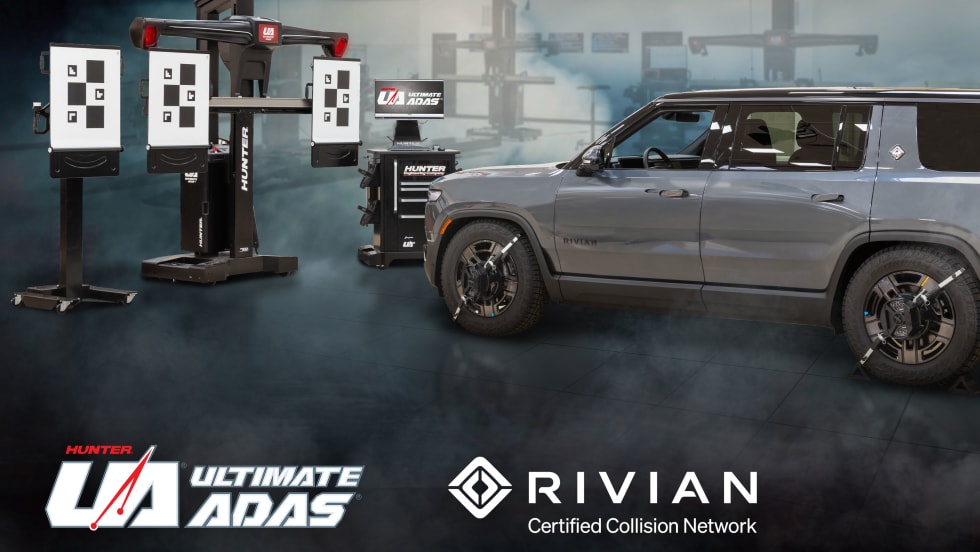
Hunter Engineering’s Ultimate ADAS alignment and calibration system has been approved for Rivian’s entire vehicle lineup. Ultimate ADA provides static calibration coverage for more than 90% of vehicles in operation.