




Pepco Holdings: Blueprint for a Green Future
The company’s commitment to the community leads to a greener fleet. In addition to making environmentally conscious vehicle purchases, PHI evaluates its entire fleet operation for ways to reduce its carbon footprint.
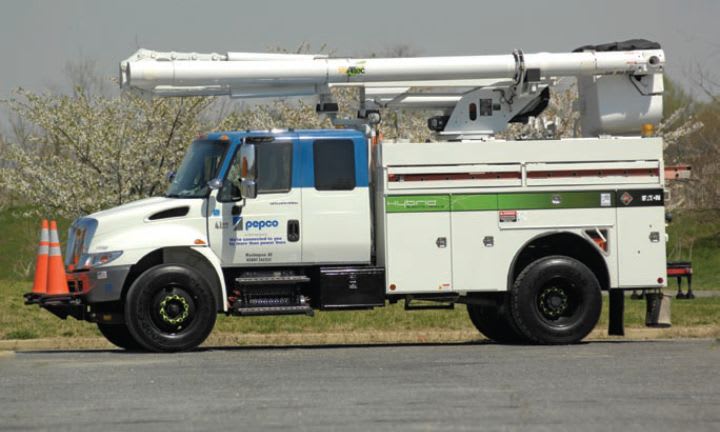
Pepco Holdings, Inc., headquartered in Washington, D.C., delivers electricity to about 1.9 million customers in Delaware, the District of Columbia, Maryland, and New Jersey.
As one of the largest energy delivery companies in the Mid-Atlantic region, Pepco Holdings, Inc. (PHI) has energy consumption on the brain.
However, the company isn’t focused solely on customers’ energy consumption. In fact, it trains a keen eye on energy challenges in the community at large and that has meant making some changes to the company’s fleet.
PHI, headquartered in Washington, D.C., delivers electricity to about 1.9 million customers in Delaware, the District of Columbia, Maryland, and New Jersey. Through its subsidiaries Pepco, Delmarva Power, and Atlantic City Electric, PHI delivers regulated electricity. Delmarva Power also delivers natural gas.
PHI’s leadership recognized its ability to respond to the threat global warming poses. “The way we do business directly impacts our community and the environment, and the public concern about global warming can no longer be ignored,” said Dennis Wraase, chairman and CEO.
To transform to more environmentally friendly operations, PHI introduced a Blueprint for the Future in February 2007. “This initiative put PHI in a leadership role to address two of the pre-eminent energy challenges we face: the rising cost of energy and the impact of energy use on the environment,” said Frank Cottone, PHI vehicle resource manager.
The environmental initiative included replacing conventional vehicles with hybrids and alternative-fuel vehicles. Of its 2,000-unit fleet, 42 are hybrids and 116 operate on propane, compressed natural gas (CNG), E-85, or electricity. “In addition, we have switched to B-20 biodiesel at all of our company fuel sites, which helps our 792 diesel power units achieve a lower carbon footprint,” said Cottone.
Most of PHI’s alternative-fuel vehicles are light-duty units and material- handling forklifts. PHI chose Toyota Prius, Ford Escape Hybrid, and Dodge and Chevrolet alternative-fuel vehicles for employees who conduct business between the company’s three operating companies. “In addition, we have one hybrid bucket truck that we have evaluated as part of the Hybrid Truck Utility Forum (HTUF) and plan on purchasing eight more hybrid bucket trucks during 2008,” Cottone said.
The fleet additions’ most immediate benefit is better fuel economy. Compared to the vehicles they replace, the new vehicles are seeing significant gains in mpg: the Toyota Prius gets more than 43 mpg and the Ford Escape Hybrid averages more than 26 mpg.
“The benefits are pretty straightforward: better fuel economy and reduced CO2 emissions. With the escalating price of gasoline, we are reaping some economic benefits. And, according to the U.S. Environmental Protection Agency (EPA), biodiesel fuel reduces CO2 emissions by about 15 percent,” said Cottone.
In addition to environmentally conscious vehicle selection, PHI has evaluated the entire fleet operation to reduce its carbon footprint. Cottone said several “green opportunities” have been found, for example, in maintenance facility recycling of oil, rags, tires, and eliminating aerosol cans, etc.
Originally posted on Automotive Fleet
More Green Fleet
Fuel Management's Next Evolution Centers on Connected Fleet Technology
Learn how fleets are integrating fueling, telematics, tank monitoring, EV charging, and data systems to improve efficiency and visibility.
Read More →
Landi Technologies Achieves CARB Certification of Ford 7.3L RNG/CNG Platform
Landi Technologies has gained CARB certification of its Ford 7.3L Renewable Natural Gas (RNG) and Compressed Natural Gas (CNG) platform for the Ford E-450, F-450/550/600, F-650/750, and F-53/59 platforms.
Read More →
Turning Connected Vehicle Data Into Decisions That Matter
Fleet leaders have more data than ever, but turning that data into clear, actionable decisions remains a challenge. This white paper shows how leading organizations are using connected vehicle data to improve safety, reduce costs, and optimize fleet performance. Learn how to turn insight into action across your fleet.
Read More →
Are You Tracking Your Fleet's True Total Cost of Ownership?
Bobit Business Media surveyed 190 fleet professionals and found that while most fleets are tracking costs, fragmented systems and data gaps are keeping true TCO visibility out of reach. With rising pressure to control spend in an increasingly volatile environment, the gap between what fleets think they know and what the data actually shows is wider than you might expect. See how your peers are managing costs today and where the industry still has room to improve.
Read More →
Epic Charging Acquires Bluedot Technologies
Epic Charging has acquired Bluedot Technologies, expanding EV fleet charging access to more than 80% of U.S. public charging networks.
Read More →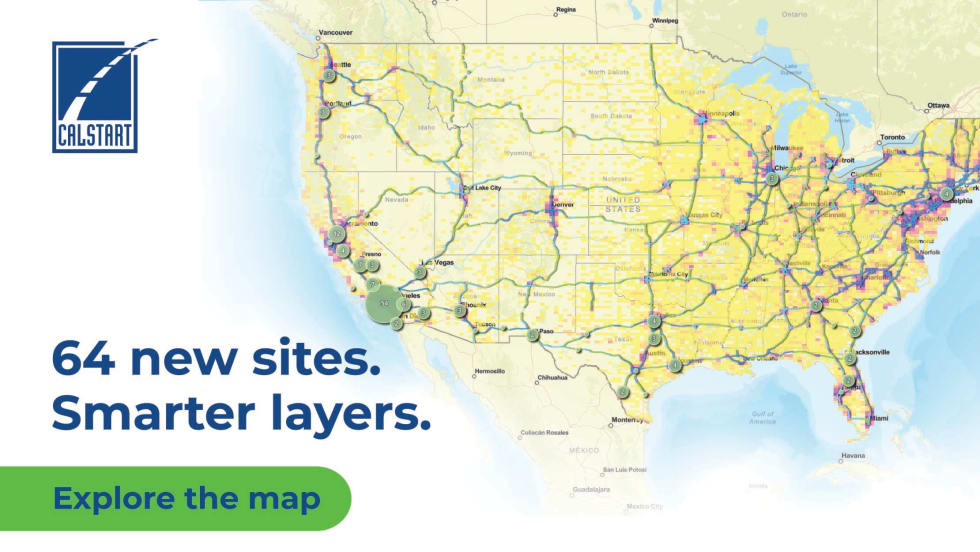
CALSTART Adds 64 New Sites and Features to Its Medium- and Heavy-Duty Zero-Emission Infrastructure Map
CALSTART’s interactive National Medium- and Heavy-Duty Zero-Emission Infrastructure Map now locates approximately 1,500 ports at 162 total public, semi-public, and shared electric vehicle (EV) charging and hydrogen refueling facilities for Class 2b-8 trucks.
Read More →
Mack Trucks Expands Full-Service EV Infrastructure Providers
Mack Trucks has expanded its comprehensive Turnkey Solutions program for Mack battery-electric vehicle customers with the addition of two new full-service providers, ABM and Lane Valente Industries.
Read More →
EV Realty Opens Major Truck Charging Hub in California’s Inland Empire
EV Realty’s San Bernardino Powered Properties’ truck charging hub, which has now opened, can serve over 200 medium- and heavy-duty trucks per day.
Read More →
WEX Launches Solution to Close the EV At-Home Charging Visibility Gap for Fleets
WEX unveiled its EV At-Home with Vehicle Fraud Protection, which ensures accurate and secure reimbursement for at-home charging.
Read More →
Toyota Motor Corporation to Join Daimler Truck & Volvo Group in Fuel Cell Joint Venture Cellcentric
Toyota intends to join Daimler Truck and Volvo Group as an equal shareholder in Cellcentric. All three shareholders intend to further strengthen Cellcentric as a leading manufacturer of fuel cell systems for heavy-duty commercial applications.
Read More →