




Nissan Enters Commercial Vehicle Market with Nissan NV
Nissan’s first entry into the commercial vehicle market in North America, the 2012 Nissan NV (Nissan Van), will be available in three models and two roof configurations.

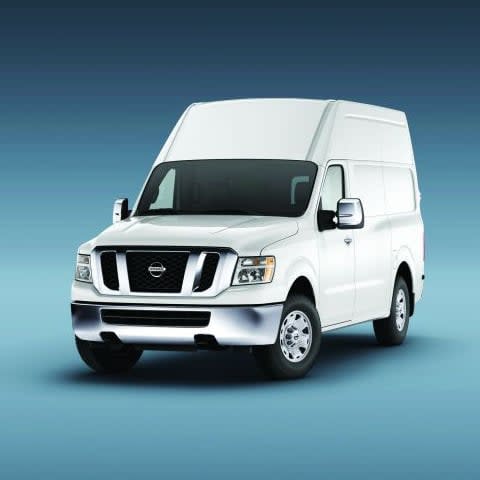
The Nissan NV high roof model provides easy cargo area ingress and egress, comfortable walk-through, and standing capability.
The 2012 Nissan NV (Nissan Van) marks Nissan's first entry into the commercial vehicle market in North America. Scheduled to launch in early 2011, the Nissan NV will be available in three models, NV1500, NV2500 HD, and NV3500 HD, and in two roof configurations - standard roof and high roof. The NV is the first high roof commercial van to offer body-on-frame construction, according to the company.
NV Designed for Practicality
The NV combines a full-length hood with access to the engine for service and maintenance, along with signature Nissan styling cues such as large headlights and vertical grille. Broad bodysides project a commercial vehicle appearance and provide ample room for company logos or advertising messages. Tall, wide doors offer easy access to the cab and cargo areas.
Standard roof models fit most garages, drive-through lanes, and car washes. High roof models provide easy cargo area ingress and egress, comfortable walk-through, and standing capability.
Roomy Interior Provides Ample Storage Space
Inside the cab is a roomy, comfortable interior with wide, supportive seating and an expansive instrument panel. The passenger seat includes a segment-exclusive fold-down feature, providing a convenient worktable. An available center console offers storage compartments and space to hold binders and a laptop computer. Other convenient storage spaces include a wide overhead console (available with high roof models) and large door pockets. The interior is fitted with heavy-duty fabrics and materials, with water repellant fabric on main seating surfaces. In addition, there are multiple power outlets, including an available three-prong 120V outlet.
The Nissan NV includes a long, wide cargo floor, square-top wheelwell housings, and nearly vertical sidewalls that maximize cargo space and accommodate aftermarket storage systems without excessive modification. The cargo area also features a full-length inner panel to prevent cargo from denting the vehicle's outer skin. Multiple weld-nut attachment points can be used for mounting shelving and racks.

Engines Combine Power and Fuel Efficiency
Powering the rear-wheel drive Nissan NV will be a choice of two powerful, yet fuel-efficient engines - a 4.0L 24-valve V-6 and 5.6L 32-valve V-8. Both will be mated to a standard 5-speed automatic transmission.
Other features include independent front suspension with stabilizer bar and solid rear axle with leaf springs and stabilizer bar. The hydraulic recirculating ball steering system is engine-speed sensitive. Heavy-duty four-wheel disc brakes feature 14.1-inch rotors and four-wheel anti-lock braking system (ABS). The vans are also equipped with 17-inch steel wheels and LT245/70R17 all-season tires.
The vans come standard with the Nissan advanced air bag system, which includes dual-stage front supplemental air bags with seat belt sensors. Three-point front seat belts have pretensioners and load limiters. Supplemental front seat-mounted side-impact air bags and roof-mounted supplemental curtain air bags are also available.
The new Nissan NV will be manufactured at the automaker's Canton, Miss., assembly plant.
Originally posted on Automotive Fleet
More Operations

What Does a Potato Have to Do with Leadership?
From simple process improvements and creative problem-solving to the little moments that strengthen team culture, this conversation dives into the power of unexpected ideas and why innovation doesn't always arrive wrapped in new technology or a major initiative.
Read More →
Looking for a New Podcast for the Road? Start Here!
Looking for a new podcast? Truck Chat delivers fleet leadership insights, industry deep dives, AI discussions, innovations, and real-world stories.
Read More →
Did You Know What You Don't See May Be Costing You Big?
As more employees choose personal vehicles (including hybrids and EVs) for business use, companies face new challenges around visibility, insurance, liability, and cost control.
Read More →

Veteran Voices in Fleet | How Military Service Shapes Fleet Leaders
Across every perspective, one message is clear: the experiences gained through military service continue to influence how veterans contribute to the fleet industry every day.
Read More →
The Fleet Lessons That Don’t Show Up on a Spreadsheet
From index cards to predictive maintenance, Robert Martinez shares the hard-earned leadership lessons that shaped nearly 40 years in fleet.
Read More →
People, Leadership & the Skilled Trades Opportunity | Weekly Cheat Sheet
People, data, leadership, and the skilled trades opportunity. See what's shaping fleets today in this week's Truck Chat Weekly Cheat Sheet.
Read More →
Everyone Thinks They’re a Fleet Manager
From oil changes to procurement decisions, fleet work is often underestimated by the very people who depend on it most. Bob Stanton makes the case for why communication, not just technical expertise, is one of the most important leadership skills in fleet.
Read More →
Turning Connected Vehicle Data Into Decisions That Matter
Fleet leaders have more data than ever, but turning that data into clear, actionable decisions remains a challenge. This white paper shows how leading organizations are using connected vehicle data to improve safety, reduce costs, and optimize fleet performance. Learn how to turn insight into action across your fleet.
Read More →
From Military Service to Fleet Leadership | Shades of Fleet
Military service ends, but the lessons don't. Hear how veterans are shaping fleet leadership through adaptability, teamwork, and mission-driven thinking.
Read More →
Are You Tracking Your Fleet's True Total Cost of Ownership?
Bobit Business Media surveyed 190 fleet professionals and found that while most fleets are tracking costs, fragmented systems and data gaps are keeping true TCO visibility out of reach. With rising pressure to control spend in an increasingly volatile environment, the gap between what fleets think they know and what the data actually shows is wider than you might expect. See how your peers are managing costs today and where the industry still has room to improve.
Read More →