




Propane Cleans Up Medium-Duty Trucks
Not only does propane offer lower capital costs than diesel power, but tax credits are also available for the resulting low-emission vehicles.

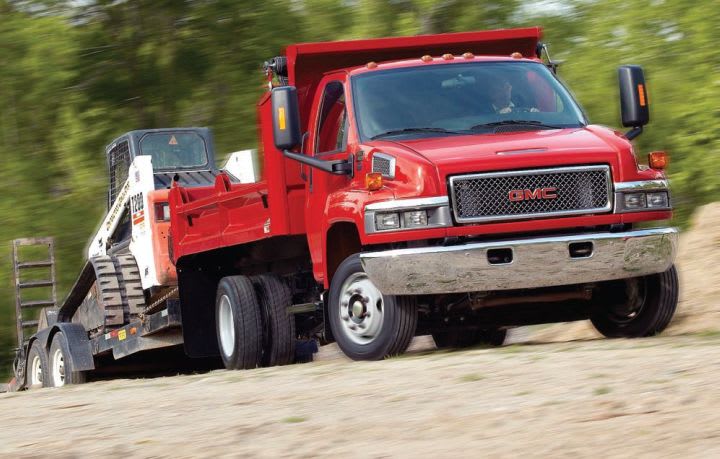
Medium-duty trucks such as this GMC Topkick can be ordered with the LPI fuel system.
Photo: GMC
CleanFUEL USA has teamed with two other companies to develop and market propane-powered versions of trucks with General Motors (GM) 8.1L V-8 Vortec gasoline engine.
The Kodiak and GMC Topkick 3500-7500 series trucks use a liquid propane injection (LPI) fuel system developed by the Italian propane engineering company, ICOM, in conjunction with CleanFUEL USA. GM supplies engines compatible with gaseous fuels and vehicle bodies. The ICOM-developed system is installed, the vehicle control module (VCM) is reprogrammed, and the truck is shipped to the dealer for buyer pick up.
The LPI system used in the vehicles replaces the gasoline fuel tank, fuel pump, and fuel injector rails with a pressurized system that delivers propane to the engine ports as a liquid. The engine’s VCM is reprogrammed to run on liquid propane instead of gasoline to operate in the trucks. The LPI system controls fuel mixing and keeps the propane from vaporizing before injection.
Responding to Demand
In 2004, according to the CleanFUEL USA Web site, they responded to a demand by medium-duty truck and bus operators for a propane engine alternative. In conjunction with ICOM of Cisterna, Italy, the company developed an LPI system using its proprietary JTG-Common Rail technology for the GM 8100 Vortec engine. Based on European technology with more than 27,000 systems already in use, the LPI system delivers propane to the cylinders in liquid form, resulting in improved fuel economy and superior performance with lower emissions. The emissions meet estimated EPA requirements through the 2009 production year for both EPA 49 State and the California Air Resource Board (CARB) certification.
LPI is not just a liquefied petroleum gas (LPG) propane fuel system. It is an integrated system, designed specifically for the OEM engine. Using the GM P-59 engine computer with a dedicated calibration specifically for propane, the LPI system replaces the gasoline fuel tank, fuel pump, and injector rails with a propane fuel tank, pump, and injector rails. LPI is a direct replacement for the OEM gasoline injection system.
Cost Advantages
The LPI vehicles cost about $10,000 more than their gasoline counterparts but represent a $6,000 savings from a comparable diesel-powered truck. Taxable entities are eligible for a tax credit that equals 50% of the incremental cost of the vehicle, plus an additional 30% of the incremental cost for vehicles with near-zero emissions under the EPAct 2005’s Alternative Fuel Motor Credit. The LPI system on GM 3500-7500 series trucks is eligible for an 80% incremental cost credit. The propane used in the vehicles is also eligible for a 50-cent per gallon credit, regardless of tax status under the SAFETEA-LU Volumetric Excise Tax Exemption program.
For additional sustainability tips and information, check out Clean Fuels.
More Green Fleet

Landi Technologies Achieves CARB Certification of Ford 7.3L RNG/CNG Platform
Landi Technologies has gained CARB certification of its Ford 7.3L Renewable Natural Gas (RNG) and Compressed Natural Gas (CNG) platform for the Ford E-450, F-450/550/600, F-650/750, and F-53/59 platforms.
Read More →
Turning Connected Vehicle Data Into Decisions That Matter
Fleet leaders have more data than ever, but turning that data into clear, actionable decisions remains a challenge. This white paper shows how leading organizations are using connected vehicle data to improve safety, reduce costs, and optimize fleet performance. Learn how to turn insight into action across your fleet.
Read More →
Are You Tracking Your Fleet's True Total Cost of Ownership?
Bobit Business Media surveyed 190 fleet professionals and found that while most fleets are tracking costs, fragmented systems and data gaps are keeping true TCO visibility out of reach. With rising pressure to control spend in an increasingly volatile environment, the gap between what fleets think they know and what the data actually shows is wider than you might expect. See how your peers are managing costs today and where the industry still has room to improve.
Read More →
Epic Charging Acquires Bluedot Technologies
Epic Charging has acquired Bluedot Technologies, expanding EV fleet charging access to more than 80% of U.S. public charging networks.
Read More →
CALSTART Adds 64 New Sites and Features to Its Medium- and Heavy-Duty Zero-Emission Infrastructure Map
CALSTART’s interactive National Medium- and Heavy-Duty Zero-Emission Infrastructure Map now locates approximately 1,500 ports at 162 total public, semi-public, and shared electric vehicle (EV) charging and hydrogen refueling facilities for Class 2b-8 trucks.
Read More →
Mack Trucks Expands Full-Service EV Infrastructure Providers
Mack Trucks has expanded its comprehensive Turnkey Solutions program for Mack battery-electric vehicle customers with the addition of two new full-service providers, ABM and Lane Valente Industries.
Read More →
EV Realty Opens Major Truck Charging Hub in California’s Inland Empire
EV Realty’s San Bernardino Powered Properties’ truck charging hub, which has now opened, can serve over 200 medium- and heavy-duty trucks per day.
Read More →
WEX Launches Solution to Close the EV At-Home Charging Visibility Gap for Fleets
WEX unveiled its EV At-Home with Vehicle Fraud Protection, which ensures accurate and secure reimbursement for at-home charging.
Read More →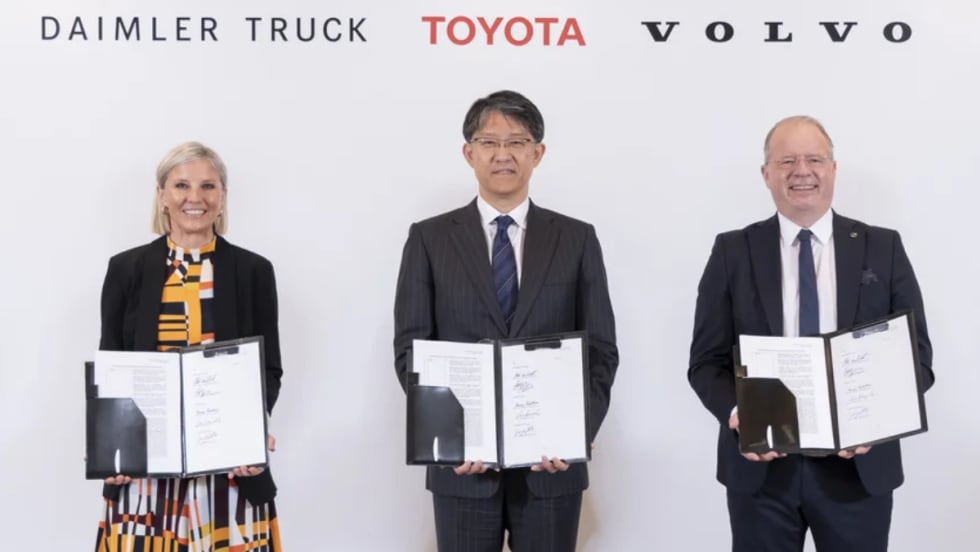
Toyota Motor Corporation to Join Daimler Truck & Volvo Group in Fuel Cell Joint Venture Cellcentric
Toyota intends to join Daimler Truck and Volvo Group as an equal shareholder in Cellcentric. All three shareholders intend to further strengthen Cellcentric as a leading manufacturer of fuel cell systems for heavy-duty commercial applications.
Read More →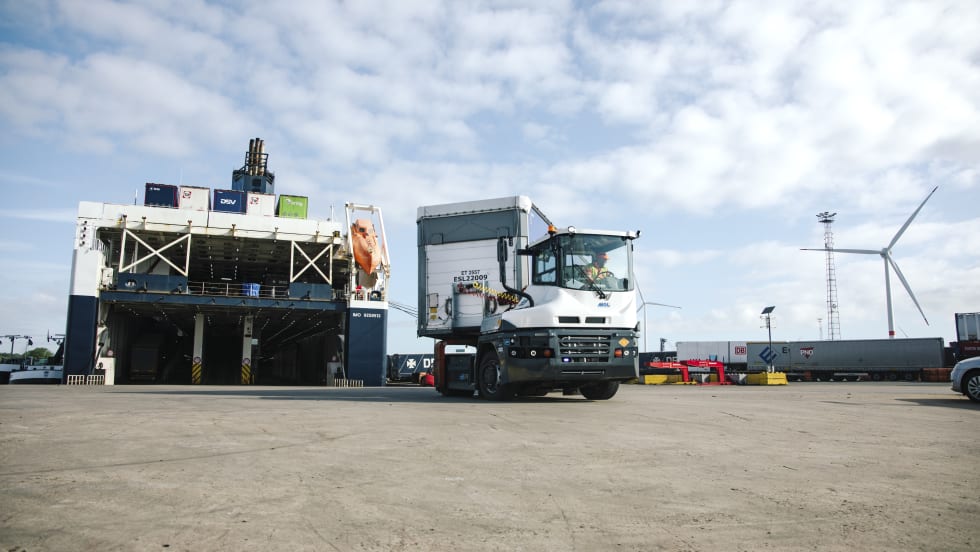
Volvo Penta Electric Drivetrain Powering Terminal Tractors
Volvo Penta and Volvo Financial Services (VFS) have partnered to support one of Northern Europe's largest shipping and logistics companies in its ambition to transition to electric terminal tractors.
Read More →