




Trucking Group Vows to Continue Fight Against CARB and U.S. EPA Emissions Regulations
The California Construction Trucking Association (CCTA) has filed a Notice of Appeal to the U.S. Court of Appeals for the Ninth Circuit in its nearly two-year-long legal case against the California Air Resources Board's (CARB) heavy-duty, on-road truck and bus regulation ("CDTOA v. CARB, Case No. 2:11-CV-00384-MCE-GGH").
The California Construction Trucking Association (CCTA) has filed a Notice of Appeal to the U.S. Court of Appeals for the Ninth Circuit in its nearly two-year-long legal case against the California Air Resources Board's (CARB) heavy-duty, on-road truck and bus regulation (CDTOA v. CARB, Case No. 2:11-CV-00384-MCE-GGH).
The organization is opposing the CARB diesel engine regulation that it said will ultimately force the replacement of most diesel powered commercial motor vehicles that do not meet 2010 EPA emissions standards in order to operate in the State of California. The CCTA contends that, despite claims used to justify this regulation by regulators and environmental groups that public grant funding is readily available to assist truckers in complying, this is not true. Small-business truckers are bearing the brunt of the multi-billion dollar expense to unnecessarily replace trucks originally built and certified to EPA emissions standards.
The CCTA originally filed its litigation to CARB's diesel engine regulation in March 2011, stating the state regulation is pre-empted by the Federal Aviation Administration Authorization Act (FAAAA), which prohibits states from enacting any law, rule, or regulation affecting the price, routes, or services of motor carriers. According to the CCTA, the Natural Resources Defense Council (NRDC) intervened by presenting a theory that CARB's regulation was not actually a state regulation but effectively a federal regulation when the EPA hurriedly approved the California State Implementation Plan (SIP) in 2012, containing the challenged truck and bus regulation.
In December 2012, the U.S. District Court issued a decision that the EPA was an "indispensable party" to the litigation, resulting from EPA approval of the SIP and that the court no longer retained jurisdiction. No decision was made on the merits of CCTA's original legal argument. The CCTA will appeal this decision.
Additionally, the CCTA will file a Petition for Review with the Ninth Circuit Court challenging EPA's approval of the SIP since, it said, the Clean Air Act prohibits the EPA from approving a SIP in conflict with other federal law. CCTA believes the approval is in conflict with the FAAAA and commerce clause of the U.S. Constitution.
Separately, the CCTA is being represented by the Pacific Legal Foundation in another action challenging the process used by the EPA in approving CARB's off-road diesel engine rules.
More Green Fleet
Fuel Management's Next Evolution Centers on Connected Fleet Technology
Learn how fleets are integrating fueling, telematics, tank monitoring, EV charging, and data systems to improve efficiency and visibility.
Read More →
Landi Technologies Achieves CARB Certification of Ford 7.3L RNG/CNG Platform
Landi Technologies has gained CARB certification of its Ford 7.3L Renewable Natural Gas (RNG) and Compressed Natural Gas (CNG) platform for the Ford E-450, F-450/550/600, F-650/750, and F-53/59 platforms.
Read More →
Turning Connected Vehicle Data Into Decisions That Matter
Fleet leaders have more data than ever, but turning that data into clear, actionable decisions remains a challenge. This white paper shows how leading organizations are using connected vehicle data to improve safety, reduce costs, and optimize fleet performance. Learn how to turn insight into action across your fleet.
Read More →
Are You Tracking Your Fleet's True Total Cost of Ownership?
Bobit Business Media surveyed 190 fleet professionals and found that while most fleets are tracking costs, fragmented systems and data gaps are keeping true TCO visibility out of reach. With rising pressure to control spend in an increasingly volatile environment, the gap between what fleets think they know and what the data actually shows is wider than you might expect. See how your peers are managing costs today and where the industry still has room to improve.
Read More →
Epic Charging Acquires Bluedot Technologies
Epic Charging has acquired Bluedot Technologies, expanding EV fleet charging access to more than 80% of U.S. public charging networks.
Read More →
CALSTART Adds 64 New Sites and Features to Its Medium- and Heavy-Duty Zero-Emission Infrastructure Map
CALSTART’s interactive National Medium- and Heavy-Duty Zero-Emission Infrastructure Map now locates approximately 1,500 ports at 162 total public, semi-public, and shared electric vehicle (EV) charging and hydrogen refueling facilities for Class 2b-8 trucks.
Read More →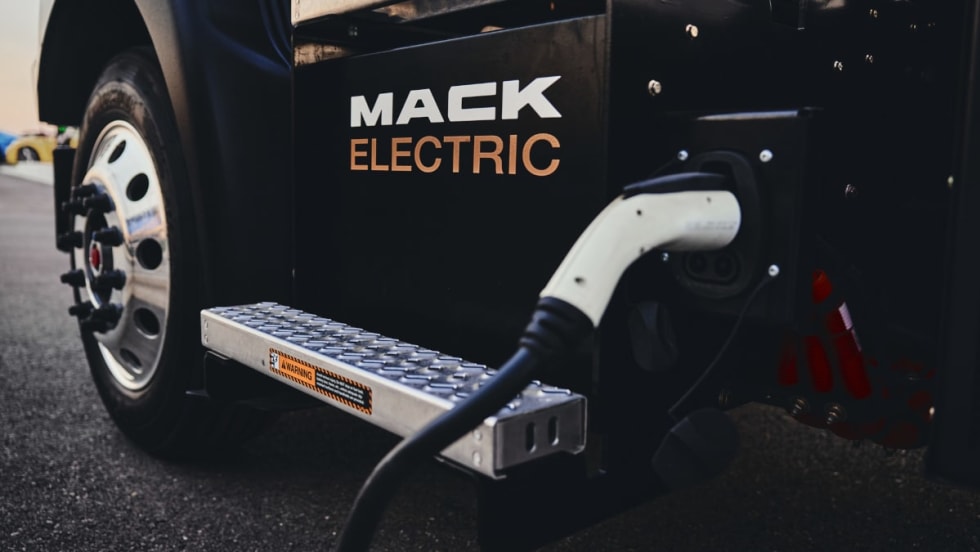
Mack Trucks Expands Full-Service EV Infrastructure Providers
Mack Trucks has expanded its comprehensive Turnkey Solutions program for Mack battery-electric vehicle customers with the addition of two new full-service providers, ABM and Lane Valente Industries.
Read More →
EV Realty Opens Major Truck Charging Hub in California’s Inland Empire
EV Realty’s San Bernardino Powered Properties’ truck charging hub, which has now opened, can serve over 200 medium- and heavy-duty trucks per day.
Read More →
WEX Launches Solution to Close the EV At-Home Charging Visibility Gap for Fleets
WEX unveiled its EV At-Home with Vehicle Fraud Protection, which ensures accurate and secure reimbursement for at-home charging.
Read More →
Toyota Motor Corporation to Join Daimler Truck & Volvo Group in Fuel Cell Joint Venture Cellcentric
Toyota intends to join Daimler Truck and Volvo Group as an equal shareholder in Cellcentric. All three shareholders intend to further strengthen Cellcentric as a leading manufacturer of fuel cell systems for heavy-duty commercial applications.
Read More →