




How Do You Choose? Selecting a Cab Chassis vs. Cutaway Chassis
Cabovers Gain Popularity in Medium-Duty Truck Fleets
When deciding between a cabover engine truck or a conventional truck, fleets are seeing some advantage to the cabover, but still lean toward the conventional truck.
by Staff
November 15, 2013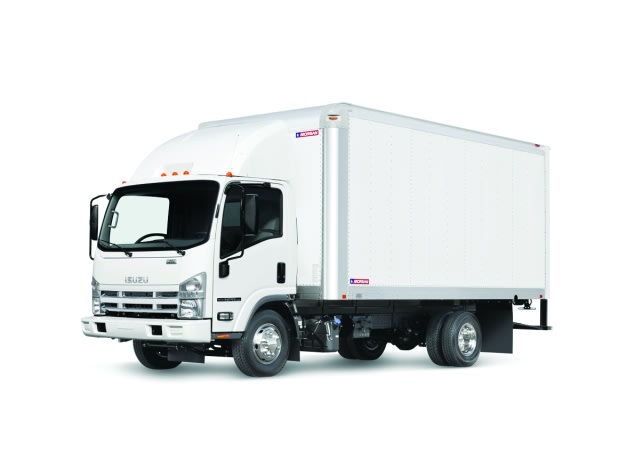
The Isuzu N-Series cabover truck is available in both gasoline and diesel models.
Photo: Isuzu Commercial Truck of America
6 min to read
Although ubiquitous across the globe, the cabover engine (COE) truck — so named because the passenger cabin literally sits on top of the engine compartment — is a relative niche player in the U.S., where conventional cabs own the lion’s share of the Class 4 to 7 medium-duty truck market.
Yet the COE (also called cabover) has become increasingly popular in recent years for a growing number of fleet applications, including urban delivery, lawn maintenance, pest control, and other jobs. In these applications, the cabover’s signature “flat nose” and wide windshield make it easier — and often safer — for drivers to maneuver in tight city and residential areas.
How do cabovers and conventional cabs compare? When choosing between the two types of trucks for specific applications, what should fleet managers consider?
Review these six comparison points:
1. Increased Truck Maneuverability
The primary reason for choosing a cabover is maneuverability, according to Mark Sugar, manager truck engineering for PHH Arval, a fleet management services provider in the U.S. and Canada.
“In highly-populated, urban geographic areas the cabover is the best option for navigating traffic-filled, narrow and challenging streets,” he said.
Ken Gillies, truck ordering and engineering leader for GE Capital Fleet Services, a global fleet management company based in Eden Prairie, Minn., agreed, but with a caveat.
“Where a customer is operating in tight streets, the cabover can be very beneficial,” Gillies said. “But, many of the newer conventional cabs have very short front bumper to back of cab (BBC) lengths, although not as short as a cabover, and may offer the required maneuverability while still allowing a fleet the advantages of a conventional cab.”
Fleet decision-makers must ensure there is a balance. “While considering the benefits of a cabover vs. a conventional configuration, decision-makers should balance the visibility and maneuverability of the cabover against the traditional benefits of the conventional cab configuration,” said Rob Baran, manager of fleet services for ARI.
Advantage: Cabover.
2. More Engine Power Options
One of the advantages of conventional cabs that Gillies referred to is a wider range of diesel engine power ratings to choose from, which enables the fleet manager to more precisely match the truck’s capabilities with the job.
As a frame of reference, Kenworth builds both cabovers (K270 and K370 models) and conventional cabs (T270 and T370 models) for its Class 6-7 lineup. The cabover models offer three horsepower and torque ranges — from 220 hp to 250 hp and up to 660 lb.-ft. of torque — whereas the conventional cabs substantially widen that range, to nearly a dozen options — from 200 hp to 325 hp, with up to 750 lb.-ft. of torque.
The truck’s application is a key factor here. If the truck is going to be used primarily for over-the-road, long-haul applications or needs to pull a heavy trailer, then the conventional cab, equipped with a higher horsepower and torque engine, would be the better fit.
Advantage: Conventional truck.
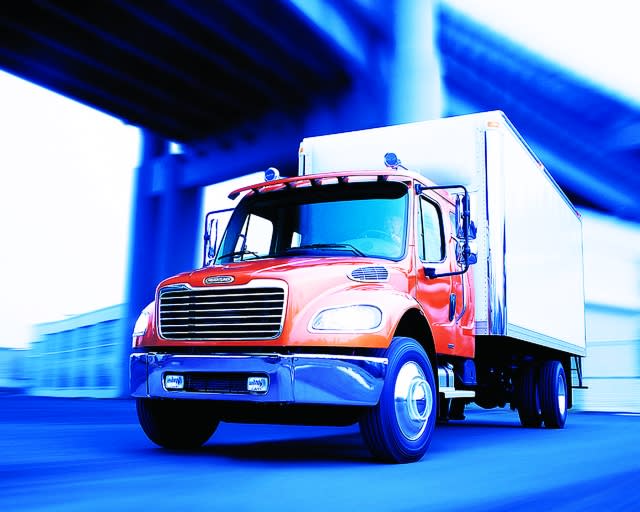
The conventional truck is still seeing an advantage in terms of engine power options, driver comfort, and acquisition costs.
Photo: Freightliner
3. The Fuel Economy Edge
Which type of cab has the edge in terms of fuel economy?
“Cabover models tend to experience a fuel economy advantage, mostly due to their smaller displacement engines,” said Gillies.
This difference in engine displacement is mostly found in Class 4-5 trucks, where cabovers, such as the Isuzu N-Series, Mitsubishi Fuso Canter, and Hino 195, are equipped with four-cylinder diesel engines, compared to conventional cabs, such as the Ford F-550, which is powered by larger V-8 or even V-10 engines. In Class 6-7 trucks, the engine displacement gap is minimal, with both cabovers and conventional cabs being equipped with big bore I-6 diesel engines in most cases.
Which cab type is more fuel-efficient ultimately depends on truck class; the larger the truck, the smaller the difference.
Advantage: Neither.
4. Ensuring Driver Comfort
Conventional cabs allow flexibility and customization, especially important for the driver’s comfort, that you don’t get with a cabover in lower GVWs, according to Don Scare, regional fleet services manager for PHH.
“Cabovers are very cookie-cutter, not even allowing for a seat choice. When you’re a driver on the road for long hours a day, a seat is a key contributor to comfort,” he said.
According to Gillies, “Some of the cabover model offerings are challenging for drivers to get in and out of, with limited space between the front edge of the door frame and the seat riser where the driver’s feet pass during every entry and exit of the cab. Also drivers feel like they are driving a ‘real truck’ when it’s a conventional cab configuration.”
In short route, stop-and-go applications, such as urban delivery or residential landscape service, driver comfort may not be as much of a concern because drivers and crew don’t spend as much time in the truck.
“Cabover configurations have gained popularity with less experienced drivers and in applications requiring multiple local deliveries or in specific industries such as landscaping. In these situations, we have found the cabover as the preferred alternative,” said Baran of ARI.
In these cases, according to the experts, cabovers would work fine, especially considering the maneuverability advantage in tight spaces. But, in the long haul, over-the-road situations, driver comfort would be of paramount importance, giving the edge to the conventional cab.
Advantage: Conventional truck.
5. Reviewing Acquisition Costs
Gillies said that, on balance, cabover models tend to run approximately 3% to 5% higher in price than comparable conventional cabs. “Lower production volume could be considered as one potential reason. Fewer competitors in a particular model/GVWR affect pricing as well,” he said.
Advantage: Conventional truck.
6. Ease of Maintenance
One of the advantages of a cabover, from a maintenance perspective, is the ease of accessibility under the hood — or, in this case, under the cab — to most of the important engine components, helping reduce repair time (and costs). However, according to Gillies, other factors tend to drive maintenance cost of cabovers higher than the conventional cabs.
“Some reasons could be: higher parts costs for cabovers, fewer dealer choices and fewer shops in general that are willing to tackle the maintenance, especially where the shop may have lower familiarity, and fewer repair parts suppliers to choose from,” Gillies cautioned.
Advantage: Cabover.
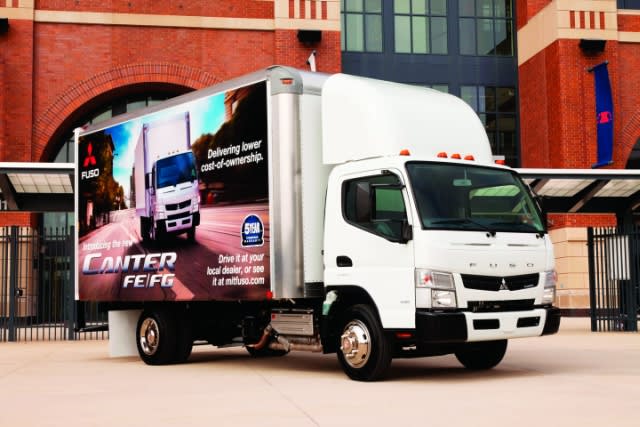
The cabover is gaining popularity in medium-duty truck fleets.
Photo: Mitsubishi Fuso Truck of America
Conventional Cabs vs. Cabovers
GE Capital Fleet Services provides details on which fleet applications are best suited for conventional cabs or cabovers:
Conventional Cabs:
Where overall length of the completed truck is not in conflict with state/federal length regulations.
When cab interior room is of high importance — where drivers need increased steering wheel to seat position room and where passengers are routinely present.
Where broader drivetrain option content is needed to get the proper match-up to the job required.
Cabovers:
Tight inner-city operations where streets are narrow and parking availability are poor.
Residential delivery and service applications can be a good vocation, especially considering how frequently the truck needs to be using the customer’s driveway or parking at the curb since the overall space that’s needed is somewhat less than with a conventional cab.
Subscribe to Our Newsletter
More Vehicle Research

Quality Highlighted as Hankook Receives International 2026 Diamond Supplier Award
Hankook accepted the International Motors 2026 Diamond Supplier Award at its manufacturing location in Clarksville, Tennessee. The location has two new phases of construction underway and, once completed, will produce 11 million tires annually.
Read More →
Workhorse Group Reports Second Quarter 2026 Results
Workhorse Group reported second-quarter financial results. Sales, net of returns and allowances, for the second quarter of 2026 were $3.6 million, compared to $0.8 million in the second quarter of 2025. However, Workhorse also reported an operating loss of $19.4 million.
Read More →
Stellar Products Now Available Through Sourcewell
Eligible public agencies can purchase Stellar Industries’ mechanic trucks, fuel/lube trucks, hooklifts, and tire service trucks through Sourcewell.
Read More →

NTEA Adds Future Truck Summit to Work Truck Week 2027
NTEA is replacing the long-running Green Truck Summit with something new: Future Truck Summit. The event, in collaboration with NAFA Fleet Management Association, is scheduled at the start of Work Truck Week 2027, March 9–12.
Read More →
Ford Fathom Production Takes Shape at Louisville Assembly Plant
Ford is rebuilding Louisville Assembly Plant around an entirely new EV manufacturing process. Here’s how the Universal EV Production System will change the way the Ford Fathom midsize electric truck comes together.
Read More →
Second-Quarter 2026 Commercial Vehicle Data Signals Key Shift in Fleet Turnover and Market Velocity
Work Truck Solutions’ Second-Quarter 2026 Commercial Vehicle Market Analysis reported positive indicators suggesting fleet managers are now rotating aging units, relieving pre-owned inventory friction as business owners move quickly to secure assets.
Read More →
EV Fleet Reality Check: What Operators Wish They Knew Before Electrifying Their Work Vans
Electric work truck upfits bring new compatibility questions. Learn how parts availability, OEM guidance, power demands, and route planning can affect fleet performance.
Read More →
Ford Unveils Name for Under-$29K Midsize Electric Truck
Ford has unveiled the name of its new midsize electric truck: Fathom. It will have a starting MSRP of $28,350, and preorders will begin in early 2027.
Read More →
DTNA Plans to Build New U.S. Manufacturing Facility
Daimler Truck North America plans to build a new, state-of-the-art manufacturing facility in the United States to strengthen its production capabilities across North America. The location has not been disclosed.
Read More →
Recalls You Need to Know About in August 2026
If you have Altec, Autocar, Chrysler, Daimler Truck, Ford, Heil, International, Orange EV, Paccar, Shyft Group, Volvo Trucks, or Wabash vehicles in your fleet, you should check these important recalls issued by the National Highway Safety Administration.
Read More →