Long a staple of the replacement tire market for trucks and vans as well as tractor-trailers, aircraft, and buses, new advances in manufacturing and technology have made retreaded tires an attractive choice for fleet owners and operators.
Big rigs, commercial and military aircraft, school buses, and the full range of vehicles operated by the U.S. Postal Service (USPS) have at least two items in common: They all demand high standards for safety, reliability, and efficiency, and they all run on retreaded tires.
Ad Loading...
Retreading is the process by which a new tread is bonded to a refurbished tire body, also known as a “casing.” It was invented in the early 1900s and came of age in the years following World War II, when as many as 12,000 retread plants sprung up around North America, many dedicated to the passenger-vehicle segment.
Ad Loading...
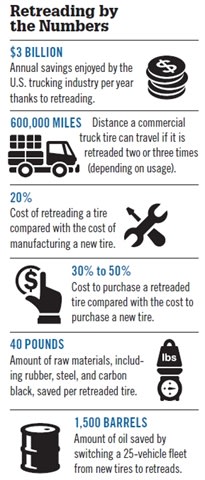
Consolidation and specialization have narrowed the field to less than 1,000 shops, but owners and operators of light- and medium-duty work trucks and vans have every opportunity to partner with retreaders and enjoy a significant cost savings — typically 30% to 50% of the cost of a newly manufactured tire — without sacrificing quality or selection, according to David Stevens, managing director of the Tire Retread & Repair Information Bureau (TRIB).
“Some people think any old tire is taken into a shop and they glue a new tread on it,” Stevens said. “If you were to take them through a retread plant and show them the process, that’s one of the best ways to make converts.”
To learn more, Work Truck met with Stevens to discuss the latest innovations in tire retreading and how fleets can benefit from the technology.
Source: WT Research Dept.
Automation & Quality Improvements
The first step in the retreading process is to inspect and test the tire body. Casings that are badly damaged or otherwise unable to support a new tread are rejected. An initial visual inspection is followed by nondestructive testing. Shearography, ultrasound, X-rays, and high-voltage metal detectors help technicians detect foreign bodies or broken steel cords.
Suitable tire bodies then have any remaining tread buffed away before entering the preparation and repair phase. Repair professionals address any injuries to the tire and reject those that may not last the expected life of the new tread. Those that survive enter the “building” phase, in which they are fitted with new treads using one of two vulcanization processes (see sidebar on page 22) before undergoing a final inspection, repainting, and relabeling.
Ad Loading...
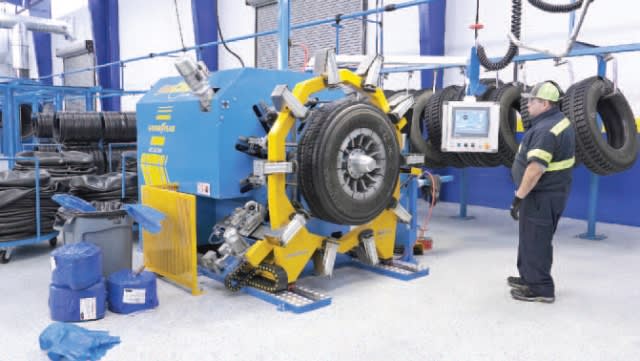
It’s a labor-intensive process that requires a number of well-trained individuals whose work is held to strict industry standards. In recent years, increased automation has made the process more efficient.
“In an automated process, the worker rolls the tire into the machine and the finished retread comes off ready for the mold or vacuum chamber,” Stevens said. “It’s just one more step toward incremental quality improvement.”
Vulcanization: Mold Cure vs. Precure
Proper curing is critical to the success of retreaded tires. The industry relies on two competing vulcanization processes to get the job done. The products of both processes are held to the same industry standards for quality, performance, and reliability.
Mold Cure: The mold-cure process applies new treads to existing casings in a way that mimics new-tire manufacturing. Uncured tread rubber is wrapped around the crown of the tire body; for “bead-to-bead” retreading, uncured rubber is also applied to the sidewalls. The assemblage is placed in a mold, where a combination of time, heat, and pressure vulcanizes the rubber and creates the tread pattern.
Precure: Treads can also be molded and “precured” before being wrapped around a casing. Technicians choose the tread that fits the size and application of each tire and place a thin layer of cushion gum bonding between the casing and the precured tread. The assemblage is vacuum-drawn in a chamber, where time, heat, and pressure cure the bonding layer and form the finished product.
Progress & Advances in Synthetic Rubber
Synthesized rubber has been around nearly as long as the automobile, but the increased cost and wartime shortages of imported natural rubber in the 1940s compelled scientists and suppliers to find new ways to replace it. Poor bonding properties gave early formulas a bad name, but advances have made synthetic rubber a staple of the tire industry.
“There is an awful lot of experimentation going on, playing with levels of natural and synthetic rubber in tire compounds,” Stevens said, noting that even slight tweaks to those levels can produce noticeable changes in grip and tread wear.
Progress is slow but steady, he added, with frequent advancements and new compounds improving the performance of new tires and retreads alike. Synthetic rubber could one day completely replace nature’s own, but for now, it’s still an additive.
Ad Loading...
“The hump they have to get over is exactly matching the properties of natural rubber,” Stevens said.
Warranties for Multiple Retreads
A generational shift has reduced the number of smaller plants as the major tire manufacturers have invested in retreading, consolidated operations, and backed the process with guarantees worthy of an all-new product.
Stevens estimates that as many as 95% of the 750 retread plants in North America are owned by or affiliated with a new-tire manufacturer, but a number of local and regional plants remain; all told, fleet managers have many to choose from.
As the industry has matured, expectations have changed. Manufacturers and fleet managers see new tires as an investment, rather than an expense.
“Fleets find a particular type of tire with a tread pattern that works, and the manufacturer can say, ‘Here’s your new tire. Protect that investment, and we can give you the same tire over and over again,’” Stevens said. At the extreme end of the spectrum are commercial aircraft, about 80% of which are equipped with retreads. “Those tires are retreaded up to 10 or 11 times.”
Ad Loading...
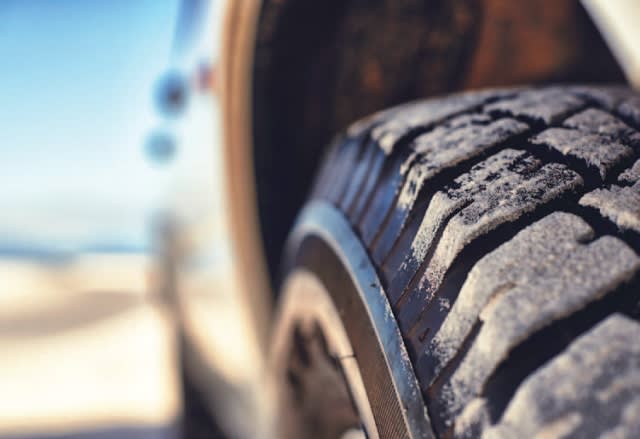
Retreading is the process by which a new tread is bonded to a refurbished tire body. (Photo: Tire Retread & Repair Bureau)
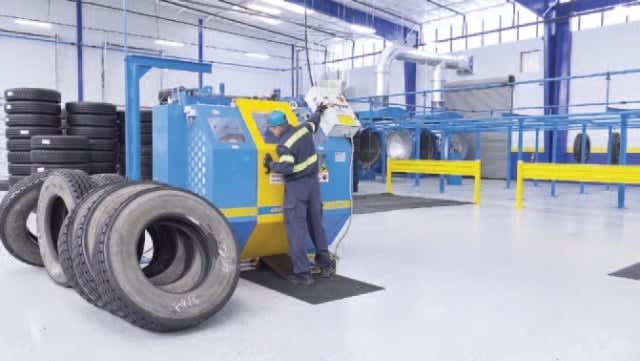
Tire bodies are tested and inspected before they are approved for the retreading process. (Photo: Tire Retread & Repair Bureau)
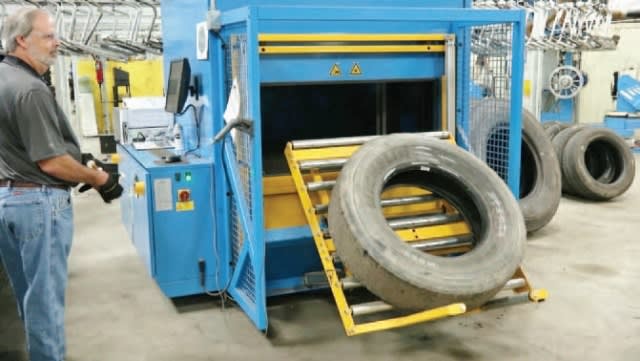
Precured treads are molded before they are wrapped around a casing. (Photo: Tire Retread & Repair Bureau)
Retreading's Environmental Impact
Fleets that ride on retreaded tires enjoy more than cost savings. As the Tire Retread & Repair Information Bureau (TRIB)’s managing director, David Stevens, explains, every retread represents a recycled tire casing — and one fewer bound for the landfill.
According to TRIB’s figures, each retread saves about 40 pounds of raw materials such as rubber, steel, and carbon black. Switching a 100-tire fleet from all-new tires to retreads would save as many as 1,500 barrels of crude oil.
This contention is backed by the U.S. Environmental Protection Agency, which in 1988 established the “Guideline for Federal Procurement of Retread Tires” (40 CFR Part 253). The guidance requires federal agencies as well as all state and local agencies and contractors that receive federal funds to purchase retreaded tires whenever it is practically feasible.
“It takes about 22 gallons of oil to manufacture a new tire and only about seven gallons to retread,” Stevens said. “If retreading didn’t exist, we wouldn’t be able to handle the landfill and recycling would collapse.”
Changes in Retreading Perceptions
Ever seen an “alligator” on the side of the road? Also known as “carcasses,” spent treads and other debris from blown-out tires are a staple on highways and roads all over the world.
Stevens said a mythology has sprung up around alligators: Since retreaded tires are generally regarded as a pastiche of previously unrelated parts, they are more likely to spontaneously disassemble, putting their operators at risk and creating an unnecessary and unsightly road hazard.
“People think they’re all retreads,” he said. “That sentiment seems to pop up in a state where a politician runs over one and decides they want to ban retreading.”
No less an authority than the National Highway Safety Traffic Administration (NHTSA) decided to look into the issue. In “Commercial Medium Tire Debris,” a report issued in December 2008, the agency detailed the results of an analysis of 1,496 alligators and casings found in five sites around the U.S. in the summer of 2007.
Analysts with the University of Michigan’s Transportation Research Institute, in partnership with the Virginia Tech Transportation Institute, collected and inspected each piece of tire debris to determine whether it came from an all-new tire or a retreaded tire and, whenever possible, to determine the cause of failure.
Ad Loading...
The results showed the proportion of debris belonging to retreaded tires matched the segment’s market share. More to the point, failures were far more likely to be ascribed to road hazards, underinflation, or overloading than any factory defect.
“They found it has almost nothing to do with the new-tire manufacturing process or the retreading process,” Stevens said. “As such, there has never been a ban at the state or federal level. Experts actually suggested more retreads be used.”
Think trucks under 26,001 pounds are automatically in the clear when it comes to IRP? Not always. Learn where lighter vehicles can still run into trip permit, apportioned registration, and IFTA compliance requirements when crossing state or provincial lines.
One of the most important recommendations for professional drivers traveling with pets is to ensure pets are properly restrained while the truck is moving. Other tips are available in the new guide from Volvo Trucks North America and Center for Pet Safety.
The American Petroleum Institute offers a list of safe vehicle refueling guidelines, including ways to avoid potential problems with static electricity discharges in fall, winter, and early spring.
Cold weather can expose weak batteries, tires, fuel systems, and maintenance gaps fast. Use this winter fleet checklist to prepare trucks and drivers before temperatures drop.
Fleet service partnerships rarely fall apart all at once. Learn the three warning signs that trust is eroding and what fleets and providers can do before downtime, frustration, and lost revenue follow.
Applause has integrated TRUCE driving metrics directly into its employee-first performance and safety platform that transforms mobile devices into AI-powered telematics.
Do you want to see what it is like to experience Detroit Assurance’s Active Brake Assist? In this video, Work Truck will put you in the cab to see how it all works and then hear more details from DTNA’s Mike Young.
Violence risks do not stop at the driver’s door. Learn five practical steps fleets can take to spot threats early and protect workers before loss occurs.
Fleet leaders don't need more data, they need clearer visibility into what the data is saying. This case study explores how one utility replaced speeding-event counts with a single metric — miles driven in violation — to strengthen safety and significantly reduce speeding violations.