





Related: Why Pickup Towing Standardization Matters for Fleets
Top Construction Fleet Challenges
With more sophisticated applications than one may guess, construction fleet managers have a unique set of challenges to work with, from differing payload and cargo-carrying requirements to regulations and more.
February 12, 2016
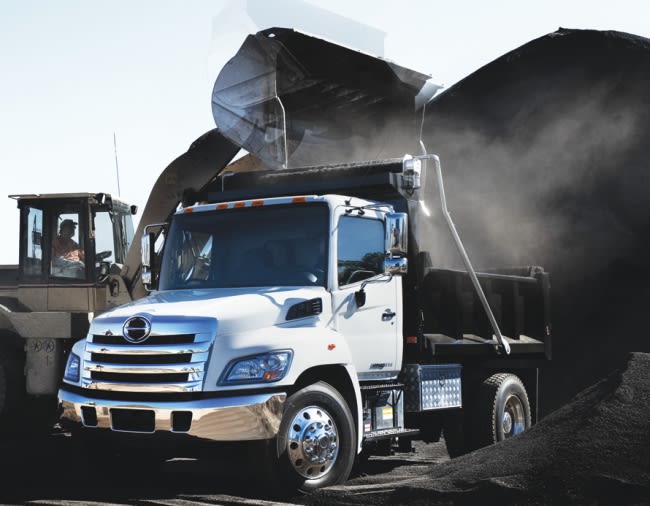
A fleet manager will do well by his or her crew to communicate and get understanding of exactly what they will be hauling to a job site.
Photo courtesy of Hino Trucks
4 min to read
While there are many similarities between the various vocational fleet operations, each one has its own unique set of challenges; especially construction fleets.
“Overall, the construction application is more highly sophisticated than your average box truck spec. Construction vehicles often carry varying amounts of expensive equipment, so a body needs to have multiple options to store equipment securely,” said Adrian Ratza, marketing manager for Hino Trucks.
Construction fleet managers have to manage many options, “from gasoline to diesel or pickup truck to medium-duty chassis,” noted Mike Levine, truck communications manager for Ford Motor Co. “They must also identify how and where the trucks will be used and match drivers and vehicles to their customer needs.”
There are numerous challenges facing today’s construction fleets.
“In areas where construction is increasing, large construction companies are faced with inadequate infrastructure, problems retaining skilled tradespeople, keeping operating costs low, managing upfit costs, and the immediate need of vehicles when a job is secured. It is difficult to find the right truck in a specific market that meets the capabilities needed and, of course, getting the right truck at the right time,” said Frank Dankovich, director of Fleet Sales, FCA Group.
The creditworthiness of a company can also be a hurdle. “Sometimes it is difficult for these companies to secure credit quickly. Fleet managers are just not managing vehicles — they are managing ‘yellow iron’ and other assets,” Dankovich said.
And, changing regulations are making an impact on construction fleets.
“For fleets with vehicles that weigh more than 10,000-pounds GVWR, a new mandate by the U.S. Department of Transportation (DOT) is going into effect requiring electronic logging devices. Since many fleets operate a wide variety of vehicles with several different telematics providers to choose from, the new logging requirements add to the expense and complexity of administering to and updating these fleets,” said Mark Namuth, senior manager, Fleet & Commercial Sales, Nissan North America Light Commercial Vehicle Business Unit.
Facing Challenges Head On
To be successful in the construction fleet industry, fleet managers must balance many factors to pick a truck that will best serve each unique business.
“You need the capability to get the job done without spending money on unnecessary capability. Reliability and durability are critical because a truck with extensive downtime is not making money for the company,” said Dan Tigges, commercial product manager, General Motors Fleet.
To accomplish this, a strong understanding of fleet operations and needs is necessary.
“Fleet managers must understand how their trucks are used, what they carry or tow, and how their trucks can make their employees more efficient. They also need to focus on the lifecycle costs of owning their trucks. Mistakes that drive high fuel costs, high repair costs, or low resale values can easily outweigh up-front savings,” Tigges said.
To ensure this kind of understanding, continuous communication is key.
“A fleet manager will do well by their crew to communicate and get an understanding of exactly what they will be hauling to a job site. From there, the fleet manager and the body distributor need to work closely to tailor that application to the crew’s needs,” said Ratza of Hino Trucks.
Embracing new technology and advancements can also help solve common challenges, including those revolving around regulations.
“The best solution for construction fleet managers is to embrace the new requirements and the technology that must be incorporated to keep vehicles in compliance. While these changes can be difficult to implement in the short term, they will help to provide long-term efficiency. Telematics can help fleets both large and small, and the technology has become more affordable. The presence of multiple suppliers in the field has helped to keep costs down,” said Namuth of Nissan.
Additionally, networking and relationships can help drive down costs and discover more creative solutions.
“Construction fleet managers can develop relationships with businesses that provide short-term fleet needs, such as a short lease of 180 days,” said Dankovich of FCA. “Establishing a good relationship with a local dealer may be able to convince the dealer to pool useful vehicles.”
Remember, the truck is a tool that needs to help the driver be efficient, according to Tigges of GM.
“Doing research on how trucks perform in the real world is critical. Fuel economy, for example, can be very different in a real-world environment than what is shown in EPA tests. Third-party publications and websites that do real-world testing and comparisons can be a great starting point,” he said.
Subscribe to Our Newsletter
More Operations

Family Ties Inside the Fleet Families Building Careers Across Generations
Three fleet families share what it really takes to work together, learn across generations, and keep business from following them home.
Read More →
Shades of Fleet Call for Voices: Fleet's Hidden Heroes
Fleet’s hidden heroes are often the ones keeping everything moving behind the scenes. September’s Shades of Fleet is looking for dispatchers, coordinators, parts specialists, and other support pros to share their stories.
Read More →
Truck Centers, Inc. Celebrates National Truck Driver Appreciation Week with $1,000 Fuel Card Giveaways
During National Truck Driver Appreciation Week, Truck Centers, Inc. is offering customers a chance to fuel up for free. Customers at all Truck Centers locations can enter to win one of four $1,000 fuel cards from Sept. 14 - 18.
Read More →
Fleet Guides, AI Time-Savers, Truck Tariffs & Fuel Strategy Lead the News
This week’s Truck Chat Cheat Sheet covers new fleet vehicle guides, practical AI use cases, U.S.-Canada truck production, mixed-energy strategy, and more.
Read More →
What Fleet Employers Are Missing When Hiring Veterans
What if some of the strongest candidates for fleet are already out there, but their experience is written in a language our industry does not always recognize?
Read More →
Automotive Fleet Opens 2026 Personal Use Survey for Commercial Fleet Managers
Less than two weeks left! Commercial and corporate fleet managers are invited to share how their organizations handle company vehicle personal-use policies, charges, and driver eligibility.
Read More →
What Resilient Fleets Do Differently When Conditions Change
Fleet resilience is about more than reacting to disruption. Lauren Fletcher talks with AP Fleet’s Alex Coveney about flexibility, planning, scaling, and what helps fleets adapt when business conditions shift.
Read More →
If We Want the Next Generation in Automotive, We Have to Give Them a Reason to Care
The automotive industry talks constantly about its workforce shortage. But before we can recruit the next generation, we may need to do a better job giving kids a reason to care about automotive in the first place.
Read More →
Ram ProMaster City Under $40K, Truck Tariffs, and AI Maintenance Lead the News
A sub-$40K commercial van, tariff questions, AI-powered maintenance, and a new EV production strategy headline this week’s Truck Chat Cheat Sheet.
Read More →
Bob Adamsky Shares the Fleet Lessons You Usually Learn the Hard Way
After more than 30 years in fleet, Arrow International’s Bob Adamsky has learned that the job is about far more than vehicles. He shares the lessons he wishes every fleet manager could learn a little earlier.
Read More →