




Learn More: The Future of Medium-Duty Truck Engines
All About Medium-Duty Work Truck Engines
Defining exactly what a truck must do is the first step in spec’ing a medium-duty truck engine.
by Lauren Fletcher & Sean Lyden
February 3, 2009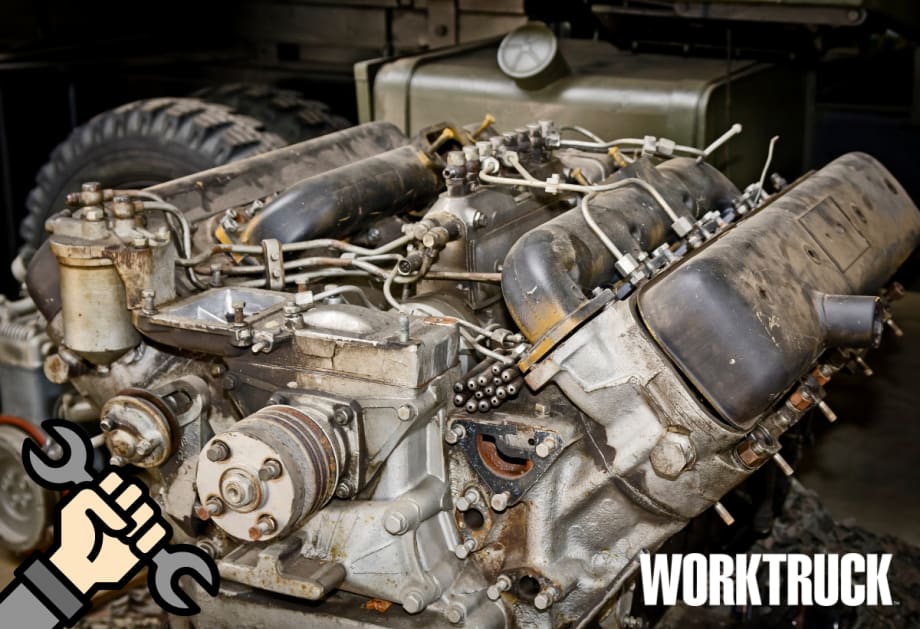
When deciding whether to overhaul/rebuild, remanufacture, or purchase a new engine, according to Boeglin, it comes down to how long you need the engine to last and your goals for the vehicle.
Photo: Work Truck
4 min to read
Matching a medium-duty truck engine to a fleet application depends on the size truck needed.
Here’s a breakdown of what to consider when spec’ing engines for medium-duty trucks up to a 33,000-lb. gross vehicle weight rating (GVWR).
Medium-Duty Truck Class 4 & 5 Engine Options
If the truck you need is a Class 4 or 5 (14,001-lb. – 19,500-lb. GVWR), engine selection is relatively simple. In many cases, only one option is available — diesel. Some manufacturers, such as Ford (F-450, F-550), GM (C-Series, W-Series), and Isuzu (N-Series, H-Series), offer both gasoline and diesel. Either way, you’re not overwhelmed with engine options.
How do you decide between gas and diesel on a Class 4 or 5? While diesel offers better fuel efficiency and engine longevity, gas engines have much lower up-front costs — a difference ranging anywhere from $6,500-$8,000 or more, depending on make and model.
Therefore, the key deciding factor is: How many miles per year will you be putting on that vehicle? Do you anticipate putting a substantial number of miles to recoup the higher investment in a diesel in a reasonable amount of time?
A general rule of thumb is 25,000-30,000 miles. If you project going over that threshold, diesel makes sense. If you’ll be doing less, then gasoline may be more cost-effective.
Run the numbers yourself to confirm what works best for you. Contact your manufacturer’s rep for approximate fuel economy numbers for both gasoline and diesel to plug in your calculations.
Medium-Duty Class 6 & 7 Options
If you’re spec’ing a Class 6 or 7 truck, engine selection becomes more complicated. For example, the Isuzu Diesel 6H 7.8L in the Chevrolet Kodiak C-7500 offers five different horsepower and torque options, ranging from 215 hp and 560 ft.-lb. torque to 300 hp and 860 ft.-lb. torque, with 230 hp and 260 hp in between. The approximate cost difference between the lowest and highest hp ratings, factoring in a heavier transmission required for the 300 hp engine, is as much as $8,500. This variance in engine hp/torque availability and cost is common across all Class 6 and 7 truck OEMs.
Matching the right hp and torque ratings to your application. How do you choose among hp and torque options? An under-spec’d engine presents performance and potential premature maintenance issues. If you over-spec, you pay a much higher cost per unit without a corresponding return on investment. How do you strike the right balance?
At this stage, involve your equipment upfitter and truck OEM rep for their counsel. They often have experience working with fleets in your industry and can offer specific recommendations so you don’t have to reinvent the wheel.
However, a few general principles, based on common applications can serve as a guide.
Higher hp and torque applications:
Over-the-road with heavy load, such as a towing and recovery vehicle.
Hilly, mountainous region.
Over-the-road pulling a heavy trailer.
Lower to mid-range hp and torque application:
Pickup and delivery where the truck does not need to reach full highway speed often.
Slower speed applications such as asphalt spreader, dump body, or mechanic’s crane/service body truck.
Over-the-road, on flat terrain, with lighter load.
Which scenario best matches your application? When you’ve defined exactly what you need the truck to do, you have the information you need to match the right engine to do the job.
Rebuild, Remanufacturer, or Buy New?
When it comes to replacing a truck engine, should you rebuild or overhaul, purchase a remanufactured engine, or just get a new truck? Bob Boeglin, national sales manager, from Jasper Engines and Transmissions offers his advice.
First, what’s the difference between these engines?
"Many times, the difference between remanufactured, rebuilt, or overhauled engines is simply how long it will last," said Boeglin.
Overhauling an engine is a less labor-intensive process. The repair shop will fix any problems, re-ring the pistons, grind the valves, and wash and paint the engine.
According to Boeglin, a rebuilt engine is better still, "but not at the grade of new." In a rebuilt engine, pistons are replaced, the valves are ground, old springs are reused, there may be some updates, and parts may or may not meet OEM specs.
To rebuild is to recondition by cleaning, inspecting, and replacing severely worn or broken parts. Serviceable parts are reused within the manufacturer’s acceptable wear limits. The quality of rebuilt components varies widely and many come with only a limited warranty.
Used components are pulled directly from a vehicle — typically a junkyard vehicle — and generally not so much as surface-cleaned. Used or junkyard components may have high mileage and a poor maintenance history — a failure waiting to happen, according to Boeglin. Many used or junkyard components come from a vehicle that was involved in an accident and may have unseen damage.
Remanufacturing is the process of building an engine as good as or better than new with the most current updates and new parts.
Most wearable parts are automatically replaced and all core material is closely inspected and checked against original equipment specifications. Replacement parts are new or requalified. If new, parts are made in the same production processes as original equipment.
When deciding whether to overhaul/rebuild, remanufacture, or purchase a new engine, according to Boeglin, it comes down to how long you need the engine to last and your goals for the vehicle.
Subscribe to Our Newsletter
More Operations

What Does a Potato Have to Do with Leadership?
From simple process improvements and creative problem-solving to the little moments that strengthen team culture, this conversation dives into the power of unexpected ideas and why innovation doesn't always arrive wrapped in new technology or a major initiative.
Read More →
Looking for a New Podcast for the Road? Start Here!
Looking for a new podcast? Truck Chat delivers fleet leadership insights, industry deep dives, AI discussions, innovations, and real-world stories.
Read More →
Did You Know What You Don't See May Be Costing You Big?
As more employees choose personal vehicles (including hybrids and EVs) for business use, companies face new challenges around visibility, insurance, liability, and cost control.
Read More →

Veteran Voices in Fleet | How Military Service Shapes Fleet Leaders
Across every perspective, one message is clear: the experiences gained through military service continue to influence how veterans contribute to the fleet industry every day.
Read More →
The Fleet Lessons That Don’t Show Up on a Spreadsheet
From index cards to predictive maintenance, Robert Martinez shares the hard-earned leadership lessons that shaped nearly 40 years in fleet.
Read More →
People, Leadership & the Skilled Trades Opportunity | Weekly Cheat Sheet
People, data, leadership, and the skilled trades opportunity. See what's shaping fleets today in this week's Truck Chat Weekly Cheat Sheet.
Read More →
Everyone Thinks They’re a Fleet Manager
From oil changes to procurement decisions, fleet work is often underestimated by the very people who depend on it most. Bob Stanton makes the case for why communication, not just technical expertise, is one of the most important leadership skills in fleet.
Read More →
Sponsored•June 1, 2026
Turning Connected Vehicle Data Into Decisions That Matter
Fleet leaders have more data than ever, but turning that data into clear, actionable decisions remains a challenge. This white paper shows how leading organizations are using connected vehicle data to improve safety, reduce costs, and optimize fleet performance. Learn how to turn insight into action across your fleet.
Read More →
From Military Service to Fleet Leadership | Shades of Fleet
Military service ends, but the lessons don't. Hear how veterans are shaping fleet leadership through adaptability, teamwork, and mission-driven thinking.
Read More →
Sponsored•May 29, 2026
Are You Tracking Your Fleet's True Total Cost of Ownership?
Bobit Business Media surveyed 190 fleet professionals and found that while most fleets are tracking costs, fragmented systems and data gaps are keeping true TCO visibility out of reach. With rising pressure to control spend in an increasingly volatile environment, the gap between what fleets think they know and what the data actually shows is wider than you might expect. See how your peers are managing costs today and where the industry still has room to improve.
Read More →